

Winter gazebos in Almaty
We build turnkey in 14–26 days. Insulation 100 mm, double-glazed windows and heating — the gazebo works all year round.
 Installation in 12–26 days including insulation and glazing
 5-year guarantee on work with a written contract
 A winter gazebo design in 24 hours or a 5% discount on the whole order
 No intermediaries and savings of up to 25% on the price
Winter gazebos in Almaty
We build turnkey in 14–26 days. Insulation 100 mm, double-glazed windows and heating — the gazebo works all year round.
Installation in 12–26 days including insulation and glazing
5-year guarantee on work with a written contract
A winter gazebo design in 24 hours or a 5% discount on the whole order
No intermediaries and savings of up to 25% on the price
Winter gazebos in Almaty
We build turnkey in 14–26 days. Insulation 100 mm, double-glazed windows and heating — the gazebo works all year round.
Installation in 12–26 days including insulation and glazing
5-year guarantee on work with a written contract
A winter gazebo design in 24 hours or a 5% discount on the whole order
No intermediaries and savings of up to 25% on the price
Find out the cost of a winter gazebo in 1 minute
Why people order a winter gazebo from us

We calculate the dew point
The wall build-up: cladding, a wind barrier, 100 mm of mineral wool, a vapour barrier, and interior cladding. Without a vapour barrier, moisture settles into the insulation and by February the wall is wet.

A separate slab for the stove and fireplace
We set a brick fireplace on its own reinforced slab from 200 mm, not tied to the gazebo supports — so the masonry does not crack as the frame settles.

Air intake with an open fire
A stove takes its air from the room. We build in supply vents at the bottom of the walls: without them carbon monoxide builds up in the closed space.

We account for Almaty's seismicity
The city is in a 9--point seismic zone. We reinforce the corners and joints of the frame with plates, reinforce the foundation with bars from 12 mm, and fix the frame with anchors.

A roof for the snow load
There is a lot of snow in the foothills. We calculate a load of up to 150–200 kg/m² and make a slope from 25° so that the snow slides off by itself and does not break the rafters.

Our own production
We cut the timber, weld the frame, fit the double-glazed units and install the chimneys ourselves, with no middleman contractors. Hence the timeframe from 12 days and a price with no mark-up on top.
Why people order a winter gazebo from us
The wall build-up: cladding, a wind barrier, 100 mm of mineral wool, a vapour barrier, and interior cladding. Without a vapour barrier, moisture settles into the insulation and by February the wall is wet.
We calculate the dew point
We set a brick fireplace on its own reinforced slab from 200 mm, not tied to the gazebo supports — so the masonry does not crack as the frame settles.
A separate slab for the stove and fireplace
A stove takes its air from the room. We build in supply vents at the bottom of the walls: without them carbon monoxide builds up in the closed space.
Air intake with an open fire
The city is in a 9--point seismic zone. We reinforce the corners and joints of the frame with plates, reinforce the foundation with bars from 12 mm, and fix the frame with anchors.
We account for Almaty's seismicity
There is a lot of snow in the foothills. We calculate a load of up to 150–200 kg/m² and make a slope from 25° so that the snow slides off by itself and does not break the rafters.
A roof for the snow load
We cut the timber, weld the frame, fit the double-glazed units and install the chimneys ourselves, with no middleman contractors. Hence the timeframe from 12 days and a price with no mark-up on top.
Our own production
We'll reply in 15 minutes
Why people order a winter gazebo from us
The wall build-up: cladding, a wind barrier, 100 mm of mineral wool, a vapour barrier, and interior cladding. Without a vapour barrier, moisture settles into the insulation and by February the wall is wet.
We calculate the dew point
We set a brick fireplace on its own reinforced slab from 200 mm, not tied to the gazebo supports — so the masonry does not crack as the frame settles.
A separate slab for the stove and fireplace
A stove takes its air from the room. We build in supply vents at the bottom of the walls: without them carbon monoxide builds up in the closed space.
Air intake with an open fire
The city is in a 9--point seismic zone. We reinforce the corners and joints of the frame with plates, reinforce the foundation with bars from 12 mm, and fix the frame with anchors.
We account for Almaty's seismicity
There is a lot of snow in the foothills. We calculate a load of up to 150–200 kg/m² and make a slope from 25° so that the snow slides off by itself and does not break the rafters.
A roof for the snow load
We cut the timber, weld the frame, fit the double-glazed units and install the chimneys ourselves, with no middleman contractors. Hence the timeframe from 12 days and a price with no mark-up on top.
Our own production
We'll reply in 15 minutes
A winter gazebo: what we build it from

The material determines both the price and how much heat remains inside by morning. The difference between a summer and a winter structure is in the shell.
Glued laminated or profiled timber, or rounded log. Glued laminated timber does not shrink, so we fit the double-glazed units and finishing straight away, without waiting out a season.
Wood

Metal frame
Profiled steel tube with an anti-corrosion coating. Metal freezes right through, so we cover the posts with wooden cladding and insulation — otherwise condensation settles on them.

Roof and ceiling
Metal roof tiles or corrugated sheet on battens, a pitch from 25°. Between the roof and the soffit — 100 mm of insulation: the most heat escapes through a cold ceiling.
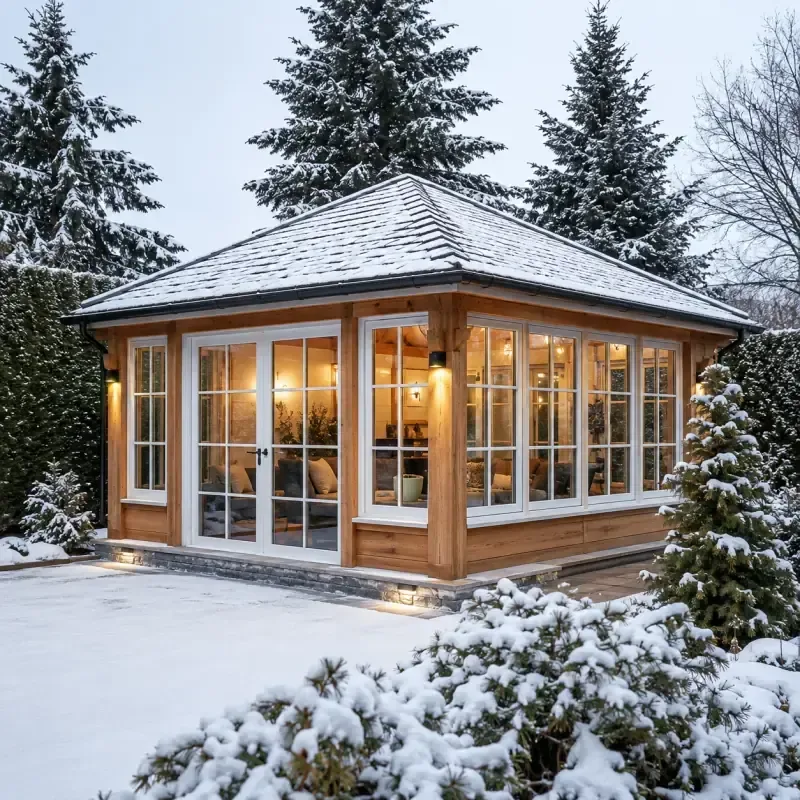
100 mm of mineral wool in the shell, a single-chamber double-glazed unit 24 mm in PVC, an insulated door. Vents at the bottom of the walls are mandatory if there is an open fire inside.
The frame, insulation, glazing and chimney are all done by one crew. That is why the junctions fit together as designed, rather than being adjusted on site.
Ensures the structure's stability during seismic activity in the region
We build on any terrain, including slopes
A separate slab for the stove
A winter gazebo: what we build it from
The material determines both the price and how much heat remains inside by morning. The difference between a summer and a winter structure is in the shell.
Wood
Glued laminated or profiled timber, or rounded log. Glued laminated timber does not shrink, so we fit the double-glazed units and finishing straight away, without waiting out a season.
Metal frame
Profiled steel tube with an anti-corrosion coating. Metal freezes right through, so we cover the posts with wooden cladding and insulation — otherwise condensation settles on them.
Roof and ceiling
Metal roof tiles or corrugated sheet on battens, a pitch from 25°. Between the roof and the soffit — 100 mm of insulation: the most heat escapes through a cold ceiling.
A separate slab for the stove
We build on any terrain, including slopes
Ensures the structure's stability during seismic activity in the region
The frame, insulation, glazing and chimney are all done by one crew. That is why the junctions fit together as designed, rather than being adjusted on site.
100 mm of mineral wool in the shell, a single-chamber double-glazed unit 24 mm in PVC, an insulated door. Vents at the bottom of the walls are mandatory if there is an open fire inside.
A winter gazebo: what we build it from
The material determines both the price and how much heat remains inside by morning. The difference between a summer and a winter structure is in the shell.
Wood
Glued laminated or profiled timber, or rounded log. Glued laminated timber does not shrink, so we fit the double-glazed units and finishing straight away, without waiting out a season.
Metal frame
Profiled steel tube with an anti-corrosion coating. Metal freezes right through, so we cover the posts with wooden cladding and insulation — otherwise condensation settles on them.
Roof and ceiling
Metal roof tiles or corrugated sheet on battens, a pitch from 25°. Between the roof and the soffit — 100 mm of insulation: the most heat escapes through a cold ceiling.
The frame, insulation, glazing and chimney are all done by one crew. That is why the junctions fit together as designed, rather than being adjusted on site.
100 mm of mineral wool in the shell, a single-chamber double-glazed unit 24 mm in PVC, an insulated door. Vents at the bottom of the walls are mandatory if there is an open fire inside.
A separate slab for the stove
We build on any terrain, including slopes
Ensures the structure's stability during seismic activity in the region
What a winter gazebo is heated with

Brick fireplace

We build it for a specific gazebo, on a separate reinforced slab from 200 mm. The firebox is of fireclay brick on heat-resistant mortar.

- Low cost (from 350 000 KZT)
- Fast installation (1-2 days)
- Good ventilation
- Organic integration into the landscape
- Minimal foundation requirements
Advantages:

Cast-iron stove-fireplace

Cast iron takes longer than steel to warm up, but gives off its heat for several hours after the firewood has burned down. The fire is visible through the glass door.
- Can be used in different seasons
- Good protection from wind and precipitation
- Wide options for decoration
- Optimal balance of price and functionality
Advantages:

Pot-belly stove

Cheap and hot: it reaches working temperature in 15 minutes. It requires keeping an eye on the fire and supply vents at the bottom of the walls.
- All-season use
- Full protection from any weather conditions
- Installation of heating, lighting and other utilities
- A high level of privacy
- Can be used as a guest house
Advantages:

Infrared heaters

Specialised structures with a built-in cooking area, combining the functions of a gazebo and a summer kitchen.
They heat people and objects rather than the air, so the warmth is felt right after switching on. We mount them under the ceiling, so they take up no space inside.
Advantages:

Electric convector

A socket, a bracket, half an hour to install. Heats up to 9 m².
- A balance between aesthetics and functionality
- Wide design possibilities
- Optimal value for money
- Adaptation to any need and budget
Advantages:
We'll reply in 15 minutes
What a winter gazebo is heated with
Brick fireplace
We build it for a specific gazebo, on a separate reinforced slab from 200 mm. The firebox is of fireclay brick on heat-resistant mortar.
- Low cost (from 350 000 KZT)
- Fast installation (1-2 days)
- Good ventilation
- Organic integration into the landscape
- Minimal foundation requirements
Advantages:
Cast-iron stove-fireplace
Cast iron takes longer than steel to warm up, but gives off its heat for several hours after the firewood has burned down. The fire is visible through the glass door.
- Can be used in different seasons
- Good protection from wind and precipitation
- Wide options for decoration
- Optimal balance of price and functionality
Advantages:
Pot-belly stove
Cheap and hot: it reaches working temperature in 15 minutes. It requires keeping an eye on the fire and supply vents at the bottom of the walls.
- All-season use
- Full protection from any weather conditions
- Installation of heating, lighting and other utilities
- A high level of privacy
- Can be used as a guest house
Advantages:
Infrared heaters
Specialised structures with a built-in cooking area, combining the functions of a gazebo and a summer kitchen.
They heat people and objects rather than the air, so the warmth is felt right after switching on. We mount them under the ceiling, so they take up no space inside.
Advantages:
Electric convector
A socket, a bracket, half an hour to install. Heats up to 9 m².
- A balance between aesthetics and functionality
- Wide design possibilities
- Optimal value for money
- Adaptation to any need and budget
Advantages:
We'll reply in 15 minutes
What a winter gazebo is heated with
Brick fireplace
We build it for a specific gazebo, on a separate reinforced slab from 200 mm. The firebox is of fireclay brick on heat-resistant mortar.
- Low cost (from 350 000 KZT)
- Fast installation (1-2 days)
- Good ventilation
- Organic integration into the landscape
- Minimal foundation requirements
Advantages:
Cast-iron stove-fireplace
Cast iron takes longer than steel to warm up, but gives off its heat for several hours after the firewood has burned down. The fire is visible through the glass door.
- Can be used in different seasons
- Good protection from wind and precipitation
- Wide options for decoration
- Optimal balance of price and functionality
Advantages:
Pot-belly stove
Cheap and hot: it reaches working temperature in 15 minutes. It requires keeping an eye on the fire and supply vents at the bottom of the walls.
- All-season use
- Full protection from any weather conditions
- Installation of heating, lighting and other utilities
- A high level of privacy
- Can be used as a guest house
Advantages:
Infrared heaters
Specialised structures with a built-in cooking area, combining the functions of a gazebo and a summer kitchen.
They heat people and objects rather than the air, so the warmth is felt right after switching on. We mount them under the ceiling, so they take up no space inside.
Advantages:
Electric convector
A socket, a bracket, half an hour to install. Heats up to 9 m².
- A balance between aesthetics and functionality
- Wide design possibilities
- Optimal value for money
- Adaptation to any need and budget
Advantages:
We'll reply in 15 minutes

we build winter gazebos to your dimensions:
We calculate heat loss and heating capacity
We select the heating: a stove, fireplace or convector
We add underfloor heating, an insulated door, lighting and sockets
By clicking the button you agree to the terms of the
 Privacy Policy
we build winter gazebos to your dimensions:
leave a requestBy clicking the button you agree to the terms of the
We calculate heat loss and heating capacity
We select the heating: a stove, fireplace or convector
We add underfloor heating, an insulated door, lighting and sockets
Or call us at
+7 (700) 347-98-76Privacy Policywe build winter gazebos to your dimensions:
leave a requestBy clicking the button you agree to the terms of the
We calculate heat loss and heating capacity
We select the heating: a stove, fireplace or convector
We add underfloor heating, an insulated door, lighting and sockets
+7 (700) 347-98-76Or call us at
Portfolio: winter gazebos
Projects completed in Almaty and the suburbs


Prices for winter gazebos in Almaty
| SERVICE | COST |
|---|---|
| TURNKEY WINTER GAZEBOS | |
| Insulated timber gazebo with soft windows, 3×3 m | from 680 000 ₸ |
| Warm timber gazebo with double-glazed windows, 3×4 m | from 780 000 ₸ |
| Winter timber gazebo with double-glazed windows, 4×4 m | from 880 000 ₸ |
| Enclosed winter one with a grill, 4×5 m | from 950 000 ₸ |
| Winter gazebo with a cast-iron stove-fireplace, 4×4 m | from 1 050 000 ₸ |
| Insulated all-season one with underfloor heating, 4×5 m | from 1 200 000 ₸ |
| Enclosed one with a barbecue complex, 4×5 m | from 1 400 000 ₸ |
| Glued laminated timber, panoramic glazing, 5×5 m | from 1 650 000 ₸ |
| HEATING, INSULATION AND EXTRAS | |
| Insulating the envelope with 100 mm mineral wool | from 12 000 ₸ per m² |
| Electric underfloor heating with a thermostat | from 14 000 ₸ per m² |
| Single-chamber glass unit in a PVC profile | from 42 000 ₸ per m² |
| Insulated entrance door | from 65 000 ₸ |
| Pot-belly stove with a chimney | from 180 000 ₸ |
| Brick fireplace | from 260 000 ₸ |
| Cast-iron stove-fireplace with a chimney | from 320 000 ₸ |
| Electric convector with wiring | from 45 000 ₸ |
| Infrared heater | from 45 000 ₸ each |
| Monolithic slab 150 mm | from 75 000 ₸ |
| Electrical connection | from 25 000 ₸ |
| Development of a custom design | from 30 000 ₸ |
| Delivery within the city | from 15 000 ₸ |
| Delivery across the region | from 25 000 ₸ |
How we build a warm gazebo

01.
Site survey and heat loss
We inspect the plot, price the glazing and select the heating capacity. A visit within Almaty is free.
02.
Design and estimate
We calculate the snow load, the wall build-up and the chimney cross-section. We fix the price in the estimate.
03.
Contract
Timeframes, a 5-year warranty, the payment schedule. The price does not change after signing.
04.
Foundation and frame
A slab or piles, a separate slab for the stove, then a frame with reinforced corners.
05.
The shell and heating
Insulation 100 mm, vapour barrier, double-glazed windows, door, installation of the stove and chimney.
06.
Handover and the first firing
We light it in front of you, check the draught and the vents, and hand over the warranty card.
How we build a warm gazebo
Site survey and heat loss
We inspect the plot, price the glazing and select the heating capacity. A visit within Almaty is free.
01.
Design and estimate
We calculate the snow load, the wall build-up and the chimney cross-section. We fix the price in the estimate.
02.
Contract
Timeframes, a 5-year warranty, the payment schedule. The price does not change after signing.
03.
Foundation and frame
A slab or piles, a separate slab for the stove, then a frame with reinforced corners.
04.
The shell and heating
Insulation 100 mm, vapour barrier, double-glazed windows, door, installation of the stove and chimney.
05.
Handover and the first firing
We light it in front of you, check the draught and the vents, and hand over the warranty card.
06.
We'll reply in 15 minutes
How we build a warm gazebo
Site survey and heat loss
We inspect the plot, price the glazing and select the heating capacity. A visit within Almaty is free.
01.
Design and estimate
We calculate the snow load, the wall build-up and the chimney cross-section. We fix the price in the estimate.
02.
Contract
Timeframes, a 5-year warranty, the payment schedule. The price does not change after signing.
03.
Foundation and frame
A slab or piles, a separate slab for the stove, then a frame with reinforced corners.
04.
The shell and heating
Insulation 100 mm, vapour barrier, double-glazed windows, door, installation of the stove and chimney.
05.
Handover and the first firing
We light it in front of you, check the draught and the vents, and hand over the warranty card.
06.
We'll reply in 15 minutes

We will price your winter gazebo

Thank you! We will contact you within 3 minutes.
By clicking the “Get a loan” button you agree to the terms
Leave a request — we will confirm the size of the plot, select the heating and prepare an estimate within a day. A measuring visit within Almaty is free.
We will price your winter gazebo
Thank you! We will contact you within 3 minutes.
By clicking the “Get a loan” button you agree to the terms
Privacy PolicyLeave a request — we will confirm the size of the plot, select the heating and prepare an estimate within a day. A measuring visit within Almaty is free.
By clicking the “Get a loan” button you agree to the terms
Thank you! We will contact you within 3 minutes.
We will price your winter gazebo
Privacy PolicyLeave a request — we will confirm the size of the plot, select the heating and prepare an estimate within a day. A measuring visit within Almaty is free.
A winter gazebo for a dacha and a country house
At first glance the difference between a glazed and a winter gazebo seems unclear. A glazed gazebo is a structure whose perimeter is closed with glass. It gives good protection from wind and driving rain, but in frost it stays cold inside, close to the outdoor temperature.
A winter gazebo is a more complex structure. On top of the glazing it adds an insulated shell, a vapour barrier and a heat source. Every winter gazebo is glazed, but not every glazed one is a winter gazebo. If the perimeter is glazed but the walls, floor and roof are not insulated, heating such a gazebo in freezing weather is pointless: the heat will escape through the enclosing structures.
A winter and a glazed gazebo: what the difference is in practice
Choosing between a cold and a warm shell should be based on how you plan to use the building. For a cup of tea in mild cool weather and protection from the wind, a glazed gazebo is enough. For proper relaxation in freezing weather you need an insulated gazebo with heating.
If you are not planning to insulate and heat, and only need a glass shell for the warm season — those are glazed gazebos.The thermal envelope: walls, floor and roof
The basis of any warm gazebo is a properly assembled thermal envelope. This is exactly what sets winter gazebos apart from summer ones, not the thickness of the timber in the posts. All the surfaces separating the interior space from the outside must be insulated.
The walls of a winter gazebo are insulated with mineral wool of 35-50 kg per cubic metre density, with a layer thickness of 100 mm. The roof is insulated thicker than the walls, with a 150 mm layer, and this is justified: warm air rises, and a noticeable part of the heat escapes through an uninsulated ceiling. The floor is insulated with a 100 mm layer of mineral wool.
A typical mistake during construction is to insulate the walls but forget about the floor and roof. In such a gazebo your feet are cold even with the heater running, and condensation forms on the cold ceiling. If the frame is steel, the posts freeze right through: they are covered with cladding and insulation so that thermal bridges do not negate the whole thermal envelope.
Vapour barrier and dew point: where mistakes are most often made
In a winter gazebo design the vapour-barrier section is often underestimated, and this is exactly where critical mistakes are made. A simple rule applies: the vapour-barrier film goes on the room side, and the wind-and-moisture membrane on the street side. If they are swapped, moisture from the warm air gets into the insulation and condenses there.
Wet mineral wool loses its insulating properties and does not fully recover them after drying: the fibres become compressed and gaps remain within the layer. Redoing such a shell is expensive, so it is easier to build it correctly from the start.
A ventilation gap of 40-50 mm is left between the insulation and the outer cladding. Through it the moisture that did get into the structure is carried out. A ventilated gap extends the service life of both the insulation and the cladding.
Heating: a stove, fireplace or electric
The choice of heat source depends on how often you plan to use the gazebo in winter and whether you need the ability to cook. Each option has its own features.
An electric convector is selected at a rate of 1 kW of power per 10 square metres of insulated space. It is mounted on the wall, takes up no usable area and needs no chimney. There is one downside: if the power goes out, the gazebo is left without heating. A convector with wiring — 45 000 KZT.
Infrared heaters heat people and objects rather than the air, so the warmth is felt right after switching on. In a large room they do not always give even heating. One heater — 45 000 KZT.
A steel pot-belly stove reaches working temperature quickly, while a cast-iron stove-fireplace takes longer to heat up but also gives off heat for longer after the firewood has burned down. A pot-belly stove with a chimney costs from 180 000 KZT, and a cast-iron stove-fireplace with a chimney — from 320 000 KZT. For a winter gazebo with a stove this is a practical option, if there is somewhere to store the firewood.
A brick fireplace is built for a specific gazebo. It is set on a separate reinforced slab at least 200 mm thick, not tied to the gazebo supports, and a basalt gasket is placed between the masonry and the wooden structures. The cost is from 260 000 KZT, with the foundation added on top.
Electric underfloor heating is a supplement, not the main heat source. It is laid at a power of 120-150 W per square metre: it warms your feet but cannot heat the air in hard frost. Underfloor heating with a thermostat — 14 000 KZT per square metre.
The chimney and open-fire safety
A winter gazebo with a fireplace or stove requires strict compliance with fire-safety rules. The chimney from a hearth inside the gazebo: a cross-section of at least 140x140 mm, and an outlet at least 0,5 metres above the roof ridge. If the pipe is lower, the draught worsens and the smoke may come into the room.
The distance from the firebox to unprotected combustible structures is at least 500 mm, and to those protected with a non-combustible finish at least 380 mm. In front of the firebox a non-combustible sheet at least 700x500 mm is laid on the floor with its long side along the firebox. Where the chimney passes through the roof a fire barrier is made — a widening of non-combustible material that prevents the heat from passing to the wooden elements.
A stove takes its combustion air from the room. In an airtight gazebo with no supply of fresh air the stove starts to smoke and the air in the room is quickly used up. That is why supply vents are built in at the bottom of the walls — a grille in the wall or a duct from the under-floor space. Without an air intake, heated gazebos with wood heating are dangerous.
More about the hearth itself on the neighbouring pages: gazebos with a grill and gazebos with a barbecue.Condensation, ice and ventilation
Condensation forms where warm moist air meets a cold surface. On single glazing this happens even at a small temperature difference, and in frost ice inevitably forms along the edges of the glass. A single-chamber double-glazed unit — two panes and one air gap, an installed thickness of about 24 mm — keeps this boundary inside the unit rather than on the surface facing the room.
But even a double-glazed unit does not save a gazebo that is sealed shut. Without air movement moisture builds up in the structures and mould appears on the wood. That is why supply valves or opening sashes are provided, a ventilation gap is left in the roof, and the room is aired after gatherings, when the humidity inside is at its highest.
How to use the gazebo in winter
Using an all-season gazebo in Almaty has its own specifics. The snow load in the foothills reaches 150-200 kg per square metre, so the design roof pitch is set from 25 degrees. At such a pitch the snow slides off on its own, but during a thaw you should watch for ice on the overhangs.
If water is supplied to the gazebo, it is shut off for the winter and the system is blown through, and outdoor taps and hoses are removed so they are not burst by freezing. The chimney is cleaned before the start of the season, and firewood is kept under a canopy: damp firewood gives little heat and a lot of soot.
A floor with underfloor heating is finished with tiles or porcelain stoneware — they conduct heat well and are not afraid of moisture. Furniture is chosen from materials resistant to changes in temperature and humidity: rattan, aluminium, and wood with a protective impregnation. Soft furniture not intended for outdoors is not left in the gazebo in winter.
Foundation, timing and what makes up the price
Under an insulated gazebo a monolithic slab 150 mm thick is more often made: it provides a level, warm floor and a rigid base for the glazing, and costs 75 000 KZT. Under a brick fireplace a separate reinforced slab at least 200 mm thick is poured. A pier foundation and screw piles are also possible, but they are set below the soil freezing depth.
Almaty is in a 9-point seismic zone: the frame corners and joints are reinforced with plates, and the foundation is reinforced with bars from 12 mm. This is a mandatory requirement for all winter gazebo designs in the region.
The price is made up of four parts: the frame and foundation, the shell insulation, the glazing and the heat source. The first three are included in the turnkey price of the structure; the heating is counted separately — from an electric convector at 45 000 KZT to a brick fireplace from 260 000 KZT. Insulating the shell with 100 mm of mineral wool with finishing — 12 000 KZT per square metre, a single-chamber double-glazed unit 24 mm in a PVC profile — 42 000 KZT per square metre, and an insulated entrance door — 65 000 KZT.
The construction time is from 12 to 26 days depending on the size and structure. A warm timber gazebo with double-glazed windows 3x4 m takes 14-18 days to build, and a winter gazebo of glued laminated timber with panoramic glazing 5x5 m — 22-26 days. We carry out the frame, insulation and fitting of the double-glazed units all year round. The only limitation is brick masonry: the mortar needs above-zero conditions while it sets, so in frost the masonry is postponed or a heated enclosure is set up. The warranty on the structure is 5 years, and a measuring visit within Almaty is free. We work across Almaty and the Almaty region: Kaskelen, Talgar, Issyk, Uzynagash.