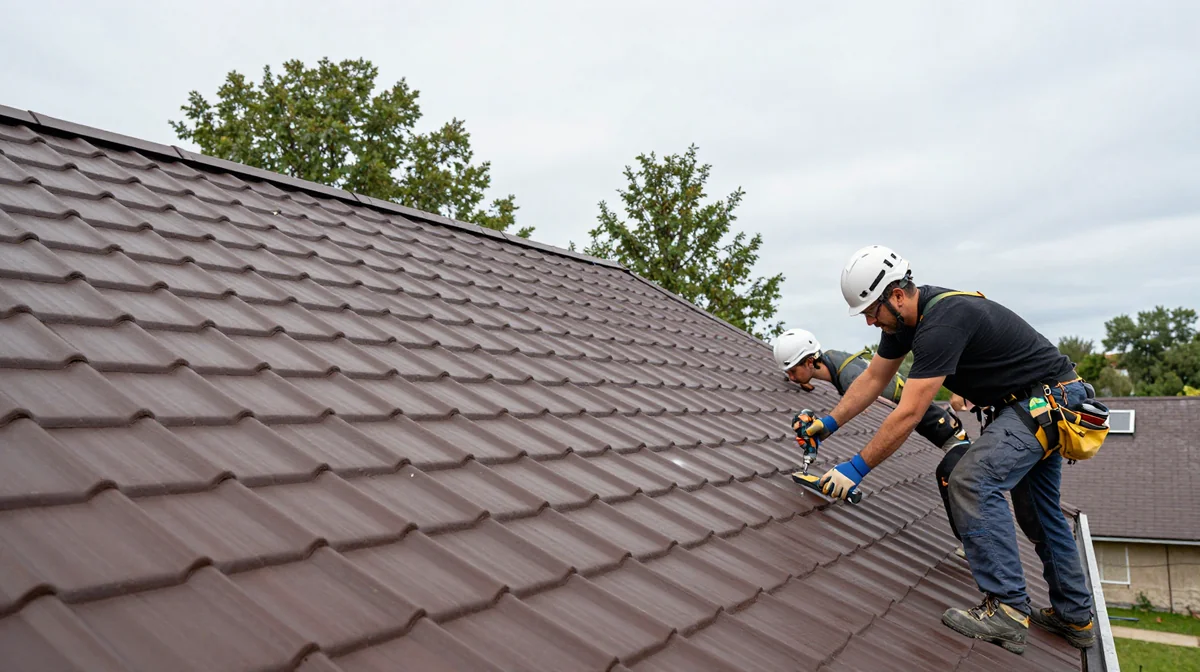
ROOFING in ALMATY
from 2 300 tenge.* per m²
Is the roof leaking or has the slate served its time? We will re-roof a house of 120–180 m² in 5–14 working days or eliminate a leak at a junction.
 Free measurement,
estimate in 1 day We fix leaks from
2 hours Warranty from 5 years in
the contract 6 types of coatings
for any slope
ROOFING in ALMATY
from 2 300 tenge.* per m²
Is the roof leaking or has the slate served its time? We will re-roof a house of 120–180 m² in 5–14 working days or eliminate a leak at a junction.
Free measurement,
estimate in 1 day
We fix leaks from
2 hours
Warranty from 5 years in
the contract
6 types of coatings
for any slope
TYPES OF ROOFING
WORK we carry out
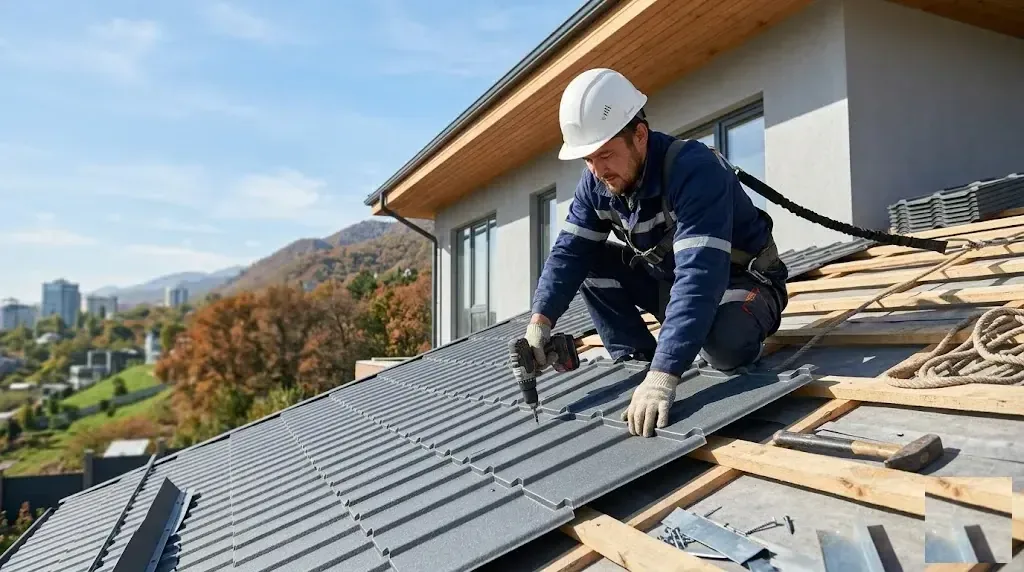
Installation of metal tiles
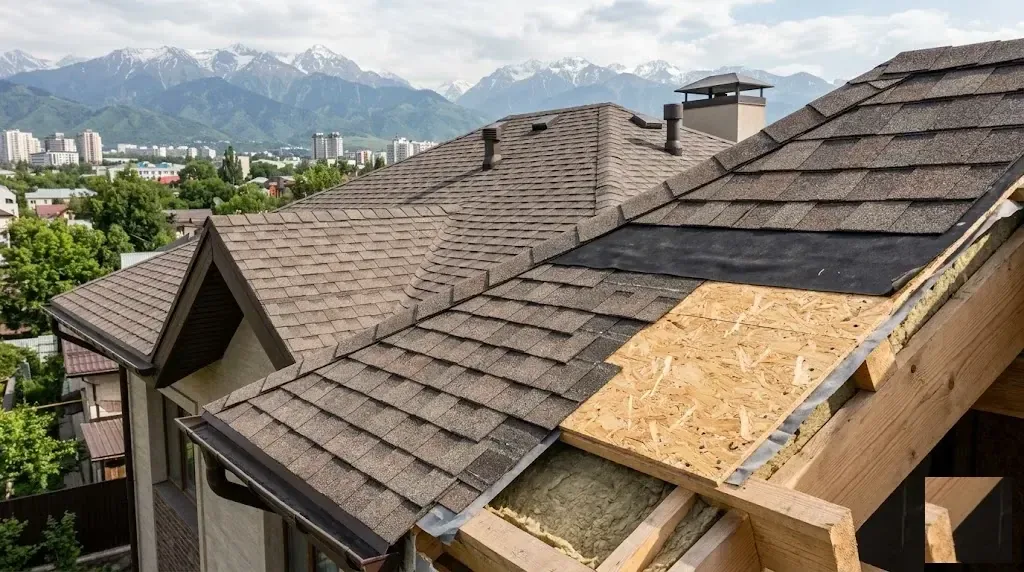
Soft roofing installation
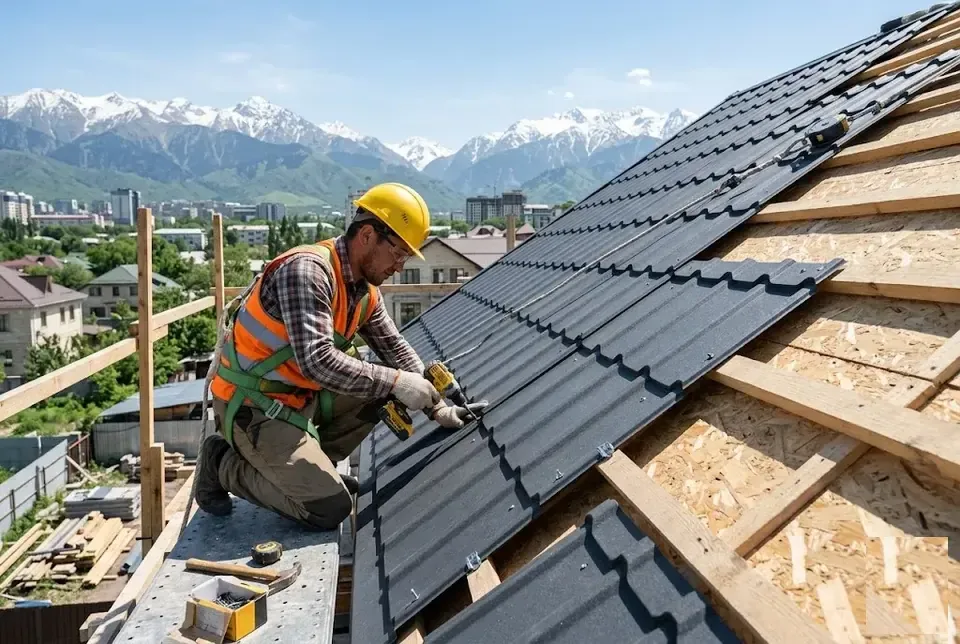
Profiled sheet roofing
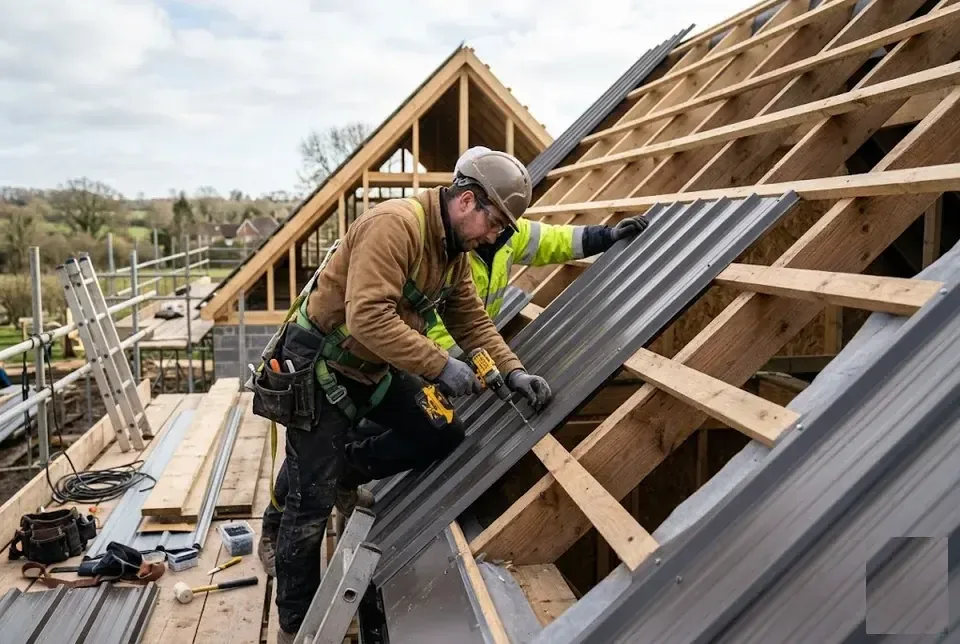
Standing seam roofing
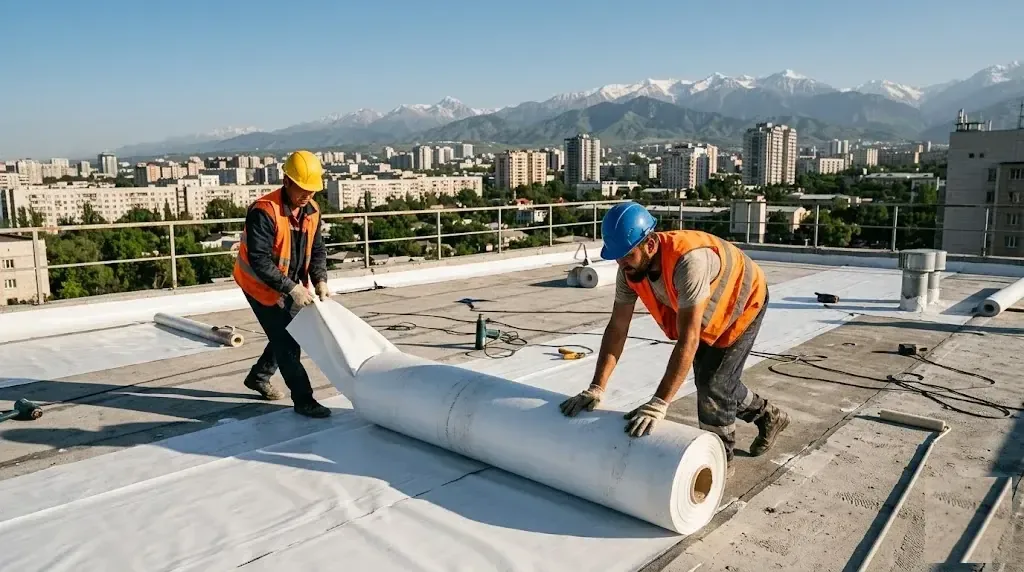
PVC membrane installation
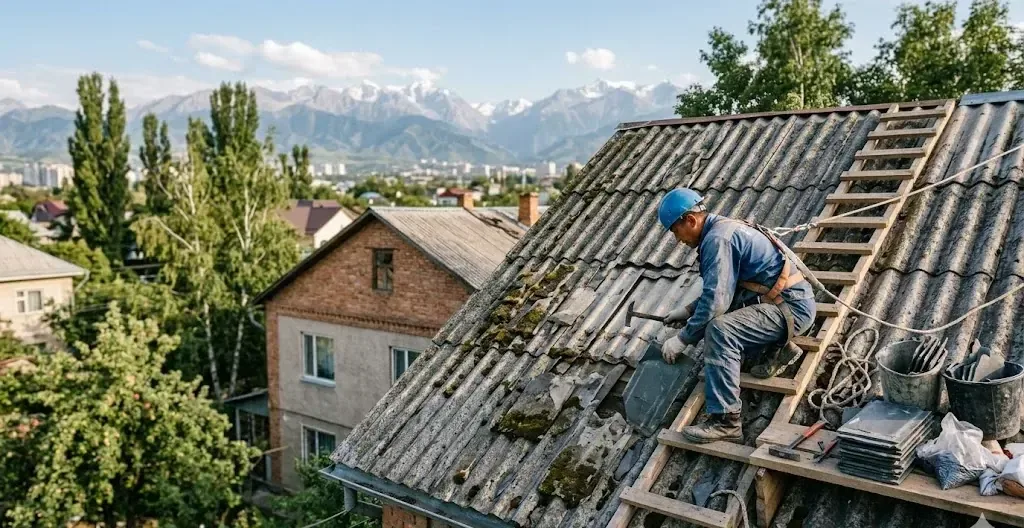
Roof and leak repairs
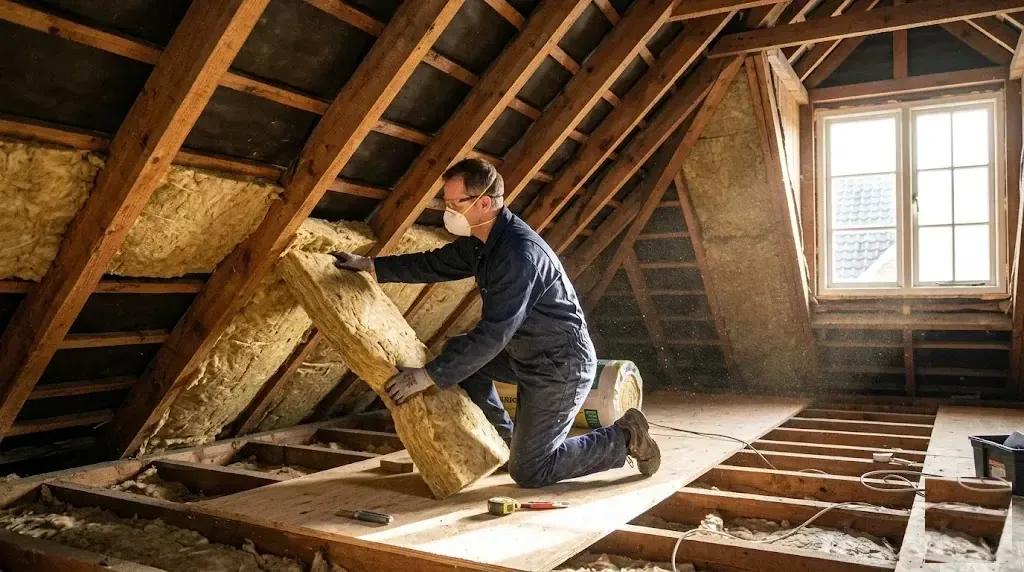
Roof insulation
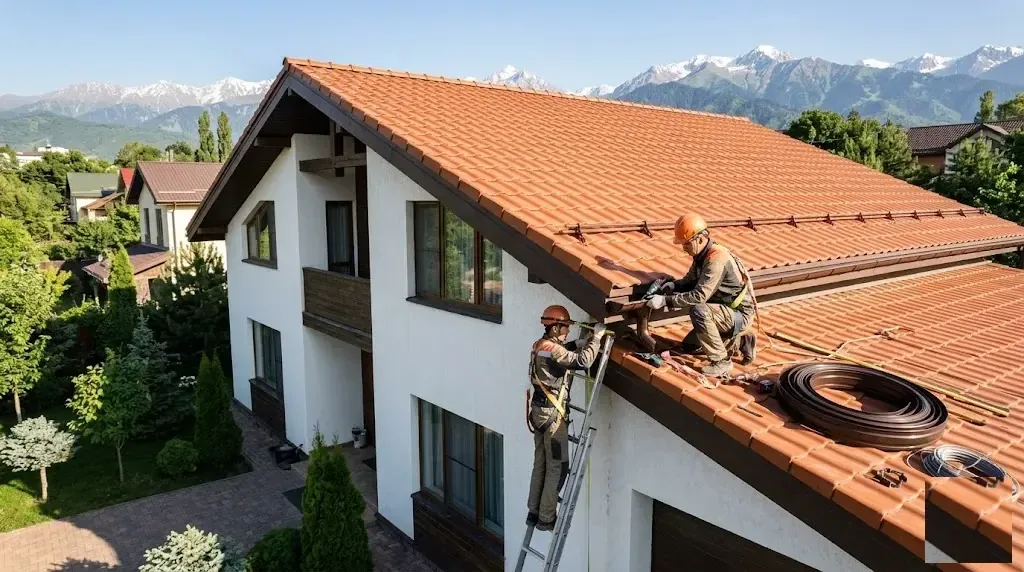
Gutter system installation
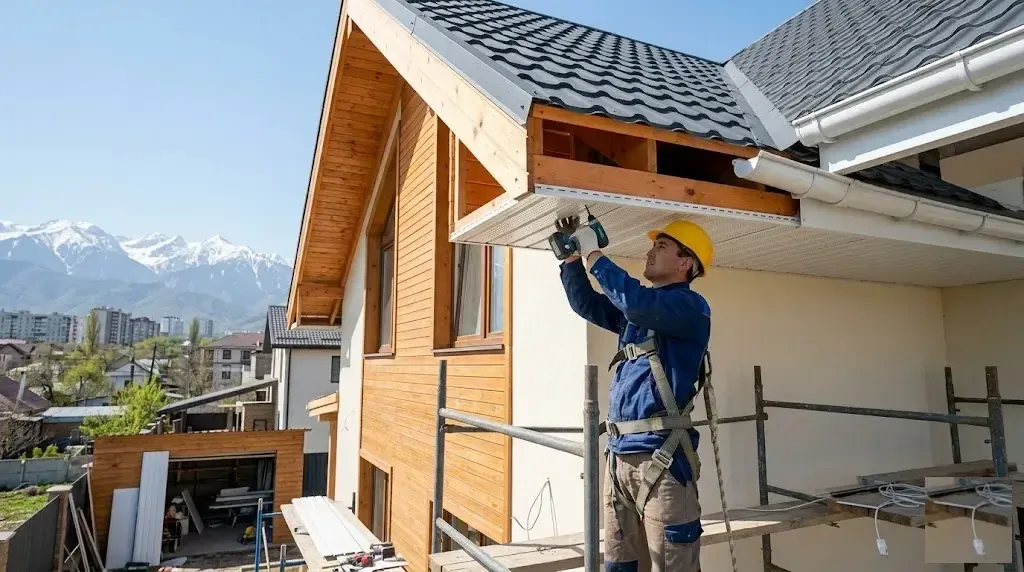
Soffit cladding of the eaves
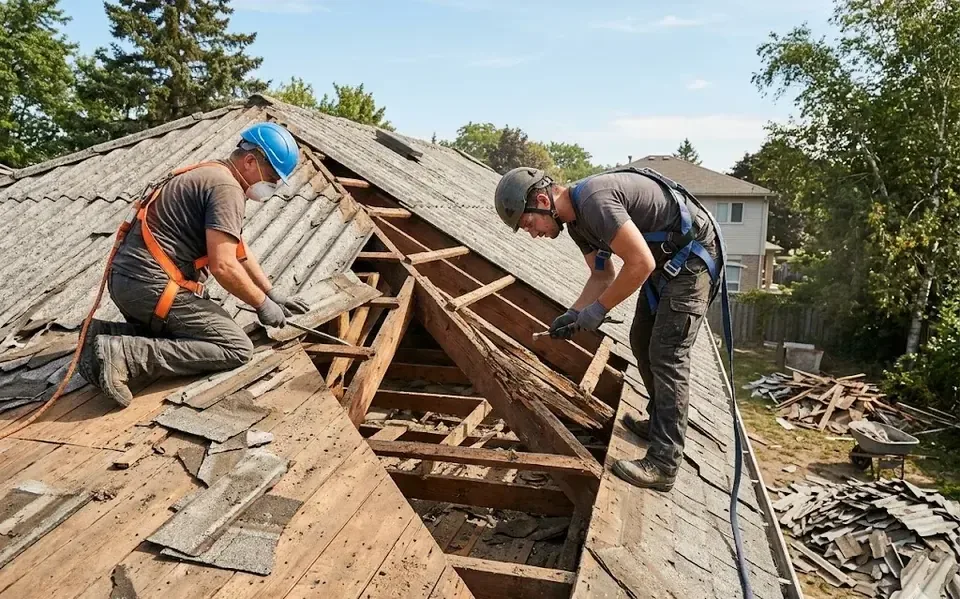
Removal of the old roof
TYPES OF ROOFING WORK
we carry out
Installation of metal tiles
Soft roofing installation
Profiled sheet roofing
Standing seam roofing
Removal of the old roof
Gutter system installation
Roof and leak repairs
Roof insulation
Soffit cladding of the eaves
PVC membrane installation
We will call you back within 3 minutes
TYPES OF ROOFING WORK
we carry out
Installation of metal tiles
Soft roofing installation
Profiled sheet roofing
Soffit cladding of the eaves
Removal of the old roof
Gutter system installation
PVC membrane installation
Roof and leak repairs
Roof insulation
Standing seam roofing
We will call you back within 3 minutes
COST OF ROOFING WORKS in
almaty
| SERVICE | COST | TIME |
|---|---|---|
| Site visit for measurement and estimate (per project) | free of charge | from 1 day |
| Metal tile installation (per m²) | from 2 500 ₸ | from 3 days |
| Corrugated sheet roofing (per m²) | from 2 300 ₸ | from 3 days |
| Soft roofing installation (per m²) | from 3 200 ₸ | from 4 days |
| Standing seam roof (per m²) | from 3 800 ₸ | from 5 days |
| PVC membrane installation (per m²) | from 3 500 ₸ | from 4 days |
| Dismantling of the old roof (per m²) | from 1 200 ₸ | from 2 days |
| Roof insulation (per m²) | from 1 800 ₸ | from 2 days |
| Installation of a gutter system (per linear metre) | from 2 000 ₸ | from 2 days |
| Soffit installation on the eaves (per linear metre) | from 2 200 ₸ | from 2 days |
| Leak repair, local repair (per unit) | from 15 000 ₸ | from 2 hours |
Advantages of ROOFING WORKS BY Profi-Dom

No condensation
We install a counter-batten and a 40–50 mm ventilation gap — the insulation does not get wet, and the rafters do not rot

Our own crews
The foreman is assigned to the site from measurement to handover, the site manager accepts every layer of the pie.

Equipment for any roof
There is a tool for every roof type: torches for torch-on roofing and hot-air devices for PVC membrane.

Installation 5–14 days
We roof a 120–180 m² house in 5–14 working days — we fix the start and end dates in the contract.

Warranty of 5 years
We provide a warranty on installation work from 5 years — the terms are set out in the contract, and you can contact us directly.

Quote with no extra charges
Profiled sheeting from 2 300 ₸/m², metal tiles from 2 500 ₸/m² — flashings and gutters as separate lines.
Advantages of ROOFING WORKS BY Profi-Dom
We install a counter-batten and a 40–50 mm ventilation gap — the insulation does not get wet, and the rafters do not rot
No condensation
The foreman is assigned to the site from measurement to handover, the site manager accepts every layer of the pie.
Our own crews
There is a tool for every roof type: torches for torch-on roofing and hot-air devices for PVC membrane.
Equipment for any roof
We roof a 120–180 m² house in 5–14 working days — we fix the start and end dates in the contract.
Installation 5–14 days
We provide a warranty on installation work from 5 years — the terms are set out in the contract, and you can contact us directly.
Warranty of 5 years
Profiled sheeting from 2 300 ₸/m², metal tiles from 2 500 ₸/m² — flashings and gutters as separate lines.
Quote with no extra charges
We will call you back within 3 minutes
HOW WE WORK
- 01.Consultation
We discuss your roof, confirm the area, type of roofing and timelines, then produce a preliminary cost estimate.
- 02.Measurement visit
We come to the site, measure the slopes, junctions and substrate, and check the condition of the rafters and battens.
- 03.Estimate and coating
We select roofing material for your home and budget and present an estimate with prices for roofing works.
- 04.Contract
We fix the price, installation deadlines and a warranty of 5 years or more in the contract, so the terms are clear to both parties.
- 05.Delivery of materials
We deliver the roofing, insulation, waterproofing and flashings to the site and lift them onto the roof.
- 06.Demolition and substrate
We remove the old covering, repair or replace the rafters and battens, and prepare a level base for the roof.
- 07.Roof installation
We assemble the roofing system — insulation, waterproofing, vapour barrier — and lay the chosen covering.
- 08.Handover of the facility
We install trim pieces, the gutter system and soffits, remove debris and hand over a finished roof.
Get the cost and timeline of roofing works in 1 minute

FIND OUT THE COST OF ROOFING WORK FOR YOUR PROJECT
Leave a request and we will contact you within 3 minutes
Thank you! We will contact you within 3 minutes.
By clicking the button you agree to the terms of the
 Privacy Policy
FIND OUT THE COST OF ROOFING WORK FOR YOUR PROJECT
Leave a request and we will contact you within 3 minutes
Thank you! We will contact you within 3 minutes.
By clicking the button you agree to the terms of the
Or call us at
+7 (707) 068-88-68Privacy PolicyFIND OUT THE COST OF ROOFING WORK FOR YOUR PROJECT
Leave a request and we will contact you within 3 minutes
Thank you! We will contact you within 3 minutes.
By clicking the button you agree to the terms of the
Or call us at
+7 (707) 068-88-68Roofing in Almaty from PROFI-DOM: coatings, prices, timelines, and warranty
Roofing in Almaty from PROFI-DOM — a full turnkey cycle: measurement and estimate, rafter system and roofing pie, installation of metal tiles, corrugated sheets, soft and seam roofing, gutters and snow guards. Installation of corrugated sheets costs from 2 300 ₸ per m², metal tiles — from 2 500 ₸ per m². Measurement and estimate are free, warranty on installation — from 5 years in the contract.
Published: 1 · Updated: 1
About the author

Which roofing to choose for a house in Almaty's climate
Roofs in Almaty operate under harsh conditions: snow loads in the foothills, squally winds in the gorges, freeze-thaw cycles and seismic activity. The choice of covering is determined not only by price, but also by the roof pitch, the weight of the roof build-up and the operating conditions of the specific house.
Which coverings PROFI-DOM installs
- Monterrey and modular metal tiles: profiled steel sheets with a polymer coating — the standard option for pitched roofs on a private house.
- Corrugated sheets S-21 and NS-35: load-bearing profile for outbuildings, garages and roofs with a pitch of 8° or more.
- Soft tiles: bitumen fibreglass shingles for complex shapes, attics and roofs with a pitch of 11° or more.
- Standing seam roofing: panels made of galvanised steel with a double standing seam — for architectural and historic roofs.
- PVC membrane: a welded sheet for flat trafficable roofs with a slope of 1,5° or more.
- Composite and ceramic tiles: premium coverings for permanent homes with a service life of 40 years or more.
How to choose roofing for snow, wind and seismic activity
For pitched roofs of a private house in the foothills, metal tiles and seam roofing are practical — they withstand increased snow loads, do not accumulate moisture at the joints and are repairable. Wind in the gorges of the Trans-Ili Alatau produces gusts up to 25-30 m/s: the coating is fastened into every second wave through a sealing washer, and the overhangs are closed with a wind bar. Seismicity of 9 points on the MSK-64 scale requires a rigid connection of the rafter system with the mauerlat and diagonal ties — soft roofing on a solid OSB-3 base holds its shape better here than heavy tiles. The heavier the coating, the more powerful the rafter system must be: ceramics gives 40-60 kg/m² and requires timber 50×200 with a pitch of 600 mm, while a light PVC membrane is suitable only for flat roofs. In attics under metal without sound insulation, every hailstone is heard — lay mineral wool between the rafters.
Comparison of roofing coverings: slope, weight, service life
| Coating | Minimum slope | Weight of 1 m² | Service life | Noise during rain |
|---|---|---|---|---|
| Metal roof tiles | from 14° | 4–5 kg | 30–50 years | medium |
| Corrugated sheeting | from 8–12° | 4–6 kg | 20–40 years | high |
| Soft roof tiles | from 11–12° | 8–12 kg | 25–40 years | low |
| Standing seam roofing | from 7–10° | 5–7 kg | 40–60 years | medium |
| PVC membrane | from 1,5–2° | 2–3 kg | 25–40 years | low |
| Torch-applied roll materials | from 1,5–2° | 4–6 kg | 15–25 years | low |
| Composite roof tiles | from 14° | 6–7 kg | 40–50 years | low |
| Ceramic tiles | from 22° | 40–60 kg | 50–100 years | low |
Noise from rain is an underrated parameter: under metal, an attic without sound insulation can be heard throughout the house.
Roofing materials in Almaty: how we purchase and supply them
We buy roofing materials directly from suppliers and deliver them to site in batches according to the installation schedule, so the covering doesn't sit out in the open. We carry out measurement and estimating before work begins: we measure the slopes, calculate the area allowing for overhangs, valleys and abutments, and list the flashing components separately — ridge caps, wind trims, drip edges, sealants. We use steel with a Polyester or PVDF polymer coating 0,45-0,5 mm thick — such a sheet withstands hail and doesn't fade in the sun. We deliver soft tiles on pallets in factory packaging so the shingles don't stick together in the heat. We calculate from actual measurements, not by eye: too few sheets means the crew stands idle for 3-5 days, while too many leaves dead stock that the supplier won't take back.
Roof build-up and installation mistakes that cause the roof to leak
The roof of a private house is not just a finish coating but a layered system from the rafters to the ridge. A mistake in any layer shows up as a leak within one or two winters, when fixing it costs more than building it correctly from the start.
What a roofing build-up is and why a counter-batten is needed
A roof build-up is a sequence of layers from the rafters to the covering: vapour barrier, insulation, waterproof windproof membrane, counter-batten, batten and the final covering. For metal tiles and profiled sheeting a diffusion membrane is mandatory — it releases vapour from the insulation but does not let water in from outside; for soft roofing, a continuous deck of OSB-3 or moisture-resistant plywood 9-12 mm is used instead. The counter-batten is a batten 25×50 or 30×50 mm nailed along the rafters over the membrane: it creates a 40-50 mm ventilation gap between the waterproofing and the batten. Without this gap, condensation accumulates under the metal, runs down onto the insulation and destroys it in a single season — when wet, mineral wool loses up to 60% of its insulating properties. Ventilation only works with through-flow from the eaves to the ridge: if there is no drip edge with mesh at the bottom and no outlet gap at the top, the air stands still.
House roof: how to insulate the slopes without condensation and ice dams
We insulate the house roof with mineral wool, calculating the thickness for the Almaty climate: for a pitched roof we take 200-250 mm in two layers with overlapping joints, for an attic — up to 300 mm, and we always leave a ventilation gap — otherwise warm air from the house condenses on the cold metal and turns into ice on the overhangs. The density of basalt wool for slopes is 35-45 kg/m³, for flat sections — from 90 kg/m³; glass wool at 11 kg/m³ settles after 3-4 years and exposes the top of the rafter leg. The vapour barrier is installed on the inside, the waterproof wind barrier — on the outside, and mixing up the layers is a common mistake in DIY insulation. In our projects we seal the vapour barrier joints with butyl tape — a 5 mm gap causes local condensation, which shows up as a stain on the attic ceiling as early as the first winter.
Why a cheap crew costs you more: typical mistakes
- Cutting corners on waterproofing: instead of a membrane at 900-1500 ₸/m², roofing felt or ordinary film is laid — condensation forms under the metal, and the insulation gets soaked within a season.
- No counter-batten: saving 350-500 ₸/m² on timber deprives the build-up of a ventilation gap, and within a year the battens and rafters are covered in mould.
- Improper pipe flashings: instead of a factory-made apron with a seal, they smear silicone — after one winter the joint comes away and water runs down the chimney into the insulation.
- Valley done "by eye": the lower flashing is laid without marking and without extending 200-300 mm beyond the axis — during heavy rain, water breaks through the coating at the most vulnerable point.
- Fastener without a sealing washer: the self-tapping screw is driven at an angle or overtightened — the rubber gasket tears, and the fastening point becomes a hole for leakage.
Which trim pieces are needed and how their quantity is calculated
We install a full set of ancillary elements — eaves and gable trims, drip edges, ridge and valley elements — and calculate them by the length of the slopes and the roof perimeter. The eaves trim covers the fascia board and directs water into the gutter: its length equals the length of the eaves overhangs, the standard is 2 m with an overlap of 50-100 mm, meaning 10 m of eaves requires 6 trims. The gable trim protects the edge sheets from wind uplift, its length equals the total length of the gables; the ridge element — by the length of the ridge with an overlap of 100 mm; the valley — by the length of the internal corners in double volume. Our surveyor calculates the ancillaries together with the fasteners — 8-10 screws per 1 m² of covering. Without a drip edge, water seeps under the battens, and without a gable trim, squally winds in the gorges tear off the edge sheets.
What makes up the cost of roofing works
The price per m² of roofing is not the final estimate figure. It covers one set of works, while removal, flashings, gutters and snow guards are priced separately. We explain how to read an estimate and avoid extra charges along the way. You can get a preliminary budget on the roof cost calculator page.
Roofing prices: what is included in the m² and what is charged separately
- The price per m² includes: installation of the finishing covering, battens, counter-battens, waterproofing membrane and fasteners — the full roof build-up across the roof slope area.
- Calculated separately: removal of the old covering, flashing components (valleys, ridge caps, eaves trims, abutments), the gutter system and snow guards.
- Separately, insulation: mineral wool or PIR boards, vapour barrier and soffit lining are calculated by area and layer thickness.
- Separately — reinforcement: replacing or extending rafters, antiseptic treatment, installation of the wall plate.
- With us: the cost per m² of work is calculated with a detailed estimate for each line item — the client sees what they are paying for.
- Check the estimate: if a contractor quotes a single figure per m² without a breakdown, ask for the list of flashings and junctions before signing the contract.
Turnkey roofing: how a fixed estimate is put together
Turnkey installation at PROFI-DOM begins with the foreman visiting the site: he measures the area of the slopes, the length of the valleys, the junctions to pipes and parapets, the lifting height and the angle of inclination. From these data the volume of metal tiles, profiled sheeting or soft roofing is calculated with a 7-10% allowance for cutting, the footage of the lathing with the spacing for the specific profile, and the quantity of fasteners — 8-10 screws per m² of covering. The estimate is signed before the start and does not change during the process: if the crew made a mistake in calculating the material, the additional purchase is at the contractor's expense.
How much does it cost to replace slate with metal tiles
We replace slate with metal tiles, including full dismantling, waste removal and, if necessary, reinforcement of the rafter system — the final cost depends on the roof area and the condition of the rafters. On a house with 120-150 m² of slopes, dismantling the old slate takes 1-2 days; removal of asbestos-cement sheets is a separate line item, since slate is a material requiring special disposal. Under slate, the rafters are often weakened by years of leaks: if they are not checked during replacement, the new metal tiles will be laid on a rotted base and sagging will appear in the very first winter. Our specialist during the site survey opens up 2-3 sections of the battens to assess the condition of the timber before the estimate is signed.
Repairs, leaks and replacement of old roofing
A leak does not always mean the entire coating needs replacing. Often a local repair of a detail — an abutment, a valley or a damaged sheet — is enough. We explain how to act in winter and when repair no longer helps.
Roofer services: how we fix a roof leak in winter
The PROFI-DOM crew responds to leaks all year round: in winter we locate the entry point by ice on the eaves and damp patches on the insulation, carry out emergency sealing, and schedule full repair of the detail for the warm season. Emergency sealing is a temporary measure: mastic or self-adhesive tape holds the detail until the thaw, but does not replace restoring the abutment and replacing the damaged metal tile or profiled sheet. On properties in the foothills — Remizovka, Kamenka, Butakovka — it is the valleys and pipe penetrations that leak most often in winter: snow accumulates there, and during a thaw water gets under the covering and freezes in the battens. Looking for a leak "by the ceiling" is pointless — water enters higher up and runs down the rafters; the entry point is identified by the membrane and battens.
How often does a roof need repair, and when is it time to replace it
A scheduled inspection once every 2–3 years extends the service life of the coating: roofs in Almaty endure sharp temperature changes, and minor defects are better caught in advance. A full replacement is needed when leaks recur in different places or the coating has exhausted its resource. Metal tiles have a resource of 30–50 years, corrugated sheeting 20–40, soft tiles 25–40, slate and roofing felt 10–15 — — replacement is planned according to these terms, not by the first stain on the ceiling. Signs that repair will no longer help: through corrosion over 20–30% of the sheet area, rot of the rafter system, swollen roofing felt with exposed base. Dismantling the old coating and removing debris are separate estimate lines during replacement: from an old roof of 120–150 m² several truckloads of waste accumulate, which must be taken to a landfill. Installation is possible even in winter at temperatures without sharp fluctuations, but soft tiles and torch-applied materials are laid only in the warm season.
Additional works: gutters, eaves, snow guards, insulation
Roofing work in Almaty does not end with laying sheets. Additional elements turn individual layers into a complete system: without them, the coating works at half strength, and weak nodes fail first. We analyze what exactly these works cover and where savings are wasted.
Snow guards and gutter system: why they are needed in Almaty
At PROFI-DOM, snow guards and gutter systems are installed on all pitched roofs: snow slides off in slabs and, without barriers, tears down the gutters and endangers people below. In foothill areas — Medeu district, Butakovka, Kamanka — there is noticeably more snow on the slopes than in the city centre, and tubular barriers on metal tiles distribute the pressure across several points. On standing seam roofing we install point snow guards, on corrugated sheeting — grille sections every 1,5-2 metres along the slope. We supply fasteners as galvanised self-tapping screws with an EPDM gasket colour-matched to the roofing, so that the entry points do not rust after the first winter. Snow guards are fixed through the roofing into the battens — if they are mounted on the metal only, when the snow slides off they will tear out the sheets together with the fasteners.
Soffit installation on eaves and gutter installation
- Perforated soffits: they close the eaves lining and supply air to the ventilation gap — without them condensation stays in the roof build-up and soaks the insulation.
- Gutter: the 125-150 mm cross-section is selected according to the roof slope area, with a gradient of 2-3 mm per linear metre — with less, water stagnates and bursts the metal in winter.
- Brackets: 50-60 cm spacing for plastic and 30-40 cm for metal, fixed to the fascia board or to the rafters before the roofing is laid.
- Sloping outlets and downpipes: calculated by the number of slopes, one outlet for every 10-12 metres of gutter, otherwise water overflows onto the façade.
- Drip edge and wind bar: direct water into the gutter and protect the end of the battens from driving rain.
Roofing crew, timelines, contract and warranty
The quality of a roof is determined not by the brand of covering, but by the crew that installs it. Let us look at who exactly works on site, how to check a contractor before signing the contract, and what the warranty should contain.
Roofers in Almaty: why we work with our own crews
PROFI-DOM is a direct contractor: the craftsmen in our crews work on a permanent basis rather than being recruited for each order through an aggregator. The foreman is assigned to the project from measurement to handover, and the site manager runs 2-3 roofs simultaneously and is responsible for acceptance of every layer — from the counter-batten to the ridge assembly. The same crews work for us on projects in Talgar, Kaskelen and Esik, so the installation technology is identical at any address. When a crew is hired in, responsibility for defects is blurred between the intermediary and the craftsmen — with a direct contractor the warranty is the same at every stage. That is why in a contract with us the foreman's name is stated before installation begins: if the crew changes, you learn about it in advance, not after the battens have been exposed.
Roof installation timelines and how to check a contractor before ordering
- Timelines: installing the roof of a house with an area of 120-180 m² takes from 5 to 14 working days — the timeframe depends on the pitch, the number of valleys and abutments.
- Contract: a fixed estimate listing the layers of the build-up, the coating brand, the insulation thickness and the price per m² without "we'll clarify on site".
- Portfolio: addresses of properties in Almaty and the suburbs that you can view in person, not just in photos in a chat.
- Warranty: a written document with a specific term for the work and separately for materials — verbal promises like "we'll call you back if anything" don't count.
- Site visit: the surveyor comes to the property before the contract is signed; we travel to roofs in Almaty, Talgar, Kaskelen, Esik, Besagash and Irgeli within 1-2 working days.
Warranty on roofing works and what the contract must include
We provide a warranty on our work, and in the contract we specify the composition of the roofing pie, the brand of coating, the deadlines and the procedure for remedying defects. The warranty for roof installation starts from 5 years and is written into the contract; the manufacturer's warranty on the coating applies separately — its term depends on the brand of material. The contract specifies the thickness of insulation, the type of waterproofing and vapor barrier, the rafter spacing and the fastening method — these parameters determine whether the roof of the house will withstand the snow loads of the foothills and the squalls in the gorges. A warranty without a described scope of work means nothing: if the document does not specify the layers of the pie and the brand of materials, it will be impossible to prove installation defects. Therefore, before signing the acceptance certificate, check each item of the estimate against what was actually delivered to the site.
Conclusion
Let us sum up the main things that determine the durability of a house roof: the pairing of covering with pitch, the order of layers, transparency of the estimate and protective elements. These four pillars matter more than the brand of material and the contractor's promises.
Key takeaways
- The covering is chosen according to pitch and weight: metal tiles and standing seam work on pitched roofs, PVC membrane only on flat roofs.
- The roofing system matters more than the covering: the counter-batten, waterproofing and ventilation gap determine whether the structure will leak.
- The estimate must be itemised: the price per m² does not include dismantling, trim pieces and gutters — these are charged as separate line items.
- Snow guards and gutters are not an option: in the Almaty climate, without them snow sliding off tears away the roofing and endangers people below.
- The contract and warranty are the selection criterion: a fixed estimate and a written warranty protect against defects, missed deadlines and extra charges along the way.