
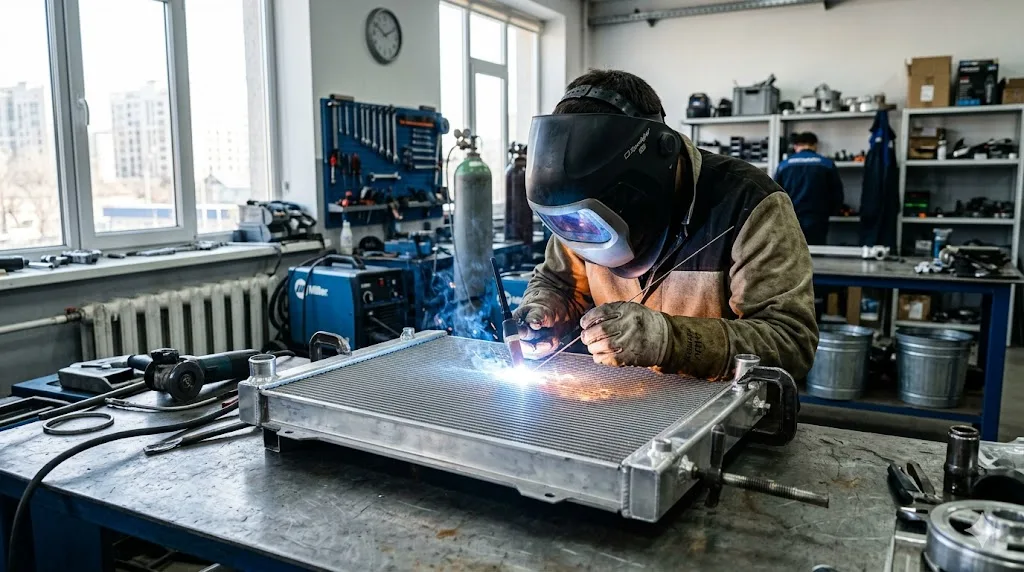
ALUMINIUM WELDING IN ALMATY
from 7 000 KZT* per 1 METRE OF WELD
Durable and high-quality aluminium welding thanks to high quality standards and the high qualification of our staff.
 Joints to GOST 5264-80
Installation from 1 day Arrival within 45 minutes
Installation from 1 day 3-year warranty
 Prices from 5000 ₸
Contract and estimate

ALUMINIUM WELDING IN ALMATY
from 7 000 KZT* per 1 METRE OF WELD
Durable and high-quality aluminium welding thanks to high quality standards and the high qualification of our staff.
Joints to GOST 5264-80
Installation from 1 day
Arrival within 45 minutes
Installation from 1 day
3-year warranty
Prices from 5000 ₸
Contract and estimate
ALUMINIUM WELDING IN ALMATY
from 7 000 KZT* per 1 METRE OF WELD
Durable and high-quality aluminium welding thanks to high quality standards and the high qualification of our staff.
Joints to GOST 5264-80
Installation from 1 day
Arrival within 45 minutes
Installation from 1 day
3-year warranty
Prices from 5000 ₸
Contract and estimate
ALUMINIUM
WELDING SERVICES
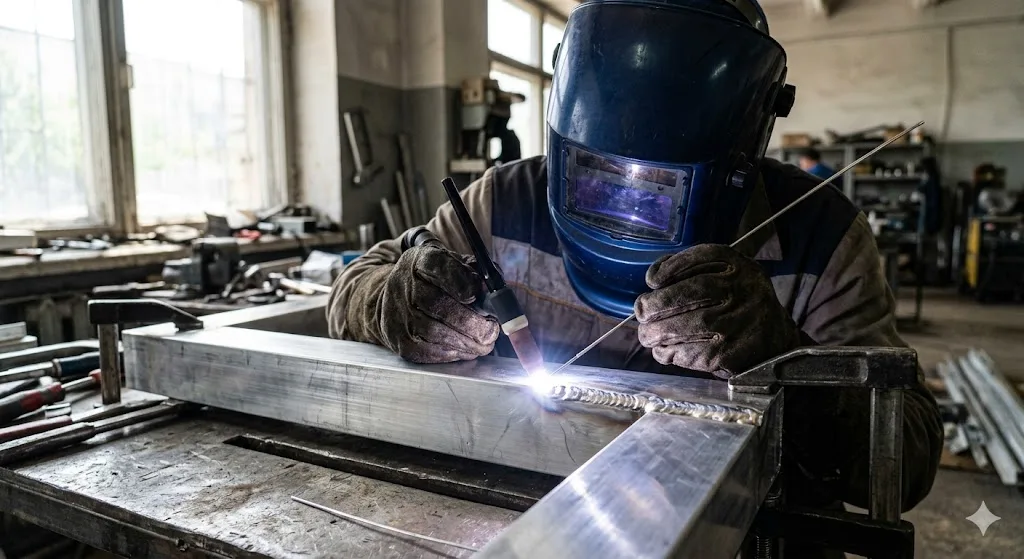
Welding of aluminium structures
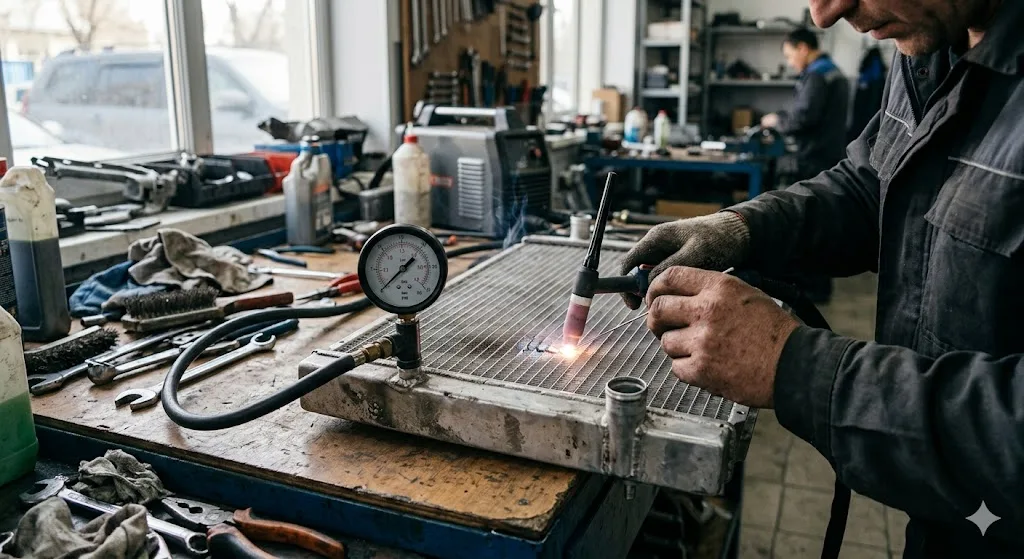
Repair of aluminium radiators
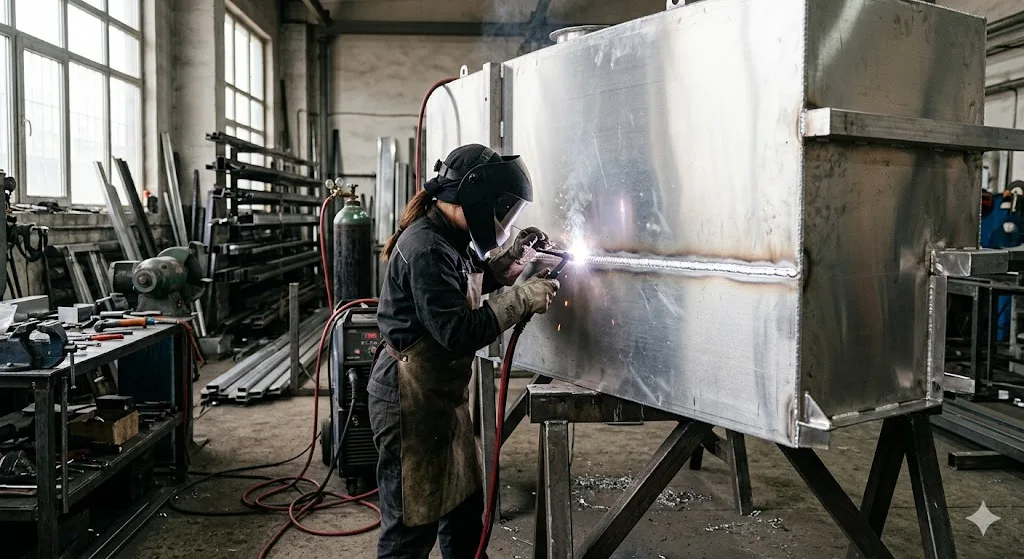
Manufacture of aluminium tanks
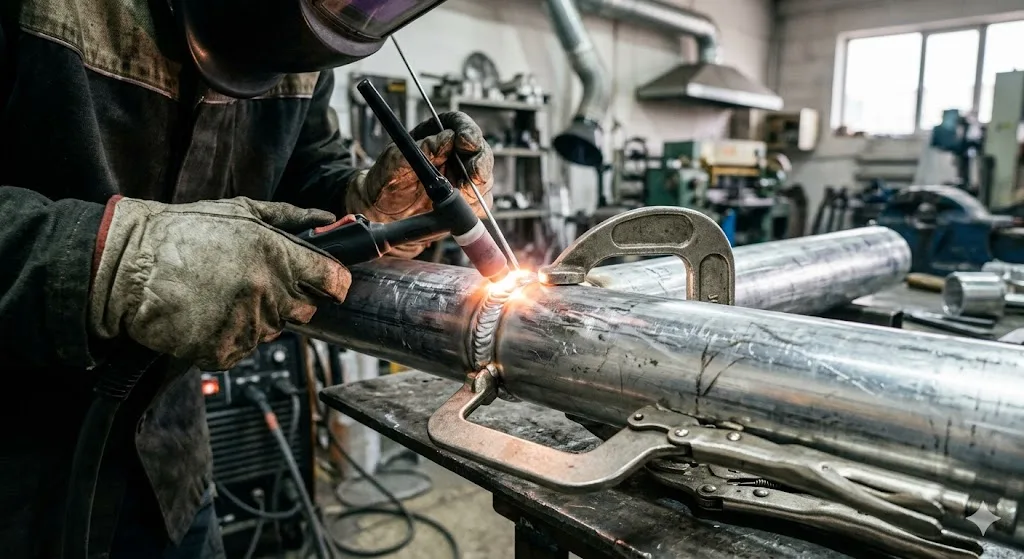
Welding of aluminium pipelines
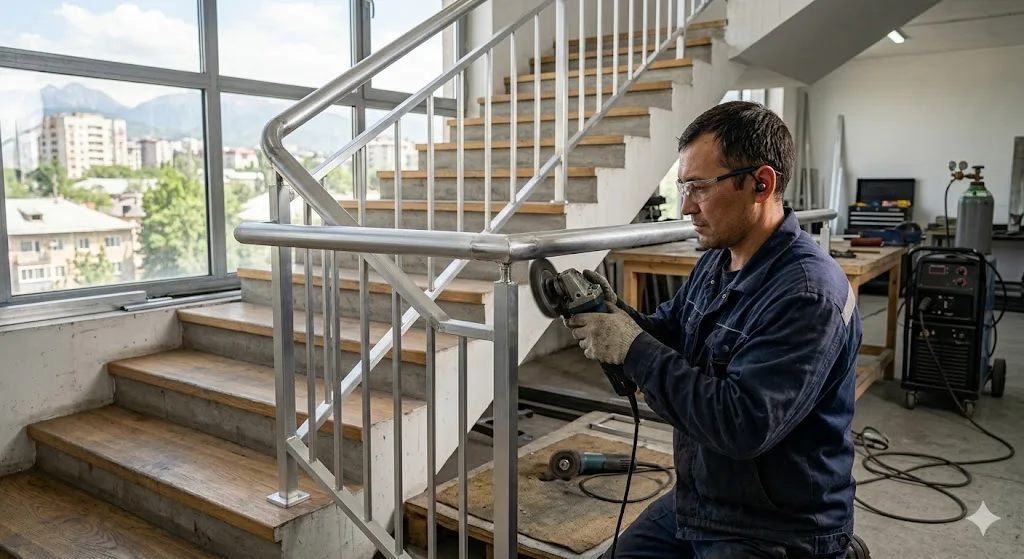
Installation of aluminium handrails
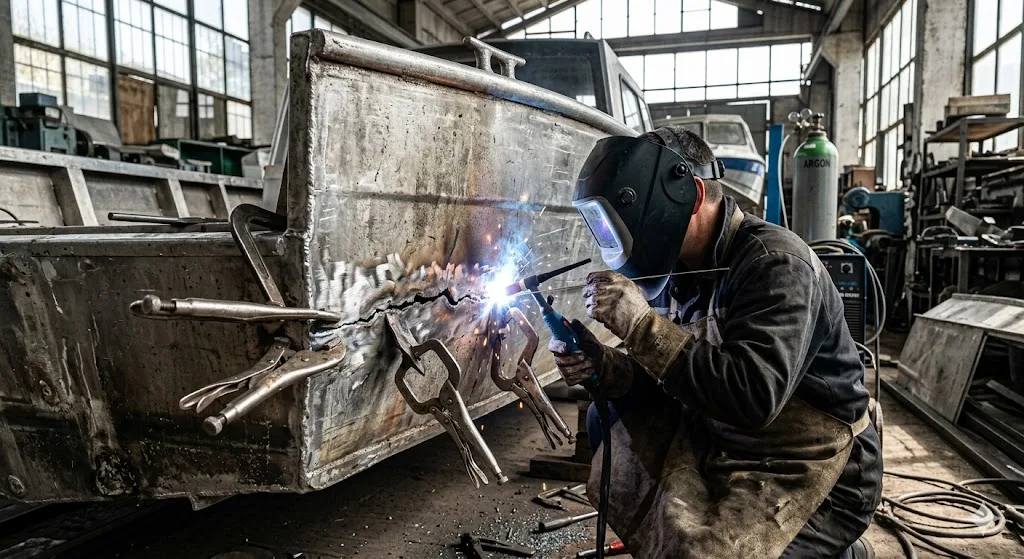
Restoration of aluminium housings
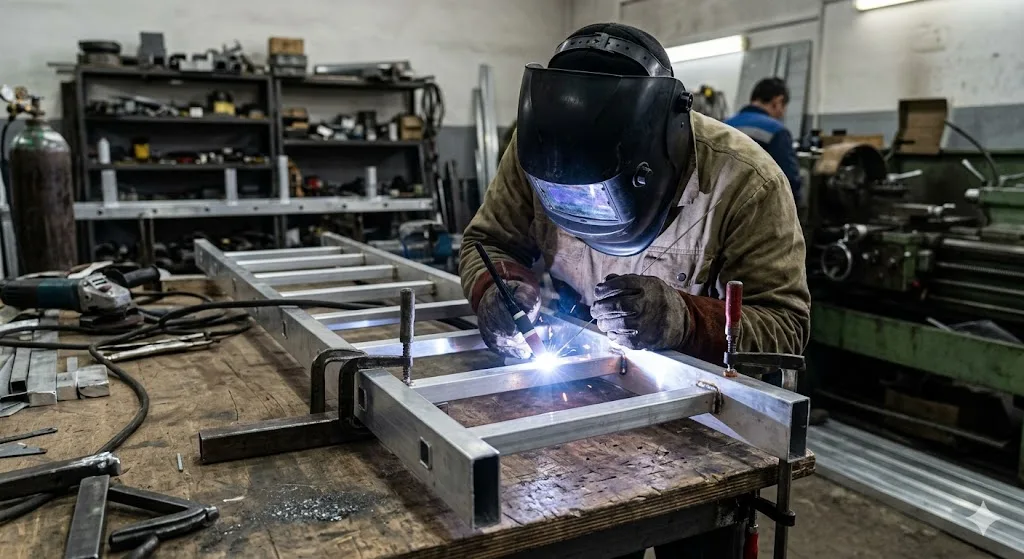
Welding of aluminium staircases
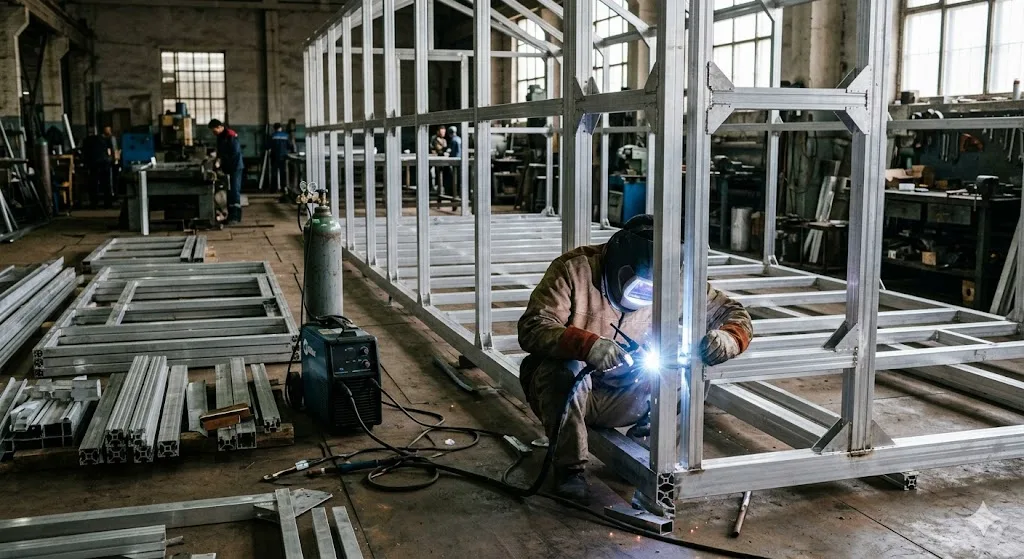
Manufacture of aluminium frames
ALUMINIUM
WELDING SERVICES
Welding of aluminium structures
Installation of aluminium handrails
Repair of aluminium radiators
Restoration of aluminium housings
Manufacture of aluminium tanks
Welding of aluminium pipelines
Welding of aluminium staircases
Manufacture of aluminium frames
We will call you back within 3 minutes
ALUMINIUM
WELDING SERVICES
Welding of aluminium structures
Installation of aluminium handrails
Repair of aluminium radiators
Restoration of aluminium housings
Manufacture of aluminium tanks
Welding of aluminium pipelines
Welding of aluminium staircases
Manufacture of aluminium frames
We will call you back within 3 minutes
ALUMINIUM WELDING PRICES
IN ALMATY
| SERVICE | COST | TIME |
|---|---|---|
| Minimum order and specialist call-out | ||
| On-site visit by a technician across the city (Almaty) | from 3 000 ₸ | from 1 hour |
| Minimum order value | from 5 000 ₸ | — |
| Argon welding (main works) | ||
| Welding of aluminium structures (per metre of seam) | from 2 500 ₸ | from 1 hour |
| Welding stainless steel (per metre of weld) | from 3 000 ₸ | from 1 hour |
| Welding copper pipes (per joint) | from 1 500 ₸ | from 30 minutes |
| Welding titanium parts (per item) | from 5 000 ₸ | from 2 hours |
| Repair of radiators and heat exchangers (per point) | from 3 500 ₸ | from 1 hour |
| Additionally | ||
| Gas cylinder replacement (argon) | from 2 000 ₸ | from 30 minutes |
| Grinding and polishing of the weld | from 1 000 ₸ | from 30 minutes |
| Urgent call-out (within 2 hours) | from 5 000 ₸ | from 1 hour |
Advantages of ALUMINIUM WELDING with Profi-Dom

Neat seams with no defects
We follow the welding technology and clean every seam so that the structure is strong and attractive

Certified craftsmen with experience
All welders have confirmed qualifications and regularly undergo skills assessments

Professional equipment
We work with modern inverter machines that provide a stable arc and precise control

Meeting the agreed deadlines
We complete orders from 1 day, fix the completion date in the contract and do not drag out the process

An official warranty on the work
We give a warranty of up to 3 years on all welded joints, set out in the closing documents

Transparent price in KZT
The cost is fixed in the estimate before work begins, with no hidden mark-ups or extra charges
Advantages of ALUMINIUM WELDING with Profi-Dom
We follow the welding technology and clean every seam so that the structure is strong and attractive
Neat seams with no defects
All welders have confirmed qualifications and regularly undergo skills assessments
Certified craftsmen with experience
We work with modern inverter machines that provide a stable arc and precise control
Professional equipment
We complete orders from 1 day, fix the completion date in the contract and do not drag out the process
Meeting the agreed deadlines
We give a warranty of up to 3 years on all welded joints, set out in the closing documents
An official warranty on the work
The cost is fixed in the estimate before work begins, with no hidden mark-ups or extra charges
Transparent price in KZT
We will call you back within 3 minutes
Advantages of ALUMINIUM WELDING with Profi-Dom
We follow the welding technology and clean every seam so that the structure is strong and attractive
Neat seams with no defects
All welders have confirmed qualifications and regularly undergo skills assessments
Certified craftsmen with experience
We work with modern inverter machines that provide a stable arc and precise control
Professional equipment
We complete orders from 1 day, fix the completion date in the contract and do not drag out the process
Meeting the agreed deadlines
We give a warranty of up to 3 years on all welded joints, set out in the closing documents
An official warranty on the work
The cost is fixed in the estimate before work begins, with no hidden mark-ups or extra charges
Transparent price in KZT
We will call you back within 3 minutes
HOW WE WORK
- 01.Discussion and estimate
We consult you free of charge by phone or messenger and prepare a transparent estimate with no hidden charges.
- 02.Measurement visit
We visit the site at a time convenient for you to take precise measurements and account for the specifics of the location.
- 03.Creating a sketch
We develop a detailed drawing of the future structure so that you can clearly see the result before the work begins.
- 04.Approval of the contract
We set out in the contract the final price, clear deadlines and warranty obligations for all types of work.
- 05.Metal preparation
We purchase certified rolled metal of the required grades and thicknesses, guaranteeing the strength and durability of the product.
- 06.Professional welding
We make all the welds on modern equipment, ensuring reliable and neat-looking joints.
- 07.Anti-corrosion protection
We treat the metal with primer and paint, protecting the structure from corrosion and extending its service life.
- 08.Delivery and installation
We deliver the finished product to your address in Almaty and install it on your site strictly according to the design.
Find out the cost and timeframe for building your prefabricated warehouse in 1 minute
catalogue of completed welding work
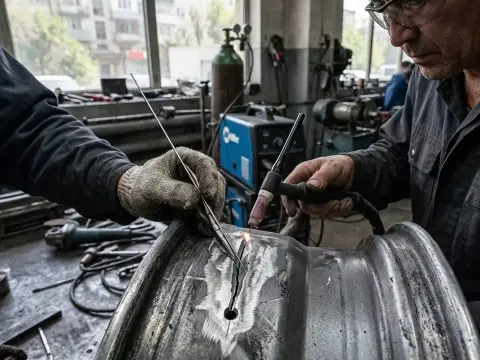 Repair of a crack on a cast wheel in the Car City area (Auezov district)
The work took 1 hour, the cost was 8 000 ₸. The disc was successfully balanced and returned to the car.
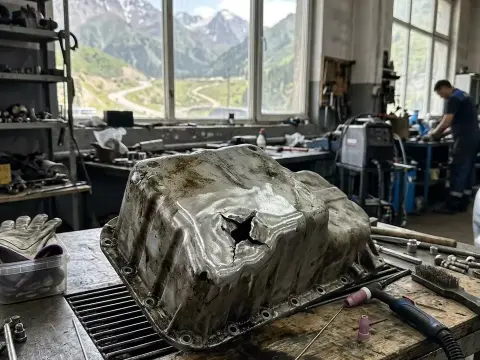 Welding a punctured oil sump after driving over a BAO
The repair was done in 3 hours, price — 15 000 ₸. The client saved over 80 000 ₸ on buying a new pallet.
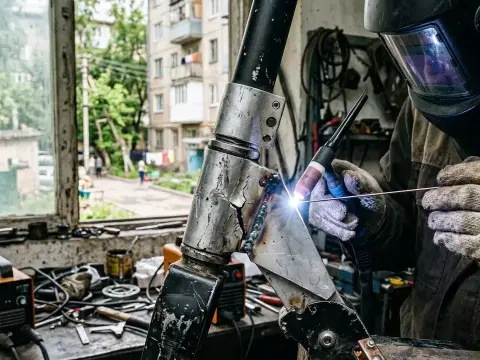 Repair of a broken steering column on an electric scooter in the Almaly district
Completed in 1,5 hours, cost — 7 000 ₸. The structure became stronger than the factory one, and the scooter went back into service.
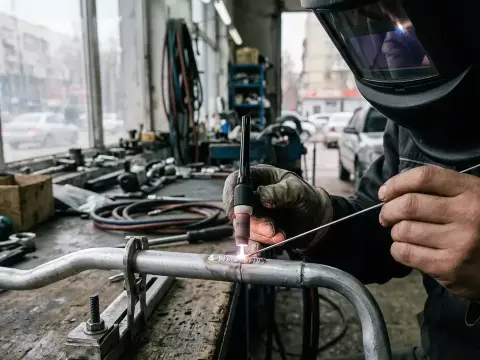 Repair of an aluminium car air conditioner tube at a service station on Ryskulov Avenue
The process took 40 minutes, the price was 5 000 ₸. The system was charged with refrigerant and successfully holds pressure.

FIND OUT THE COST OF WELDING WORK FOR YOUR PROJECT
Leave a request and we will contact you within 3 minutes
Thank you! We will contact you within 3 minutes.
By clicking the button you agree to the terms of the
Or call us at
+7 (707) 068-88-68Privacy PolicyFIND OUT THE COST OF WELDING WORK FOR YOUR PROJECT
Leave a request and we will contact you within 3 minutes
Thank you! We will contact you within 3 minutes.
By clicking the button you agree to the terms of the
Or call us at
+7 (707) 068-88-68Privacy PolicyFIND OUT THE COST OF WELDING WORK FOR YOUR PROJECT
Leave a request and we will contact you within 3 minutes
Thank you! We will contact you within 3 minutes.
By clicking the button you agree to the terms of the
Or call us at
+7 (707) 068-88-68In detail about aluminium welding
Aluminium welding in Almaty is TIG (argon-arc) welding with alternating current AC, which removes the oxide film and produces a clean, pore-free weld. PROFI-DOM welds wrought and cast alloys, thin-walled parts from 0.5 mm and aluminium-steel bimetal, with a price per 1 cm of weld and on-site visits across the city.
What we weld — aluminium alloys and typical parts
Aluminium is not a single material but a family of alloys with different properties. Aluminium for welding requires precise knowledge of its grade — the filler and mode depend on this. The welding technology, filler and final price depend on which alloy your part is made of.
What aluminium alloys are there and what is welded from them
We weld three main groups of alloys: wrought (AMg5, AMg6, AD31, 6061), cast (AK7, AK9 — silumin) and aluminium-steel bimetal, and each group has its own technology and filler. Wrought alloys are ductile and are welded with ER5356 fillers to ensure corrosion resistance to sea water (boats, AMg tanks) or ER4043 to ensure joint strength up to 240 MPa (frames, AD31/6061 ladders). Cast alloys (silumin) with a silicon content up to 12% require preheating the part to 200–250 °C and an ER4047 — filler, otherwise the joint cracks due to differences in shrinkage. Aluminium-steel bimetal cannot be welded directly — only through a bimetallic insert or friction welding. Before bringing a part in, determine its alloy from the marking on the body or the data sheet — this will immediately give the technician an understanding of the mode and filler.
Table of alloys, filler rods and typical parts
| Alloy | Type | Typical parts | Our filler metal |
|---|---|---|---|
| АМг5, АМг6 | Wrought | Boats, vessels, tanks, marine equipment | ER5356 |
| АД31, 6061 | Wrought | Bicycle frames, staircases, handrails, structures | ER4043 |
| AK7, AK9 (silumin) | Casting | Block heads, housings, pallets, castings | ER4047 |
| Aluminium + steel | Bimetal | Adapters, frames, housings | Bimetallic insert |
| Thin-walled (0.5–2 mm) | Any | Radiators, intercoolers, thin housings | ER4043 / ER4047 |
If silumin is welded with AMg filler, the seam will develop cracks — the difference in melting point and composition is to blame.
Which aluminium parts are most often brought to the workshop
- Cooling radiator: thin-wall aluminium 0.5–1.5 mm, pulsed TIG, ER4043 — filler — the most common task; you will burn through the part without pulsed mode.
- Engine sump / gearbox housing: AK7–AK9 casting, part preheating, ER4047 filler.
- Cylinder head / housing: silumin, requires preheating to 200–250 °C.
- Aluminium boat / launch: AMg5–AMg6, filler ER5356 for corrosion resistance.
- Bicycle frame: 6061, filler ER4043, geometry check after welding.
- Household castings / moto parts: ladders, cookware, brackets — we select the filler according to the composition.
How aluminium is welded and why it is difficult
Aluminium is a capricious metal: the oxide film melts at 2000 °C, and the aluminium itself at 660 °C. Understanding how to get around this is the main skill of an argon welder.
Why aluminium is difficult to weld — oxide film and porosity
The oxide film on aluminium melts at 2000 °C, while the metal itself melts at 660 °C, so a standard arc does not work — the film remains and the joint ends up with pores and cracks. When heated, aluminium instantly oxidises in air, restoring the oxide layer in fractions of a second, and beneath it the metal remains molten but insulated. Air humidity is another trap: hydrogen released when water breaks down in the arc dissolves in the liquid aluminium and, on solidification, forms gas pores that make the joint loose and leaky. For cast parts such as engine blocks or sumps there is an added risk of cracks due to alloy shrinkage during cooling — if the cooling rate is not controlled, the joint will split within a week. If the oxide film is not removed with alternating current AC, the joint will be loose, with gas pores — the part will leak or crack under load.
TIG welding of aluminium — how it works
TIG (argon-arc) aluminium welding is work with a tungsten electrode in an argon atmosphere on AC current, which itself breaks down the oxide film and produces a clean weld. Aluminium welding at PROFI-DOM is carried out on AC current, which itself breaks down the oxide film. Argon is supplied from a cylinder through the torch and displaces air from the welding zone — without it, aluminium instantly oxidises and the weld becomes covered with a black deposit. The welder adjusts the AC balance: the positive half-wave breaks down the oxide, the negative one melts the metal, and for different AMg, AD or AK alloys the ratio of the half-waves is changed so as not to overheat the part. The filler is selected for the specific alloy: for castings — silumin, for wrought alloys — AMg, and for aluminium-steel bimetal a special bimetallic insert or transition filler is used, otherwise the weld will delaminate. MIG for aluminium is a semi-automatic machine with wire; it is faster but produces more spatter and porosity; TIG is slower but the joint is leak-tight and precise, so TIG is chosen for repairing parts.
Preparing aluminium for welding — cleaning and preheating
- Acetone cleaning: removes oil, dirt and moisture — the main sources of pores in the joint; we wipe the part with acetone 5 minutes before welding.
- Mechanical cleaning: we remove the oxide film with a stainless steel brush immediately before welding — an abrasive disc or file leaves iron particles that cause corrosion.
- Part preheating: for thick-walled and cast workpieces from 5 mm — up to 150–250 °C, to avoid cracks from shrinkage during cooling.
- Pulse mode: on thin-walled parts from 0.5 mm — it reduces heat input and does not burn through the metal, since at low current the oxide film is not broken up, while the pulse provides pauses for cooling.
Aluminium welding price — what determines the cost per 1 cm
Aluminium welding is not just heating metal, but precisely selecting the mode for the specific alloy. The cost of aluminium welding in Almaty depends on the alloy, thickness and complexity of access to the weld. The price of aluminium welding is made up of three factors: the type of alloy (silumin is more expensive than AD), the metal thickness (thin-walled material requires a pulsed mode) and the complexity of access to the weld. Aluminium welding price in Almaty ranges from 500 to 1500 KZT per centimetre of weld. On wrought alloys AD31 and 6061 the oxide film is uniform, filler ER5356 lays down evenly — the joint is achieved on the first attempt in 2–3 minutes per 10 cm. Cast silumins AK7 and AK9, from which sumps and crankcases are cast, contain silicon: when heated it shrinks, and without preheating the part to 200–250 °C the joint will crack after cooling. Thin-walled aluminium 0.5–2 mm (radiators, intercoolers) requires a pulsed TIG mode so as not to burn through the metal — this increases welding time by 20–30% compared with a 4 mm sheet. The most common surprise for the client is castings: silumin requires preheating and a special filler ER4047, so the price per cm is higher than for a frame made of 6061.
How much does aluminium welding cost per 1 cm — our price list
Aluminium welding price per 1 cm at the PROFI-DOM workshop starts from 500 KZT and depends on the complexity of the weld.
| Type of work | Alloy / part | Unit of calculation | Price from, ₸ |
|---|---|---|---|
| Simple seam (AD31, 6061, frames, structures) | Wrought | 1 cm of weld | 500 |
| Medium weld (AMg5, AMg6, boats, tanks) | Wrought | 1 cm of weld | 700 |
| Complex weld (silumin AK7, AK9, casting) | Casting alloys | 1 cm of weld | 1000 |
| Bimetal (aluminium + steel) | With adapter | 1 cm of weld | 1500 |
| Thin-walled (0.5–2 mm, radiators) | Any | 1 cm of weld | 800 |
| Minimum order | — | Per part | 3000 |
| On-site visit in Almaty | — | Per visit | 2000 |
What the price depends on — alloy, thickness, complexity
Welder on-site visits in Almaty — districts and cost
- Fixed call-out fee: 2000 ₸ per visit to any district — from Medeu to Nauryzbai.
- Coverage area: Auezovsky, Bostandyk, Medeu, Almaly, Zhetysu, Turксибский districts, as well as the outskirts of Aksai, Alatau and Shanyrak.
- Savings at the workshop: if the part is removable — bring it to us, you pay only for the cm of weld with no call-out surcharge.
- Minimum order: 3000 ₸ — a single condition for both options; includes equipment preparation and setup.
Welding aluminium to steel — myths and reality
Welding steel to aluminium directly is impossible because brittle intermetallics form. Aluminium cannot be joined to steel directly — brittle intermetallics form. But there are proven technologies that produce a strong joint.
Why aluminium and steel cannot be welded directly
Direct arc produces intermetallics — brittle FeAl₃ compounds that crack under the slightest load. When the arc melts both metals, iron and aluminium atoms form a crystal lattice 5-7 times more brittle than either of the original metals — on radiators or intercoolers this layer fractures even before the joint cools. These two materials do not form a solid solution due to their different crystal structures and melting points: 660 °C versus 1400-1500 °C for steel, so the melts do not mix. Even a visually even joint with an intermetallic layer 0,1 mm thick will fail under vibration or heat — check the strength by striking a control sample with a hammer if the technician suggests a direct joint.
How we join aluminium to steel — a bimetallic insert
Joining aluminium to steel is done through a bimetal insert — a factory-made adapter in which the aluminium and steel are already joined under pressure, without forming intermetallics. The specialist welds the aluminium side of the adapter to your part with AK-5 (5% silicon) filler, and the steel side with an ordinary carbon steel rod, after first milling the joint to remove the oxide film. The inserts are 2-10 mm thick, and the length is selected to match the load on the part. The alternative copper-plating method (a galvanic copper layer on steel) is suitable only for current-carrying busbars — on loaded components of a frame or engine the copper layer delaminates after 2-3 months. When ordering bimetal welding, ask the specialist about the insert thickness for your part — 2 mm is enough for an oil pan, while a frame for special machinery requires at least 5 mm.
Which parts require joining aluminium to steel
- Special machinery frames: aluminium body to steel frame — a bimetallic insert from 5 cm distributes the vibration load.
- Engine adapters: aluminium block to steel mount — a classic case on Cummins and Yanmar diesels.
- Pump housings: an aluminium housing to a steel flange — leak-tightness is ensured only by a bimetal insert.
- Exhaust systems: an aluminium intercooler to a steel pipe — when heated to 200 °C, the intermetallics expand unevenly, and a direct joint ruptures within 2-3 cycles.
- Boat components: aluminium deadwood to steel bracket — in salt water a bimetallic adapter eliminates galvanic corrosion at the joint.
Warranty and weld quality — how to tell a good technician
A guarantee on aluminium welding is not just a promise but a criterion of the welder's qualification. We break down what a real guarantee includes and how to check the seam before paying.
What a weld warranty in Almaty means
At PROFI-DOM we give a warranty on every weld — if the joint leaks, cracks or develops porosity within the agreed period, the workshop rewelds it free of charge. The warranty period for radiators and sumps is up to 6 months, for castings (crankcases, blocks) up to 3 months, provided they are used as intended. The contract records the weld length, the type of alloy (AMg, AK, silumin) and the limits of responsibility: the workshop is responsible for the leaktightness and integrity of the weld, not for the wear of the part itself. If the part was corroded, had through blowholes or cracks “in the body” — we warn about this before starting work and do not provide a warranty for these defects. The warranty does not cover the weld in the event of a mechanical impact, engine overheating or antifreeze with oil entering the welding zone — these cases are recorded in an acceptance report.
How to check the quality of a weld on aluminium
- Visual inspection: the seam is even, without cracks, porosity or undercuts, and the colour is matte silver with no black film or soot.
- Leak-tightness: radiators and tanks are tested by air pressure testing at 1,5–2 atm with immersion in water or a soap solution.
- Continuity testing: on critical parts (crankcases, gearbox housings) — ultrasonic or capillary testing (dye penetrant inspection).
- The welder's guarantee: a welder confident in their quality gives a written guarantee on the seam for at least 30 days — a verbal “come back if anything happens” does not count as a guarantee.
Why private welders from OLX give no guarantee
Private welders on OLX and in garage workshops often do not give a written guarantee, because they work without certification, on old equipment and without gas composition control — the joint may develop porosity or crack the next day. They do not have certified argon cylinders (gas purity 99,998% versus 99,5% at makeshift filling stations) or welding machines with a pulse mode for thin-walled parts. When a specialist says “the guarantee lasts as long as I am here” or “if anything happens, bring it back”, that is not a guarantee: there is no clear period, the operating conditions are not fixed, and in a month he may simply not answer the phone. A real guarantee is a written commitment stating the date, the length of the weld and the conditions under which re-welding is done free of charge.
Common jobs — radiator, sump, casting, frame and on-site visits across Almaty
Aluminium welding in Almaty is our main specialisation, and we work with on-site visits across the city. We break down the four most common aluminium jobs — what is important to know before contacting a specialist.
Welding an aluminium radiator — can it be welded and how much does it cost
An aluminium radiator can be welded — we use pulsed TIG with filler ER4043 so as not to burn through the thin-walled metal (0.5–1.5 mm), price from 800 ₸ per 1 cm of weld. On Toyota, Mitsubishi and Hyundai cooling radiators the crack most often runs along the header or along the tube — the first case requires replacing the section, the second is welded without disassembly. Intercoolers of diesel engines (Isuzu, Hino) are welded using the same technology, but require a leak test under a pressure of 1.5 atm — a joint that holds air does not always hold oil mist. If the radiator leaked at the soldered point rather than in the base metal — the chance of repair is 90%; if the crack has run along the header — the section may need replacing.
Welding an engine sump and crankcase — what is important to know
A cracked aluminium engine oil pan or gearbox sump is a common job at PROFI-DOM: we weld silumin AK7–AK9 with the part preheated to 200 °C and ER4047 filler, price from 1000 ₸ per 1 cm of weld. On VW/Audi and Subaru oil pans the crack often runs along the threaded hole of the drain plug — the metal is thinner there, and without reinforcement with a plate the joint may crack again within a year. We weld sumps only after complete disassembly and cleaning in an ultrasonic bath — residues of transmission fluid cause porosity in the joint even with back purging with argon. Before the work, the oil pan must be drained of oil and dried — oil residues cause porosity in the joint, and it will leak again.
Welding silumin and castings — cylinder heads, housings
Silumin castings (AK7, AK9) are the most difficult material to work with: we weld them with preheating to 200–250 °C, ER4047 filler and slow cooling so the part does not crack. 1JZ, 2JZ and VQ35DE cylinder heads are typical orders: the crack runs between the valve seats, where the metal experiences thermal loads, and without pre-milling the mating surface the joint may set crookedly. Water pump and thermostat housings are harder to weld — the internal channels require that the joint does not block the flow. If a silumin part is welded without preheating, the joint will crack due to the temperature difference — this is the most common mistake of garage workshops.
Welding a bicycle frame and an aluminium boat
Bicycle frames made of 6061 and 7005 alloys and aluminium boats are thin-walled structures (1–3 mm) that we weld with pulsed TIG using ER5356 filler so as not to burn through the metal. On mountain bike frames (Merida, Trek), the crack runs along the weld of the dropout or at the rear shock mount — that is where the load is in tension, and without reinforcement with a 6061 plate the joint will not last long. Flat-bottomed boats such as the “Kazanka” and “Amur” are welded in position, with the seam supported from inside by a graphite backing — this way the joint comes out leak-tight with no protrusions inside. On a boat, the seam must not only be leak-tight but also ductile — a rigid joint will crack when the bottom deforms on the waves, so the mode is selected with a current margin.
Conclusion
Aluminium welding is a process where every stage affects the result. We have gathered the key points worth remembering before contacting a specialist.
Key conclusions on working with aluminium
- AC TIG: Only this method produces a quality weld on aluminium — the MIG semi-automatic machine or electrode is not suitable because of the oxide film.
- Filler matched to the alloy: Each type of aluminium (6061, AK7, silumin) needs its own wire — ER4043 for castings, ER5356 for frames, ER4047 for sumps.
- Part preheating: parts thicker than 5 mm and silumin castings must be heated to 150–250 °C — otherwise the joint will crack due to internal stresses.
- Price per cm of weld: The service is charged per 1 cm of weld — from 500 to 1500 ₸ depending on complexity and alloy.
- Joint inspection: A quality joint has no pores, cracks or burn-through; tightness is checked with water or pressurised air before installing the part.