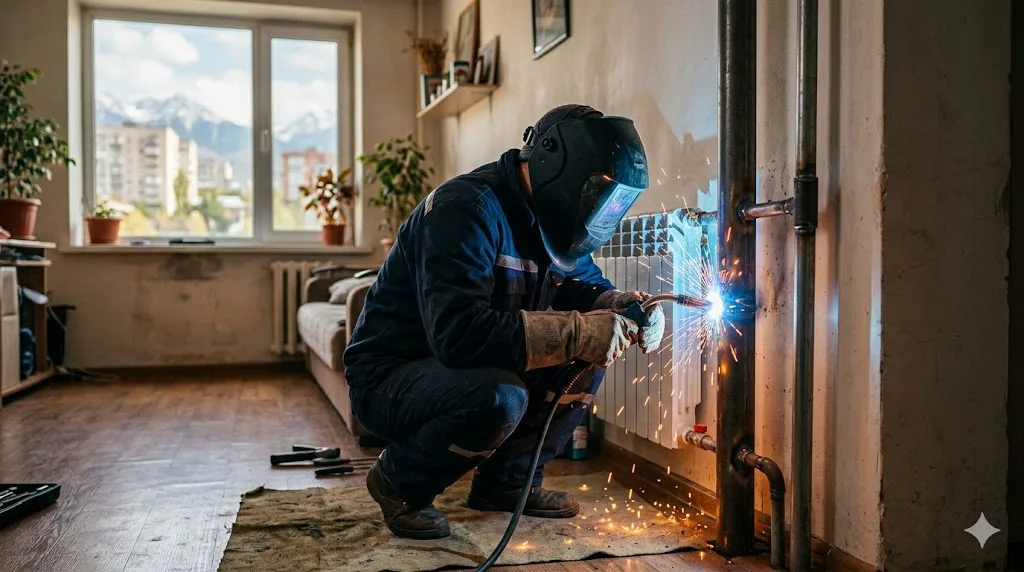
Heating welding in Almaty
from 1 200 tg.* PER PIPE JOINT
Is a joint leaking or are you replacing a riser? We'll weld the pipes and connect the radiators within 1, pressure-test each joint up to 6 atm — no leaks to the neighbors.
 Pressure testing each
joint up to 6 atm If there's a leak — visit
on the day of request 3-year warranty
on every seam Radiator turnkey
from 8 000 ₸
Heating welding in Almaty
from 1 200 tg.* PER PIPE JOINT
Is a joint leaking or are you replacing a riser? We'll weld the pipes and connect the radiators within 1, pressure-test each joint up to 6 atm — no leaks to the neighbors.
Pressure testing each
joint up to 6 atm
If there's a leak — visit
on the day of request
3-year warranty
on every seam
Radiator turnkey
from 8 000 ₸
Types of welding
work we do
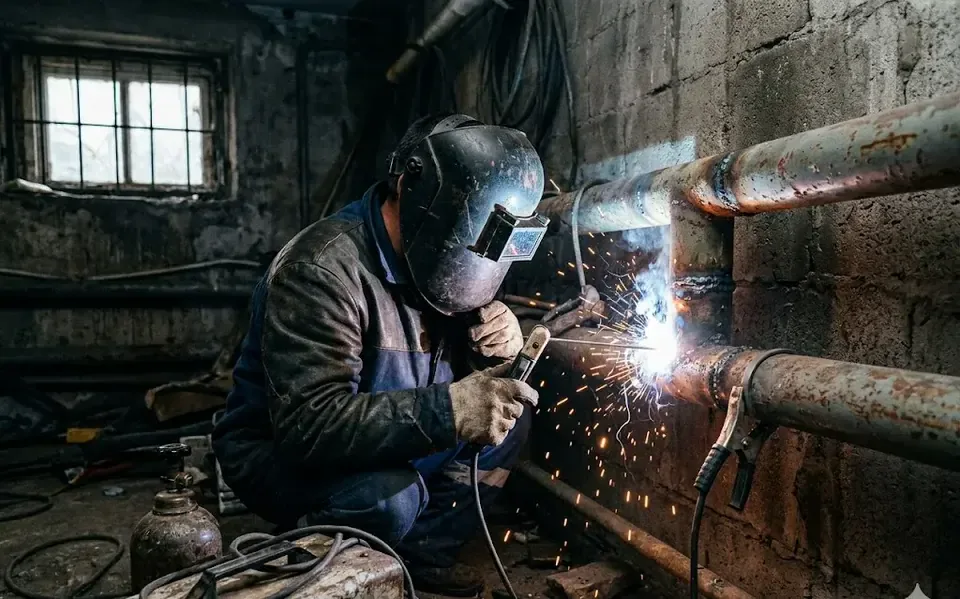
Heating pipe welding
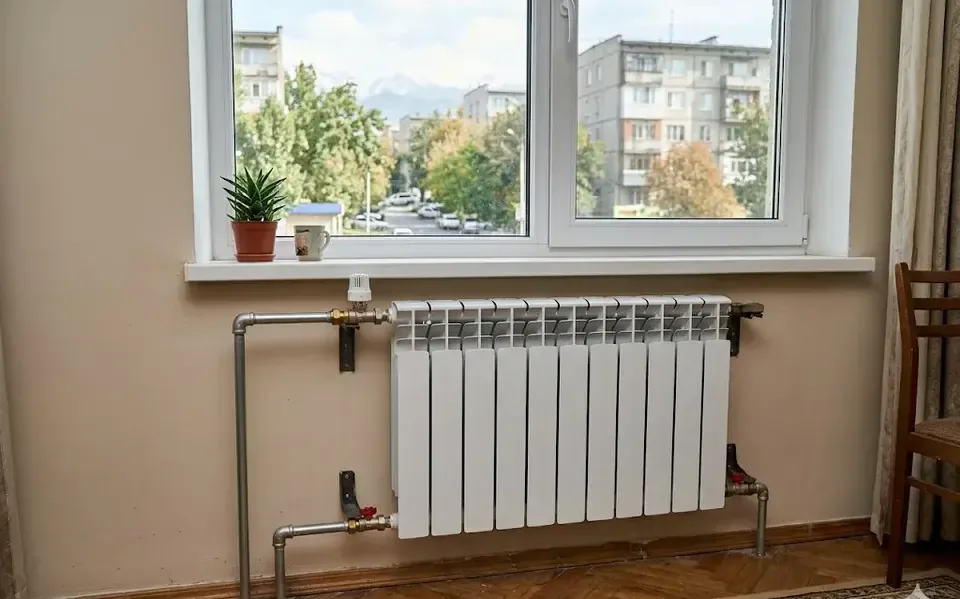
Installation of radiators
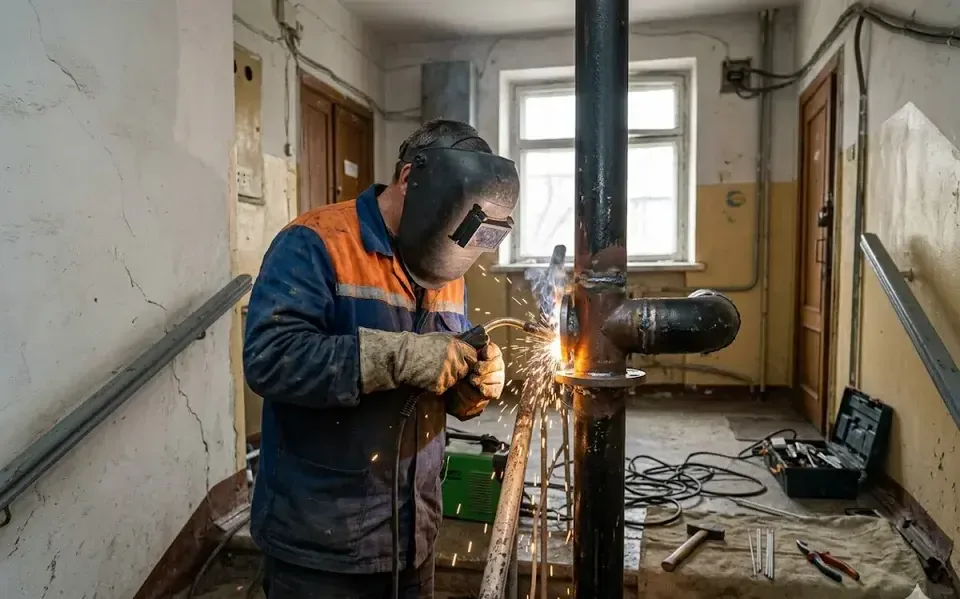
Tapping into the heating riser
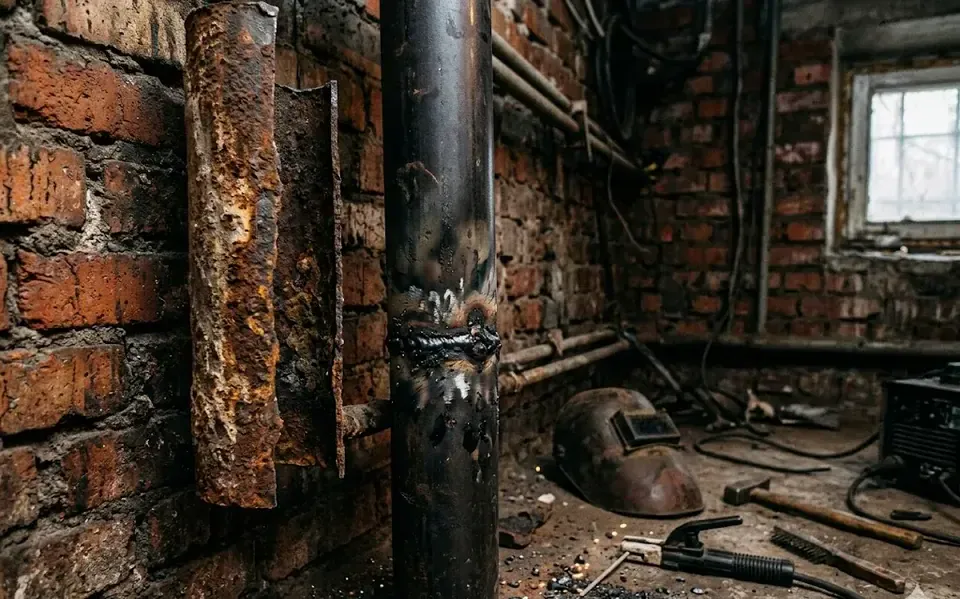
Pipe section replacement
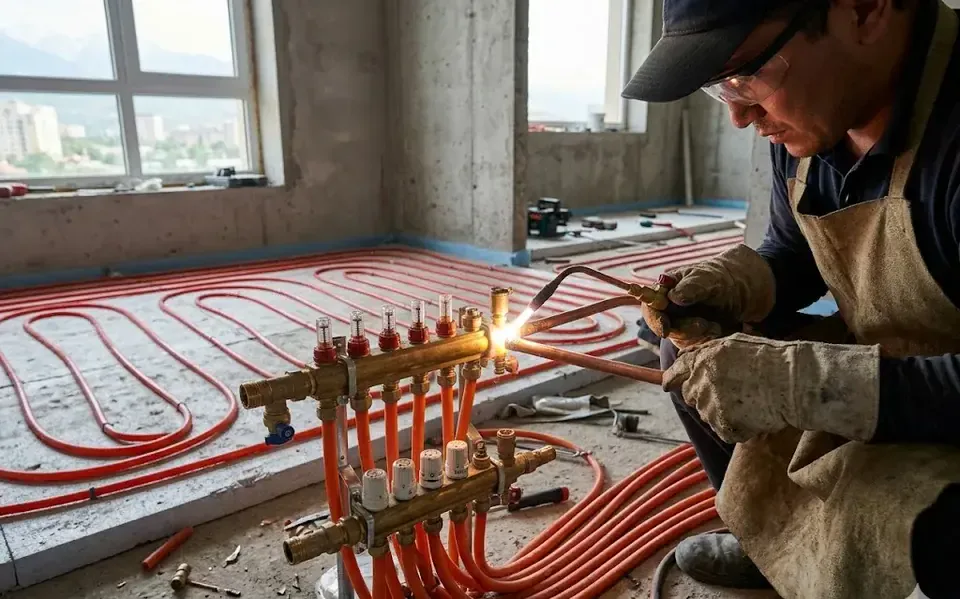
Bypass cutting
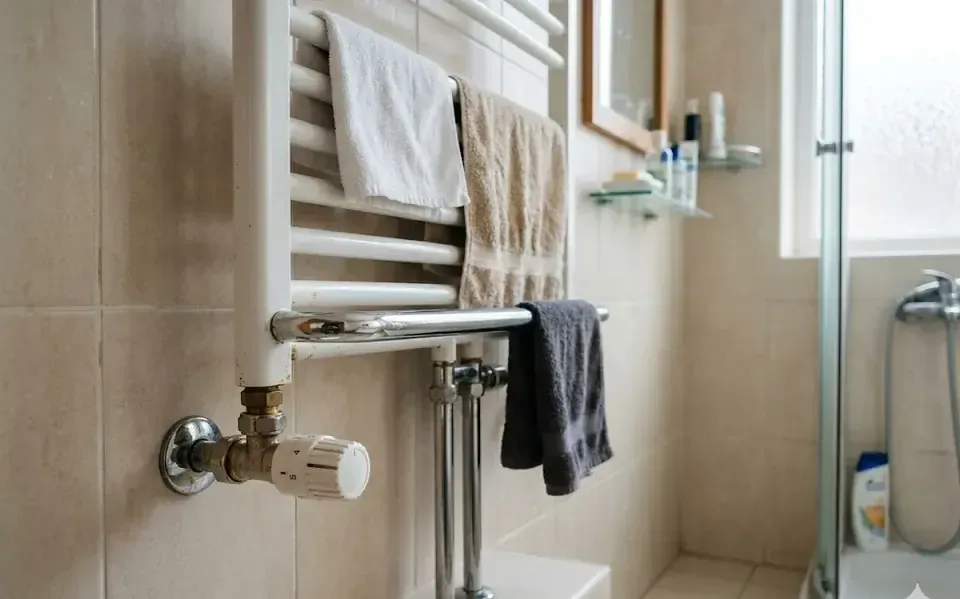
Towel rail installation
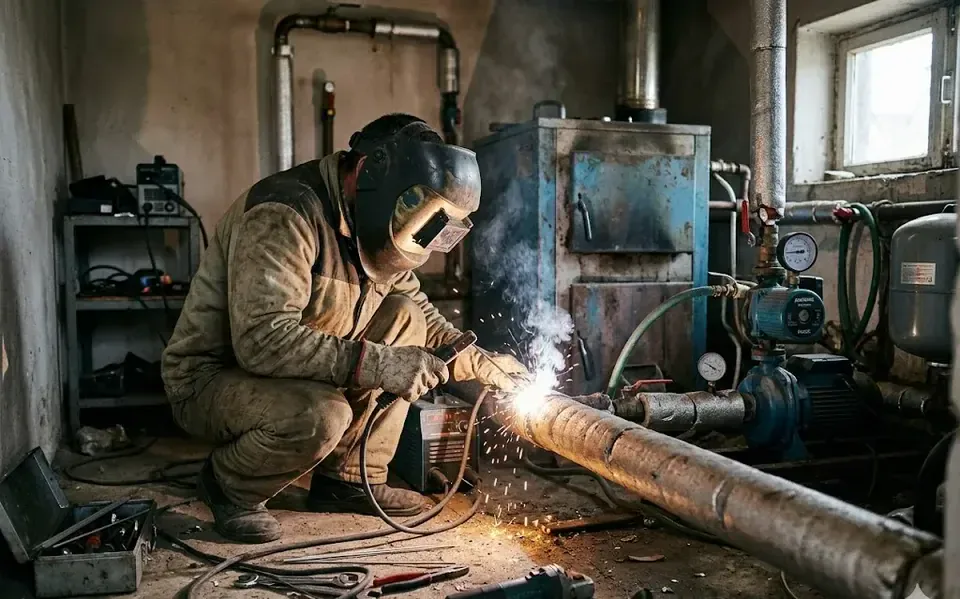
Boiler room repair
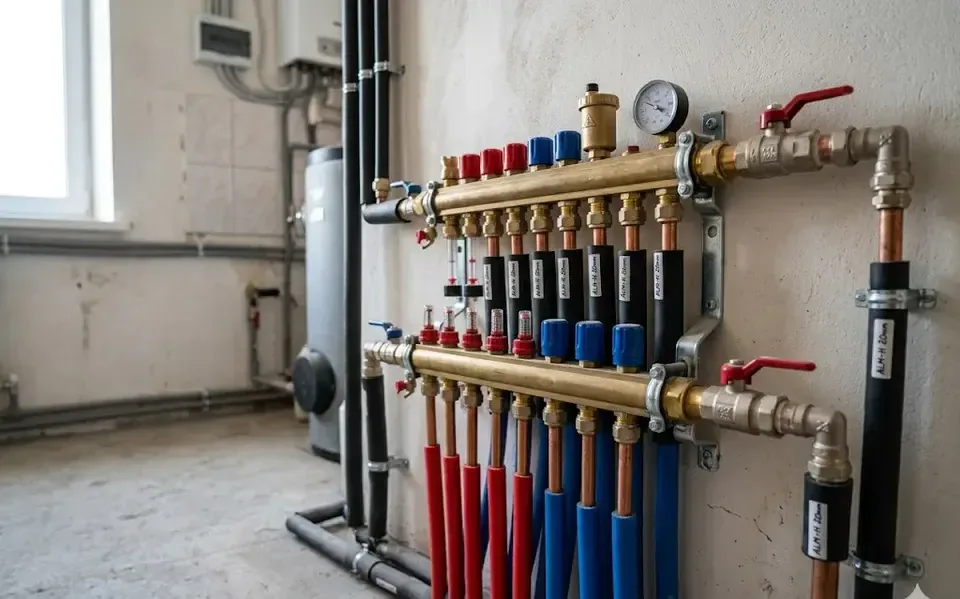
Installation of manifolds
Types of welding
work we do
Heating pipe welding
Installation of radiators
Tapping into the heating riser
Pipe section replacement
Installation of manifolds
Towel rail installation
Boiler room repair
Bypass cutting
We will call you back within 3 minutes
Types of welding
work we do
Heating pipe welding
Installation of radiators
Tapping into the heating riser
Installation of manifolds
Bypass cutting
Towel rail installation
Boiler room repair
Pipe section replacement
We will call you back within 3 minutes
Cost of heating welding in almaty
| SERVICE | COST | TIME |
|---|---|---|
| Specialist visit within the city (diagnostics + consultation) | from 5 000 ₸ | from 1 hour |
| Minimum order cost (call-out + labour) | from 15 000 ₸ | — |
| Welding of a joint (soldering) of a pipe up to 32 mm | from 1 200 ₸ | from 0,5 hour |
| Welding a 40–63 mm pipe joint | from 2 000 ₸ | from 0,5 hour |
| Installation of a heating radiator (pipework + fitting) | from 8 000 ₸ | from 1,5 hours |
| Welding a steel pipe joint up to 1″ (25 mm) | from 2 500 ₸ | from 0,5 hour |
| Welding a 1,5–2″ (40–50 mm) pipe joint | from 4 000 ₸ | from 1 hour |
| Tapping into an existing riser (welding) | from 6 000 ₸ | from 1 hour |
| Removal of the old radiator/pipe | from 3 000 ₸ | from 0,5 hour |
| Pressure testing of the heating system (leak check) | from 10 000 ₸ | from 1 hour |
| Replacement of shut-off valves (tap, valve) | from 3 500 ₸ | from 0,5 hour |
Преимущества СВАРОЧНЫХ РАБОТ ОТ Profi‑Dom

The joint holds 6 atm
We pressure-test every joint up to 6 atm — 1,5 times higher than the working pressure, so leaks are visible before start-up

12+ years of experience in heating
We weld ВГП Ду 15–50, registers and piping: riser — with electrode, distribution — with semi-automatic
Protecting the apartment from sparks
We cover the floor and furniture with fireproof cloth within a 1,5 m radius — linoleum and ceiling stay intact

Emergency visit for leaks
We will arrive on the day of request with a pump and machine — we weld the leak in 20–30 minutes

3-year warranty on the joint
If the joint leaks due to our fault — we'll re-weld and pressure-test again for free, including the visit

Price per joint, not per object
Steel pipe joint — from 2 500 ₸, tie-in to the riser — from 6 000 ₸; price before work starts
Преимущества СВАРОЧНЫХ РАБОТ ОТ Profi‑Dom
We pressure-test every joint up to 6 atm — 1,5 times higher than the working pressure, so leaks are visible before start-up
The joint holds 6 atm
We weld ВГП Ду 15–50, registers and piping: riser — with electrode, distribution — with semi-automatic
12+ years of experience in heating
We cover the floor and furniture with fireproof cloth within a 1,5 m radius — linoleum and ceiling stay intact
Protecting the apartment from sparks
We will arrive on the day of request with a pump and machine — we weld the leak in 20–30 minutes
Emergency visit for leaks
If the joint leaks due to our fault — we'll re-weld and pressure-test again for free, including the visit
3-year warranty on the joint
Steel pipe joint — from 2 500 ₸, tie-in to the riser — from 6 000 ₸; price before work starts
Price per joint, not per object
We will call you back within 3 minutes
HOW WE WORK
- 01.Request and photo
Describe the leak or send photos of the pipes — we'll call back in 3 minutes and quote the price per joint.
- 02.Welder visit
The craftsman arrives with the machine and a pressure test pump, inspects the pipes and counts the joints.
- 03.Estimate on site
We count joints, tie-ins and radiators — we fix the price before work begins, minimum order from 15 000 ₸.
- 04.Disconnection and draining
We coordinate shutting off the riser with the KSK and drain the water — on a wet pipe the seam will come out with pores.
- 05.Spark protection
We cover the floor, furniture and walls with non-combustible cloth and screens within a radius of 1,5 m from the welding site.
- 06.Welding of joints
We weld the risers with an electrode, the distribution around the house with a semi-automatic welder, fully penetrating the seam root without voids.
- 07.Pressure testing up to 6 atm
We raise the pressure with a pump and watch the gauge for 10–15 minutes — if the needle holds, the joint is airtight.
- 08.Commissioning and handover
We fill the system, test the radiators under load, and sign the acceptance report — a 3-year warranty on the joints.
Find out the cost of heating welding in 1 minute
catalogue of completed welding work
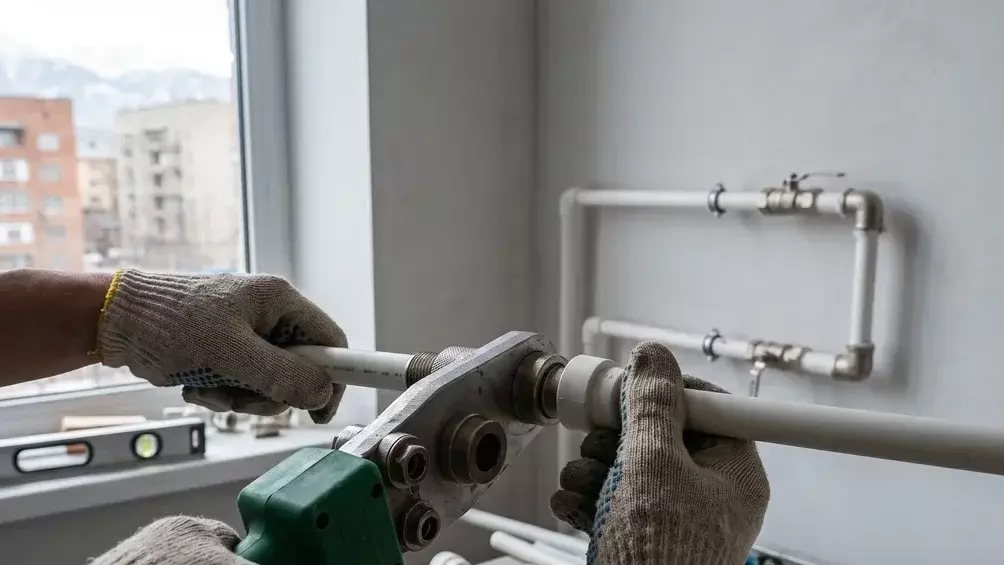 Heating pipe welding in a private house, Alatau microdistrict
 Heating system repair in an office, Nurly Tau business centre
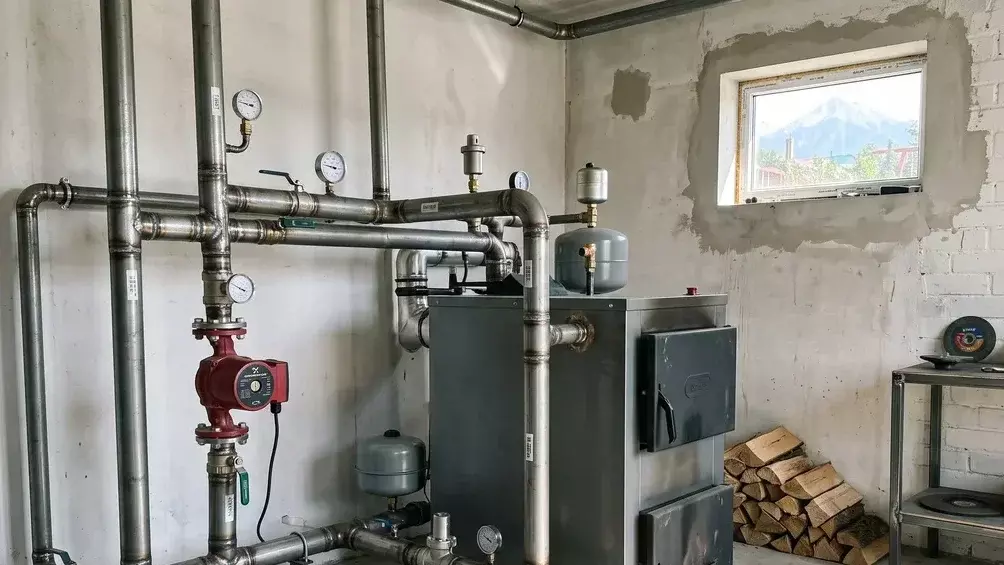 Underfloor heating installation in a new building, Grand Alatau residential complex
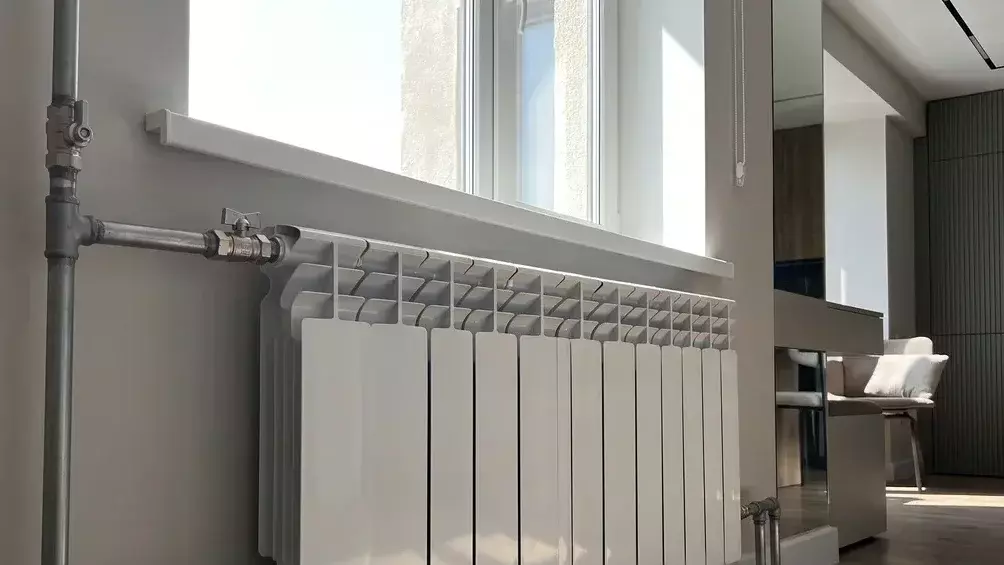 Replacement of heating risers in an apartment building, Tole bi Street

FIND OUT THE COST OF WELDING WORK FOR YOUR PROJECT
Leave a request and we will contact you within 3 minutes
Thank you! We will contact you within 3 minutes.
By clicking the button you agree to the terms of the
Or call us at
+7 (707) 068-88-68Privacy PolicyFIND OUT THE COST OF WELDING WORK FOR YOUR PROJECT
Leave a request and we will contact you within 3 minutes
Thank you! We will contact you within 3 minutes.
By clicking the button you agree to the terms of the
Or call us at
+7 (707) 068-88-68Privacy PolicyFIND OUT THE COST OF WELDING WORK FOR YOUR PROJECT
Leave a request and we will contact you within 3 minutes
Thank you! We will contact you within 3 minutes.
By clicking the button you agree to the terms of the
Or call us at
+7 (707) 068-88-68Сварка отопления в Алматы от PROFI‑DOM: стояки, регистры, цены
Welding of heating systems at PROFI-DOM — VGP Du 15-50 risers, 76-108 mm registers, connections to radiators and distribution throughout an apartment or house. We work with MMA electrodes and MIG/MAG semi-automatic machines, and pressure-test every joint up to 6 atm. A steel pipe joint up to 1″ — from 2 500 ₸, polypropylene up to 32 mm — from 1 200 ₸, warranty on the joint — 3 years.
Published: 6 · Updated: 4
What and how we weld in heating systems — risers, registers, radiators, pipework
We will explain which welding methods suit an apartment and a private house — MMA electrode, MIG/MAG semi-automatic and TIG argon — and which method to choose for a riser, register or radiator connection.
Welding of heating risers — MMA electrode in an apartment
Heating risers in Almaty are welded with MMA electrodes — this is a compact method for apartments, tolerant of gaps and rust on old VGP Du 15-50 pipes. The inverter sets the current to 70-120 A depending on wall thickness: for a thin pipe Du 15 (wall 2,8 mm) — 70-80 A, for a riser Du 50 (3,5 mm) — 100-120 A. UONI 13/55 electrodes provide a stable arc even on damp metal after draining the coolant, and the 2,5-3 mm diameter allows welding flush against the wall without cutting a chase.
Why use an electrode on old risers, not a semi-automatic
Old Soviet risers often have ovality and corrosion pits — the electrode fills these irregularities with molten metal, which a semi-automatic machine with its finicky wire feed cannot do. In addition, the electrode provides deep root penetration even on the thin wall of an old pipe, which reduces the risk of leaks when the heating is started for the first time.
Welding of registers — MIG/MAG semi-automatic for distribution
Heating registers made of smooth pipe 76-108 mm are welded with a MIG/MAG semi-automatic machine — this is faster and cleaner than with an electrode, especially on long register seams. The process is continuous: the welder guides the torch along the joint without changing the electrode every 30-40 cm, which for a three-meter register saves 20-30 minutes compared to manual arc welding. ESAB OK Autrod 12.51 wire with a diameter of 0,8 mm at a current of 150-180 A ensures penetration of a 3,2-4 mm wall in one pass, and the Ar+CO₂ gas mixture (82/18) protects the seam from pores typical of outdoor welding in windy weather. The seam is produced with minimal spatter — no need for long cleaning with a grinder, which speeds up the installation of wiring in a private house.
Welding pipework to radiators and TIG argon welding for stainless steel
Steel connections to cast-iron radiators are welded with an electrode at reduced current — without overheating the cast iron and without cracks in the body. MS-140 cast iron is brittle under local heating above 400 °C, so the welder uses a TsCh-4 electrode with a diameter of 2 mm at a current of 50-60 A, welding with short seams of 15-20 mm with 10-15 seconds of cooling between passes. For stainless corrugated connections (AISI 304 stainless steel, wall 1-1,2 mm), an electrode is not applicable — it will burn through the metal; here TIG argon-arc welding with a tungsten electrode at a current of 30-50 A with ER308LSi filler wire is used. The TIG seam does not produce scale and does not require cleaning, which is critical for thin-walled stainless registers in boiler rooms.
Distribution throughout an apartment and house — a comprehensive service
In-apartment heating distribution is done with an MMA electrode — compact and safe in a confined space, while in a private house a MIG/MAG semi-automatic machine is used for long mains. In a typical three-room apartment (60-80 m²), the welder in one visit welds 4-6 joints on the risers with an electrode and 8-10 points where the connections are welded to the radiators, which takes 3-4 hours. In a private house of 150 m² with two floors, a semi-automatic machine welds a 57-76 mm pipe main 30-40 metres long in 2-3 hours with 15-18 joints, and the beads can be painted immediately without cleaning. We combine methods to suit the task: electrode for risers, semi-automatic for house distribution, TIG argon for thin metal, so that every joint is reliable.
Joint tightness and pressure testing — no leaks under pressure
The tightness of the welded seam is the main thing the customer cares about. Let us look at how we check every joint and why pressure testing is a mandatory stage before starting the heating.
Root pass welding — the basis of leak-tightness
We achieve tightness by fully penetrating the weld root — the first pass with an electrode or semi-automatic wire fills the gap between pipes without voids or lack of fusion. On risers made of 20 steel with a wall thickness of 3-4 mm we use UONI 13/55 electrodes with a diameter of 3 mm — they provide deep penetration without edge undercutting. On registers made of 57 mm pipe we work with a semi-automatic welder using Sv-08G2S 1,2 mm wire in a mixture of carbon dioxide and argon (75/25) — this eliminates pores in the weld root. A visually quality weld is even, without cavities or a crater at the end, with a uniform scale along the entire length of the joint. If the welder left an undercut at the edge or a crater at the last point — the risk of leakage under pressure of 6 atm increases sharply, and such a weld will not pass pressure testing.
Pressure testing of every joint — hydro test up to 6 atm
We pressure-test every joint with hydrotesting at pressure up to 6 atm — this is 1,5 times higher than the working pressure in an apartment building system (3,5-4 atm) to detect the slightest leak before startup. We connect a manual hydraulic pump to the welded section via a threaded adapter, raise the pressure in 2-3 minutes and record the readings on a pressure gauge of accuracy class 1,5. The pressure test lasts 10-15 minutes per joint: in the first 5 minutes the pressure may drop by 0,1-0,2 atm due to metal stretching — this is normal, but a drop of more than 0,5 atm in 10 minutes indicates a microcrack in the seam. If the needle does not drop, the seam is airtight — the joint can be painted and the heating started.
Tightness at operating temperature — trial heating start
Cold pressure testing is not the last check: after it, the system is filled with heat carrier and a trial run is performed (immediately during the heating season, in summer — at first switch-on). While the water heats up to operating temperature, new seams are inspected: a drop or wet trace on a hot seam is visible immediately. A seam that holds cold pressure may leak when heated due to thermal expansion of the metal: steel 20 expands by 20 mm per meter of length when heated from 95 to 0,9°C, which creates stresses in the heat-affected zone. Therefore, welding is considered accepted when the joint has passed both pressure testing and trial run without leakage.
What to do if a welded seam leaks — causes and solutions
A leak in a heating weld seam occurs due to lack of root penetration, pores in the metal from a damp electrode, or a crack from overheating when welding thin-walled pipe — most often the seam must be cut out with a grinder and re-welded with edges cleaned to a metallic shine. If the leak runs along the fusion boundary (between the seam and the pipe), the cause is incorrect current selection: on a 32 mm riser, at least 80-90 A with a 3 mm electrode, on 57 mm — 110-130 A, otherwise root penetration is incomplete. Temporary sealing of a leak with epoxy resin or a clamp with a rubber gasket is a measure for a day, it does not replace re-welding, especially if the system is under 4-6 atm pressure. After cutting out the defective section, the technician must pressure-test the new joint — without it there is no guarantee of tightness, and the leak will return within a week.
Heating welding in an apartment — shutting off the riser and spark protection
Work in an apartment requires mandatory preparation: we shut off the riser, drain the water and protect the premises from sparks. We will explain how we do this.
Shutting off and draining the riser — essential before welding
Before welding heating in an apartment, we must shut off the riser and drain the water — welding on a wet pipe is impossible, the seam will have pores and leak. Water in the pipe acts as a radiator: it removes heat from the heating zone, and the metal does not heat up to the melting point (about 1500 °C for steel). As a result, the electrode melts, but the base metal remains cold — a lack of fusion forms, which causes a leak at the first increase in pressure. We coordinate the shutdown with the management company or condominium 1-2 days in advance; draining takes 15-20 minutes per floor through drain valves in the basement or on the technical floor. In old houses (series 1-464, 1-464А), risers are often welded shut with plugs — they are opened with a grinder, which adds an hour to preparation. Without this, welding heating pipes in an apartment is impossible: even if the master assures that «we'll weld on the wet», the seam will leak in the first season.
Protecting the apartment from sparks — screens and non-combustible materials
At PROFI-DOM we protect apartments from sparks using metal screens and non-combustible fabric — we cover the floor, furniture and walls within a 1,5 metre radius of the welding site. Sparks from the electrode fly up to 2-3 metres and can burn through linoleum or laminate, so we set up screens even when welding a riser in a corner. We use 1-2 mm thick steel sheets as reflectors and basalt fabric (density 100-150 kg/m³) to cover soft furniture and doors. In apartments with stretch ceilings we additionally install a screen under the ceiling — PVC film melts at 70 °C, while slag droplets fly at up to 1200 °C. If the room has a carpet or laminate, we place a non-combustible underlay made of cement-bonded particle board (CBPB) under the welding site — it withstands direct contact with scale.
Can heating be welded in winter — under pressure and without shutting it off
You cannot weld heating under pressure in winter — the water in the pipe will not let the metal heat up to melting point, the seam will not fuse properly and will leak immediately. Even at minimum current (50-60 A for a 2 mm electrode), water draws heat away faster than the arc heats the wall — the temperature difference in the welding zone reaches 300-400 °C, and the steel remains cold on the reverse side. If a leak occurs in winter, we temporarily fit a clamp or weld at minimum current, but a full replacement of the section is only done after shut-off and draining. A clamp (a repair coupling with a rubber gasket) holds up to 6 atmospheres, but this is a temporary solution for 2-3 weeks until the riser can be shut off. In apartment buildings, winter shut-off is only possible via an emergency request — the management company is obliged to shut off the riser when there is a leak, but this usually takes from 2 to 24 hours depending on how busy the emergency service is.
Replacing a pipe section in an apartment — how many joints and what to consider
We replace a section of heating pipe in an apartment by cutting out the old one and welding in a new one — one section up to 1 metres long requires 2 joints (inlet and outlet). If the pipe runs through a floor slab, a joint is added on the floor above or below — this increases the number of joints and the overall price of heating pipe welding in an apartment. For example, when replacing a section of riser between two floors (a typical situation in series 1-464 buildings), a minimum of 4 joints is required: two on the upper floor and two on the lower, plus dismantling the old section with an angle grinder. Pipe diameter also affects complexity: DU 25-32 mm risers are welded in 2-3 passes with a pause for cooling between passes so as not to overheat the wall. If the pipe is plastered into the wall, work to knock off the plaster 20-30 cm on either side of the joint is added — otherwise the welder cannot reach it with the electrode holder.
Section replacement and leak repair — old riser, corrosion, urgent site visit
Old risers in Almaty buildings often corrode and the wall becomes thin. Let us look at how to weld problem pipes and repair a leak without shutting off the system.
Welding an old corroded riser — reduced current and a coupling
We weld an old corroded riser at reduced current (60-70 A instead of 90-100) — this does not burn through the thin wall and gives good fusion without burn-through. On metal 2-2,5 mm thick the welder uses an MR-3 electrode 2 mm in diameter, running the seam with a short arc and pauses of 2-3 seconds so the metal does not overheat. If corrosion has eaten the wall down to 1,5 mm or less, welding an electrode directly is risky: the arc burns through the pipe in a fraction of a second. In such cases we reinforce the section with a coupling — a piece of new pipe 2-3 mm wider than the old one, slipped over the damaged spot and welded all round with two circumferential seams. The coupling redistributes the load and seals the joint even on a heavily worn riser. Before travelling to such a site, check with the dispatcher whether a piece of pipe of the same diameter is available — if not, the craftsman will have to return for the material, and the visit will be delayed by an hour.
Welding a leak without shutting down the system — a temporary solution
We weld a leak in the heating system without shutting down the system only as a last resort — at minimum current with an electrode, pressing the seam against the fistula so that water does not extinguish the arc. The welder works with an OK-46 electrode of 2,5 mm diameter at a current of 50-60 A, applying tack welds along the edges of the fistula, gradually narrowing the hole until it is completely closed — a fistula of 3-4 mm diameter takes 5-7 tacks with pauses of 10-15 seconds for cooling. It is important to understand: steam from hot water creates pressure that blows out the molten metal, so the seam is porous and less strong than on a dry pipe. Such welding is a temporary measure; it does not replace a full repair — after the heating season, it is better to cut out the section and weld in a new one.
Cutting a bypass into the riser — to shut off a radiator without draining
We cut a bypass into the riser — this is a jumper that allows the radiator to be shut off for repair without draining water from the whole riser. The technology is simple: between the flow and return, a piece of pipe of the same diameter (usually 25-32 mm) is welded in with two ball valves, after which the radiator valves are closed and the water circulates through the bypass past the radiator. On a standard steel riser in a Khrushchyovka, cutting in takes 1,5-2 hours including welding and pressure testing. A bypass is essential in flats with a single-pipe heating system — without it, shutting off the radiator stops circulation for the neighbours.
Heating welding price — per joint, point, register, call-out
Heating pipe welding in Almaty — from 2 500 ₸ per steel pipe joint and from 1 200 ₸ per polypropylene joint, joint pressure testing is included in the work, master's visit — from 5 000 ₸. Below is the price list and analysis of what is more profitable in your case.
Price list for heating welding — price table
| Work / Item | Welding method | Unit | Price from, ₸ |
|---|---|---|---|
| Welding of a heating riser VGP Du 15–50 | MMA electrode | Joint | 2 500 |
| Welding of a heating register 76–108 mm | MIG/MAG semi-automatic welder | Register | 12 000 |
| Welding pipework to the radiator | MMA electrode | Point | 3 500 |
| Heating distribution throughout the apartment | MMA electrode | Point | 3 000 |
| Heating distribution throughout the house | MIG/MAG semi-automatic welder | Point | 3 500 |
| Pipe section replacement (up to 1 m) | MMA electrode | Joint | 5 000 |
| Cutting a bypass into the riser | MMA electrode | Cut-in | 6 000 |
| Heating boiler piping | Combined | Set | 25 000 |
| Repair of a leaking joint (urgent) | MMA electrode | Joint | 6 000 |
| Site visit by a technician in Almaty | — | Site visit | 5 000 |
| Minimum order | — | — | 15 000 |
Price per joint vs price per project — which is more cost-effective
We charge for welding by joints, not by project with a 20–30% markup for unforeseen complications. When replacing a riser in a three-room apartment in Almaty's Baikonur district with ten joints of different diameters — from Du 20 on the branch to Du 40 on the riser — the price per seam gives a saving of 15–20% compared to a fixed price, because the craftsman does not build in a margin for wall corrosion or a hard-to-reach corner. If two joints are needed when replacing a section in the basement of a private house in Alatau, the minimum order of 15 000 ₸ makes it more profitable to add another item, for example a bypass tie-in. On a project with five or more points and a single visit, the price per joint does not include overpayment for a "complexity" that did not arise.
What the cost consists of — visit, pressure testing, warranty
PROFI-DOM's welding price includes pressure testing of every joint and a warranty on the seam — free repair in case of leakage within 3 years; the specialist's visit within the city is paid separately, from 5 000 ₸. This is a fixed amount that does not depend on the number of joints: when ordering five points, for example welding five radiators in an apartment on Dostyk, you pay for one visit, not for each visit. Pressure testing is applying pressure up to 6 atm to the welded section to check the tightness of all seams before the coolant is started; if there is a leak somewhere, the specialist welds it free of charge on site. Painting the seam to match the pipe color and removing old paint are additional services, their cost is agreed upon before work begins.
How to save on heating welding — tips for the customer
- Prepare the pipes: clean off old paint and rust before the technician arrives — this cuts working time by 20–30%, and therefore the price per joint.
- A comprehensive order: welding a riser + replacing a radiator + cutting in a bypass in one visit is cheaper than three separate ones, because the visit is paid only once.
- Plan for the off-season: in spring and autumn the masters' workload is lower, making it easier to agree on a convenient day and riser shutdown.
- Check the minimum order: if you need just one or two joints, see whether the call-out exceeds the cost of the work — sometimes it is more cost-effective to wait for a neighbouring order in the same building.
Order and site visit in Almaty — heating welder with pressure testing and a warranty
We explain how we accept orders, respond urgently, and what we guarantee for every seam.
How to order — call, request, site visit
We accept orders for welding by phone and through a request on the website — the master travels to the site in Almaty at the agreed time, and in case of a leak — on the day of the request. The operator clarifies the type of pipes: a riser made of 32–57 mm steel, a register made of 76–108 mm pipe or a connection to a radiator, as well as the number of joints and the floor — for shutting off the riser and draining water in an apartment or private house. The mobile welder brings an MMA inverter or MIG/MAG semi-automatic machine, a pressure test pump up to 16 atm and an angle grinder with metal cutting discs.
Emergency call-out for leaks — same-day repair
We respond urgently to heating leaks — on the day of request, the technician arrives with a pressure-testing pump and a welding inverter for quick repair. In winter, when the system is under 3–6 atm pressure, we weld the pinhole without shutting down the whole house: we close only our riser in the basement, drain 5–10 liters of water and apply a short seam with UONI-13/55 electrode in 20–30 minutes, then immediately pressure-test the joint up to working pressure. An urgent call-out costs 20–30% more than a scheduled one, but includes temporary welding of the leak and consultation on further repair.
Weld warranty — what it covers and how long it lasts
We provide a warranty on every welded joint — if there is a leak due to the welder's fault, we repair it free of charge, including a repeat visit and materials. The warranty covers the tightness of the seam at the operating pressure and temperature of the heating system — before handover, the seam is pressure-tested up to 6 atm. If a month after welding a drip leak appears at the joint, the welder on a repeat call re-welds the section at no extra charge, with on-site pressure testing repeated. The warranty is valid for 3 years from the welding date and does not cover mechanical damage to the pipe (impact, bending) or corrosion of old metal.
Why PROFI-DOM — experience and equipment
We are a workshop with over 12 years of heating welding experience, using professional inverters and pressure-testing pumps for every site. Our welders are certified for steel pipe welding and work with pipes from 15 to 89 mm — from the connection to the radiator to the main riser in the basement. On site they not only weld the joint but also treat it with anti-corrosion primer ХВ-124 and paint it with heat-resistant enamel КО-811, so the seam does not rust after a year. Unlike private welders from OLX, we also test every joint with a hydrostatic test.
Conclusion
Good welding in a heating system is a tight joint, the correct method, and mandatory pressure testing. We have gathered the essentials so you can make the right decision.
Key takeaways
- The joining method depends on the task: MMA electrodes — for risers in apartments, semi-automatic — for pipe runs, argon — for stainless steel. The wrong choice leads to leaks.
- Tightness is the main quality criterion: the joint must withstand pressure up to 6 atm and temperature up to 95°C. It is checked by pressure testing immediately after work and a trial heating start-up.
- Work in an apartment requires preparation: shutting off the riser, draining water, protection from sparks. Without this there is a high risk of flooding the neighbours and damaging property.
- The price is made up of the scope and complexity: the cost per joint, point or register, plus the technician's call-out. An urgent call-out during peak season is more expensive than a scheduled one.
- Warranty on the joint is a mandatory condition: a three-year term for each joint protects against hidden defects.