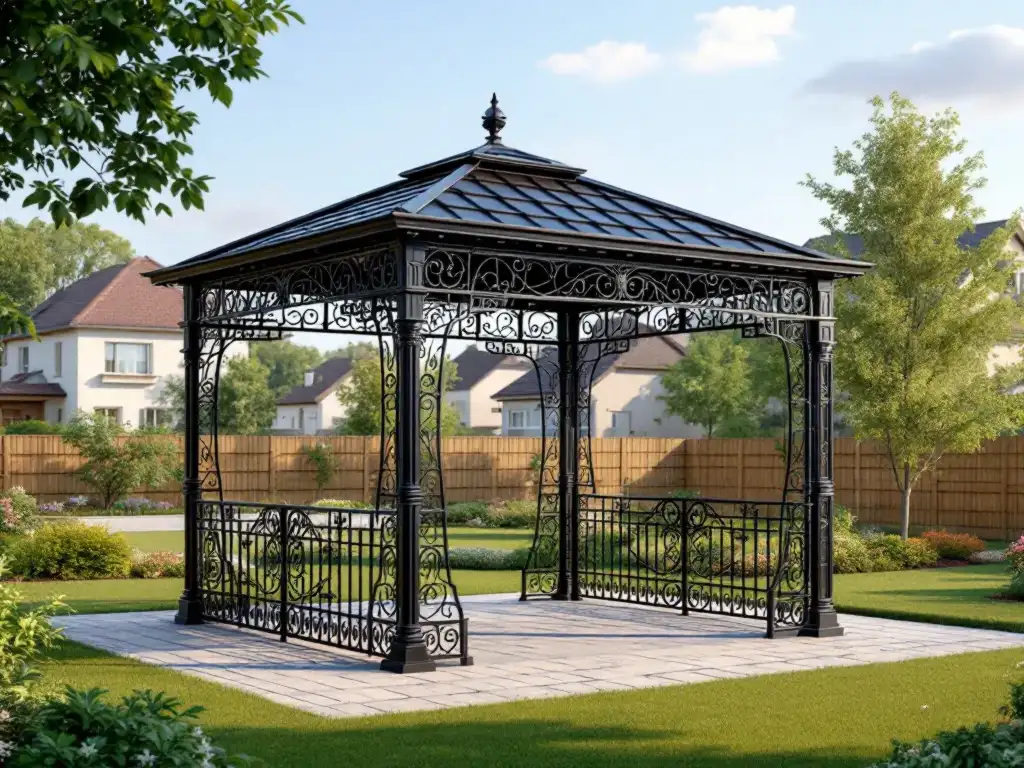
Forged gazebos in Almaty
Metal frame, cold forging, powder coating, and patina. Sketch in 24 hours, lead time 10–30 days — from 400 000 ₸
 Installation by our own crew, we make the frame and forging in our own workshop
 5-year guarantee on work with a written contract
 Gazebo sketch in 24 hours or a 5% discount on the entire order
 No intermediaries and savings up to 25%
Forged gazebos in Almaty
Metal frame, cold forging, powder coating, and patina. Sketch in 24 hours, lead time 10–30 days — from 400 000 ₸
Installation by our own crew, we make the frame and forging in our own workshop
5-year guarantee on work with a written contract
Gazebo sketch in 24 hours or a 5% discount on the entire order
No intermediaries and savings up to 25%
Find out the cost of a forged gazebo in 1 minute
Why a forged gazebo is ordered from us

Our own decor, not stamping
We bend scrolls, volutes, and torsion to your sketch and size rather than taking ready-made ones from a catalog. Stamped decor has thin metal and an identical pattern.

Forged gazebo
in 10–30 days
Canopy gazebo near the house and garden Ø3 m — 10–14 days, with openwork railing 3×4 m — 14–20 days, with hot forging and patina 4×4 m — 20–30 days.

Clean seams and grinding
We clean every joint down to smooth metal and remove scale and spatter. Under powder and patina, an uneven seam protrudes as a bump and spoils the entire forging pattern.

Rust protection
First degreasing and metal primer, then powder coating or hammer enamel. Patina — as a separate layer. Without primer, forging in Almaty rusts within a season.

Our own production
We weld the frame, bend the decor and paint in our own workshop, without intermediaries. Hence the price from 400 000 ₸, the term from 10 days and a 5-year warranty on the structure.

Calculation for snow and seismic loads
We calculate the roof load and reinforce the frame joints: Almaty is in a 9--point zone. We install the roof with a slope and drainage so snow doesn't press on the forging.
Why a forged gazebo is ordered from us
We bend scrolls, volutes, and torsion to your sketch and size rather than taking ready-made ones from a catalog. Stamped decor has thin metal and an identical pattern.
Our own decor, not stamping
Canopy gazebo near the house and garden Ø3 m — 10–14 days, with openwork railing 3×4 m — 14–20 days, with hot forging and patina 4×4 m — 20–30 days.
Forged gazebo
in 10–30 days
We clean every joint down to smooth metal and remove scale and spatter. Under powder and patina, an uneven seam protrudes as a bump and spoils the entire forging pattern.
Clean seams and grinding
First degreasing and metal primer, then powder coating or hammer enamel. Patina — as a separate layer. Without primer, forging in Almaty rusts within a season.
Rust protection
We weld the frame, bend the decor and paint in our own workshop, without intermediaries. Hence the price from 400 000 ₸, the term from 10 days and a 5-year warranty on the structure.
Our own production
We calculate the roof load and reinforce the frame joints: Almaty is in a 9--point zone. We install the roof with a slope and drainage so snow doesn't press on the forging.
Calculation for snow and seismic loads
We'll reply in 15 minutes
What we make forged gazebos from

The service life of a forged gazebo depends on the metal and corrosion protection. What we assemble from:
Profile pipe for the design load: posts, framing, roof joists. We weld the joints along the entire perimeter, not with spot welds, otherwise the frame will warp.
Frame
Forged decor
Rod and square, cold forging — curls, volutes, torsion, rings, baskets, spikes, balusters. One-off hot-forged elements — according to the sketch.
Coating
Primer for metal, then powder coating or hammer enamel. Patina gives a noble shade and an additional protective layer on the forging.

We design the forged gazebo for the plot: we look at the house, fence and plantings, select the forging pattern, metal color and roofing so that the gazebo reads as part of the yard, not standing separately.
We place the gazebo on concrete pillars or a slab with embedded parts and anchor the frame. The floor is paving tiles or decking boards. What this gives:
Posts leveled, anchoring to concrete
We clean and prime the joints, fasteners are hidden inside
Rigidity and geometry
What we make forged gazebos from
The service life of a forged gazebo depends on the metal and corrosion protection. What we assemble from:
Frame
Profile pipe for the design load: posts, framing, roof joists. We weld the joints along the entire perimeter, not with spot welds, otherwise the frame will warp.
Forged decor
Rod and square, cold forging — curls, volutes, torsion, rings, baskets, spikes, balusters. One-off hot-forged elements — according to the sketch.
Coating
Primer for metal, then powder coating or hammer enamel. Patina gives a noble shade and an additional protective layer on the forging.
Rigidity and geometry
We clean and prime the joints, fasteners are hidden inside
Posts leveled, anchoring to concrete
We place the gazebo on concrete pillars or a slab with embedded parts and anchor the frame. The floor is paving tiles or decking boards. What this gives:
We design the forged gazebo for the plot: we look at the house, fence and plantings, select the forging pattern, metal color and roofing so that the gazebo reads as part of the yard, not standing separately.
What we make forged gazebos from
The service life of a forged gazebo depends on the metal and corrosion protection. What we assemble from:
Frame
Profile pipe for the design load: posts, framing, roof joists. We weld the joints along the entire perimeter, not with spot welds, otherwise the frame will warp.
Forged decor
Rod and square, cold forging — curls, volutes, torsion, rings, baskets, spikes, balusters. One-off hot-forged elements — according to the sketch.
Coating
Primer for metal, then powder coating or hammer enamel. Patina gives a noble shade and an additional protective layer on the forging.
We place the gazebo on concrete pillars or a slab with embedded parts and anchor the frame. The floor is paving tiles or decking boards. What this gives:
We design the forged gazebo for the plot: we look at the house, fence and plantings, select the forging pattern, metal color and roofing so that the gazebo reads as part of the yard, not standing separately.
Rigidity and geometry
We clean and prime the joints, fasteners are hidden inside
Posts leveled, anchoring to concrete
Types of forged gazebos

Garden
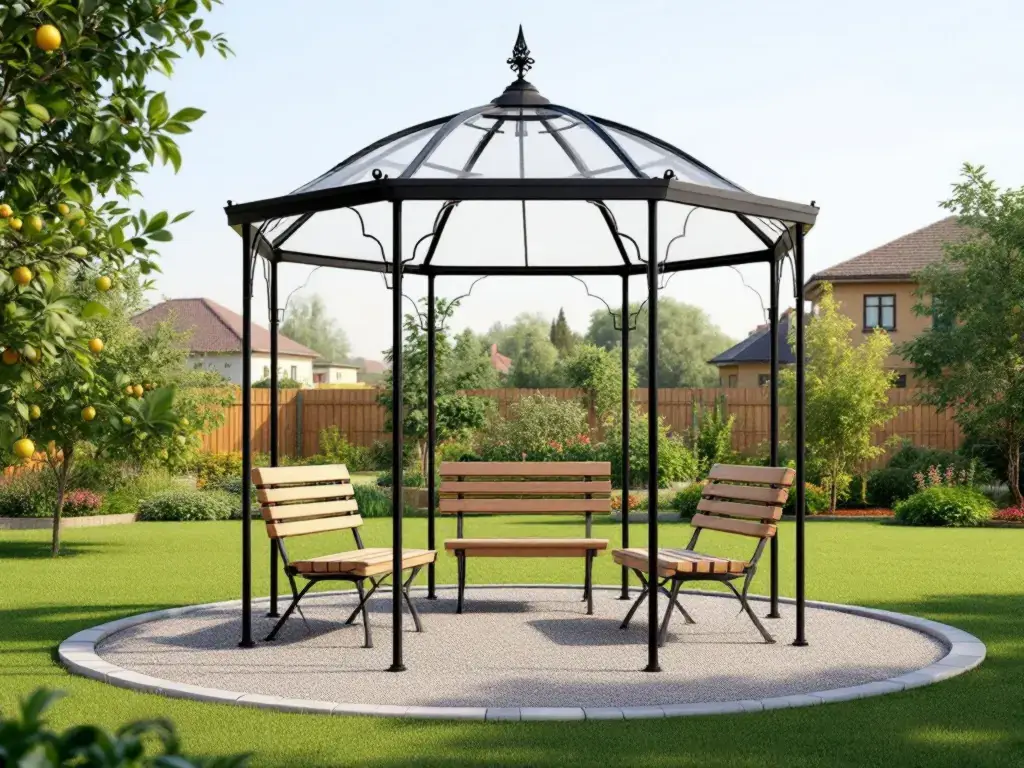
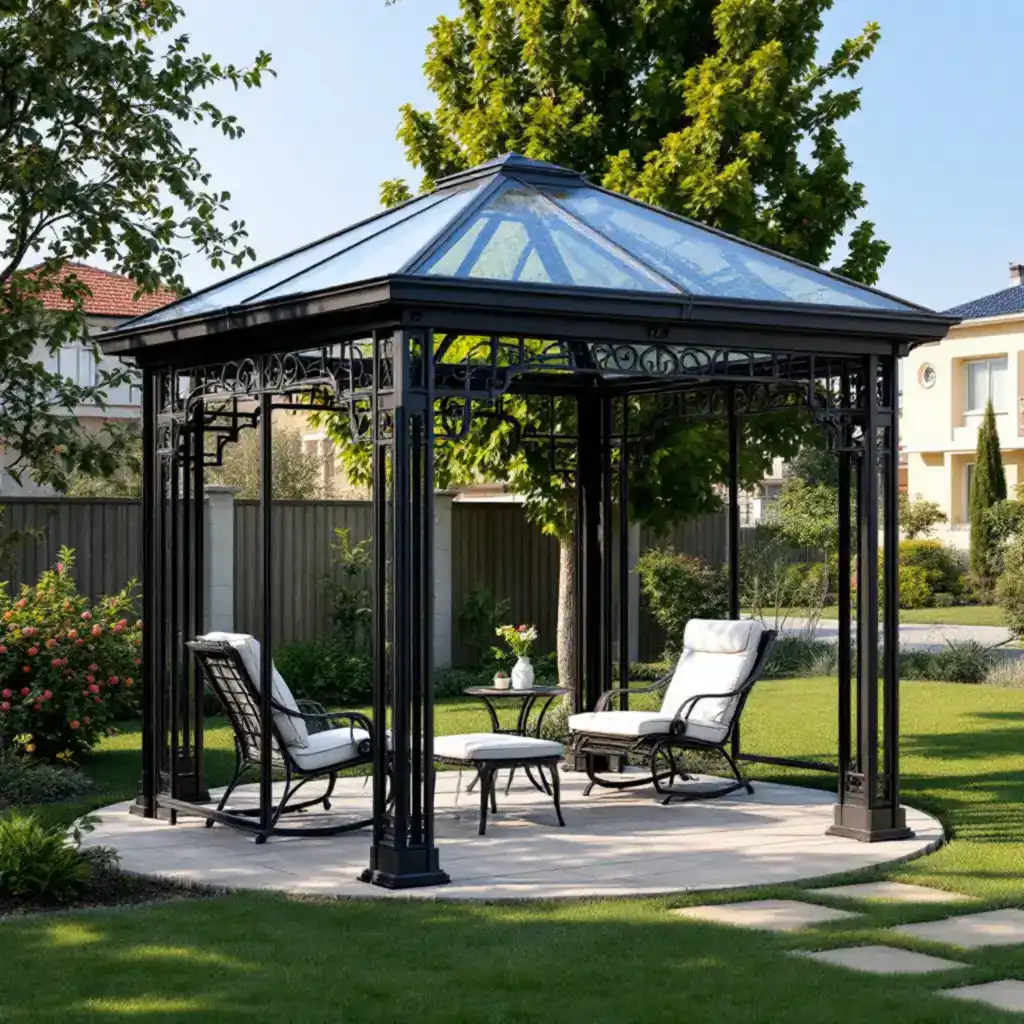
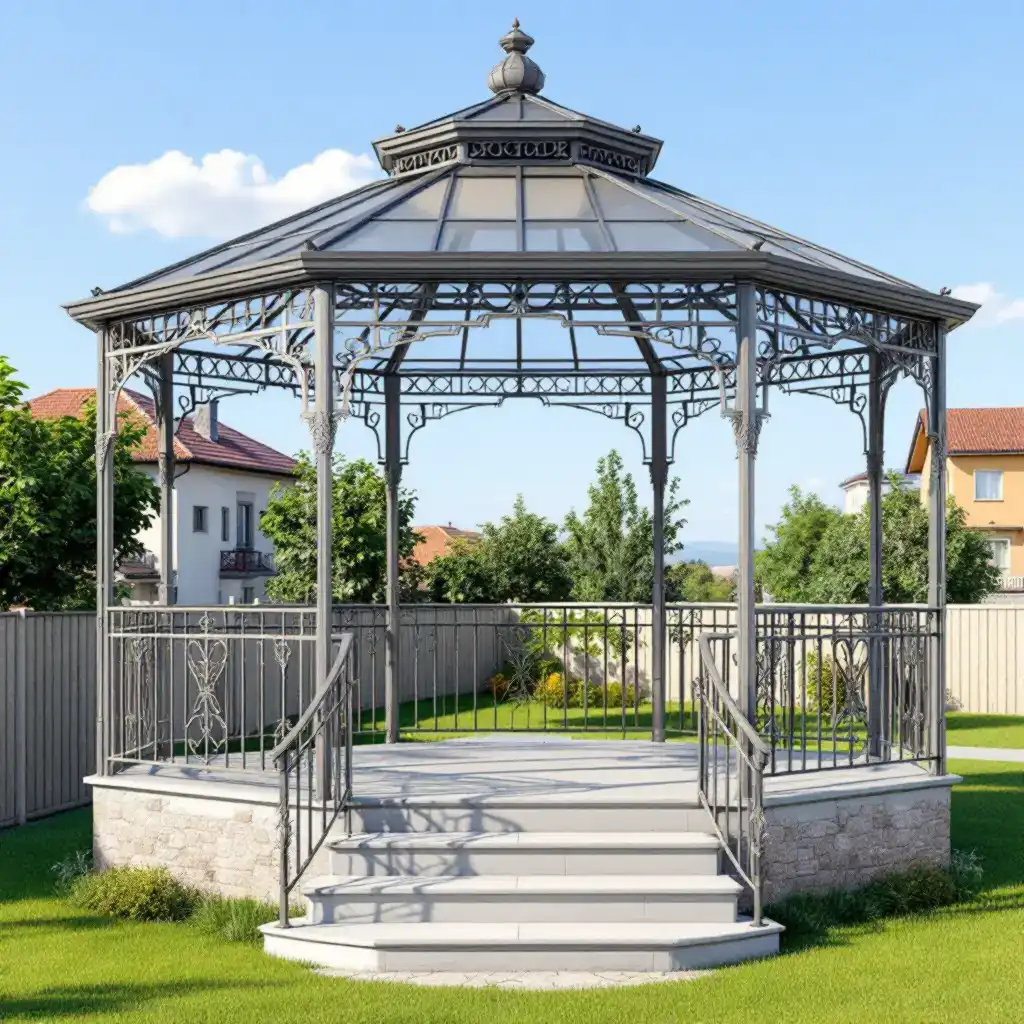
Light hexagonal gazebo Ø3 m: thin forged arches, polycarbonate dome, benches inside.

- From 480 000 ₸ for Ø3 m
- Timeframe 10–14 days
- Polycarbonate dome
Advantages:

Openwork
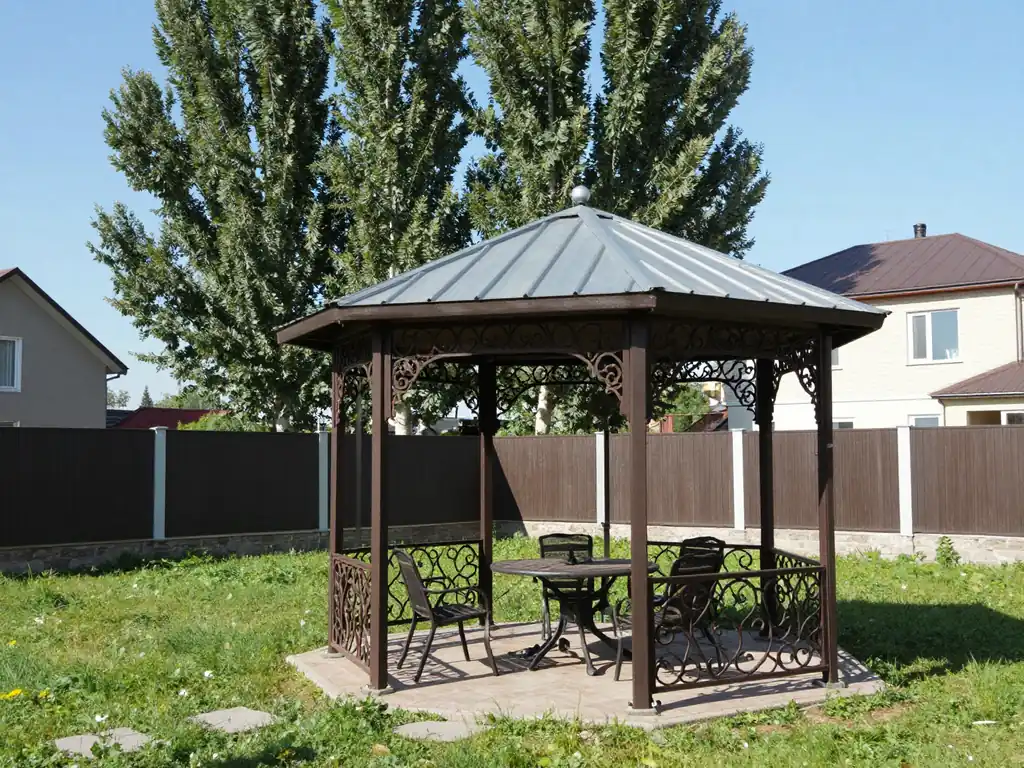
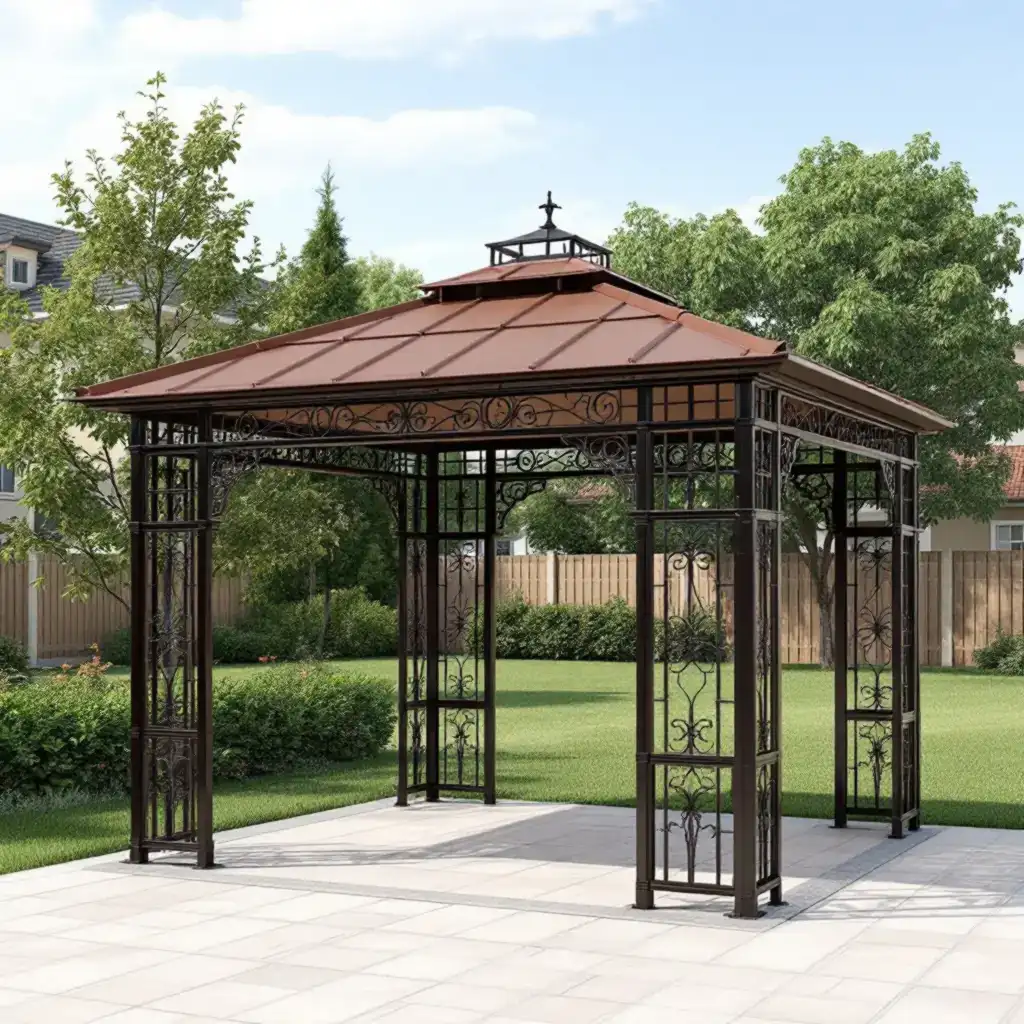
Gazebo 3×4 m with openwork forged fencing and metal roofing. The railings are part of the overall forging pattern.
- From 700 000 ₸ for 3×4 m
- Timeframe 14–20 days
- Forged railings around the perimeter
Advantages:

Canopy
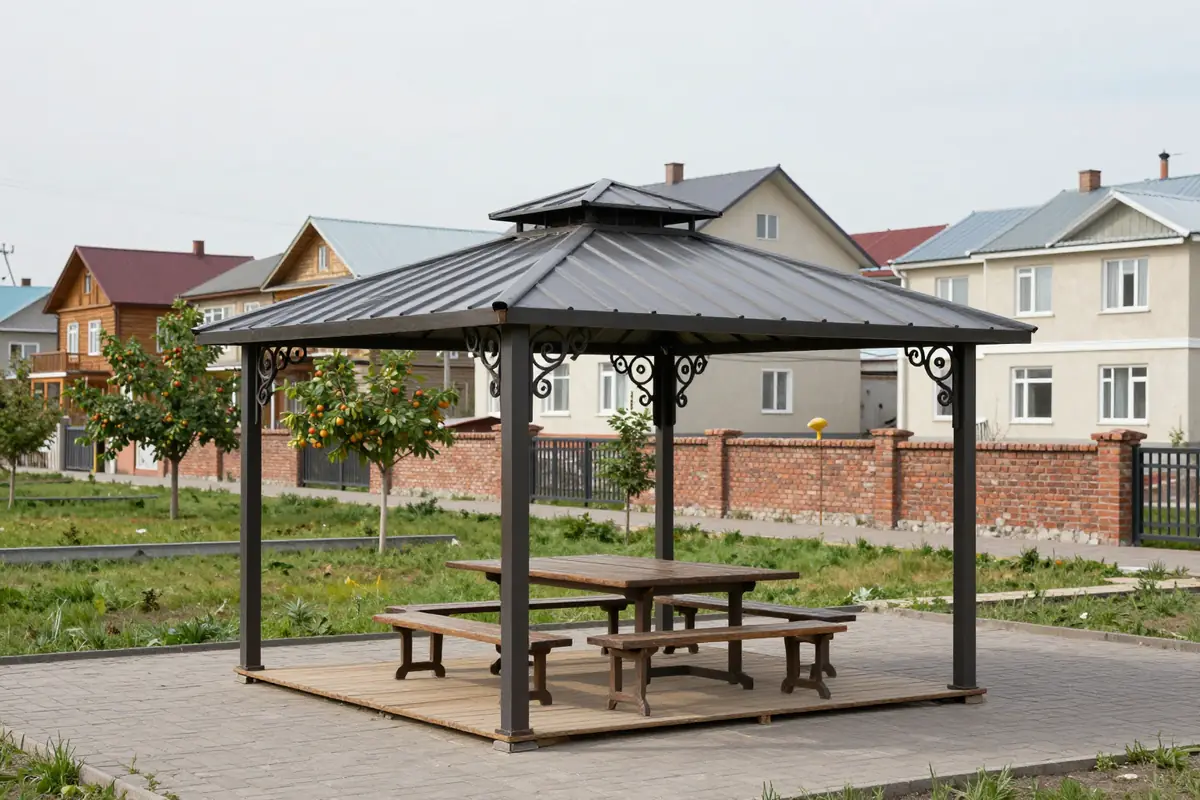
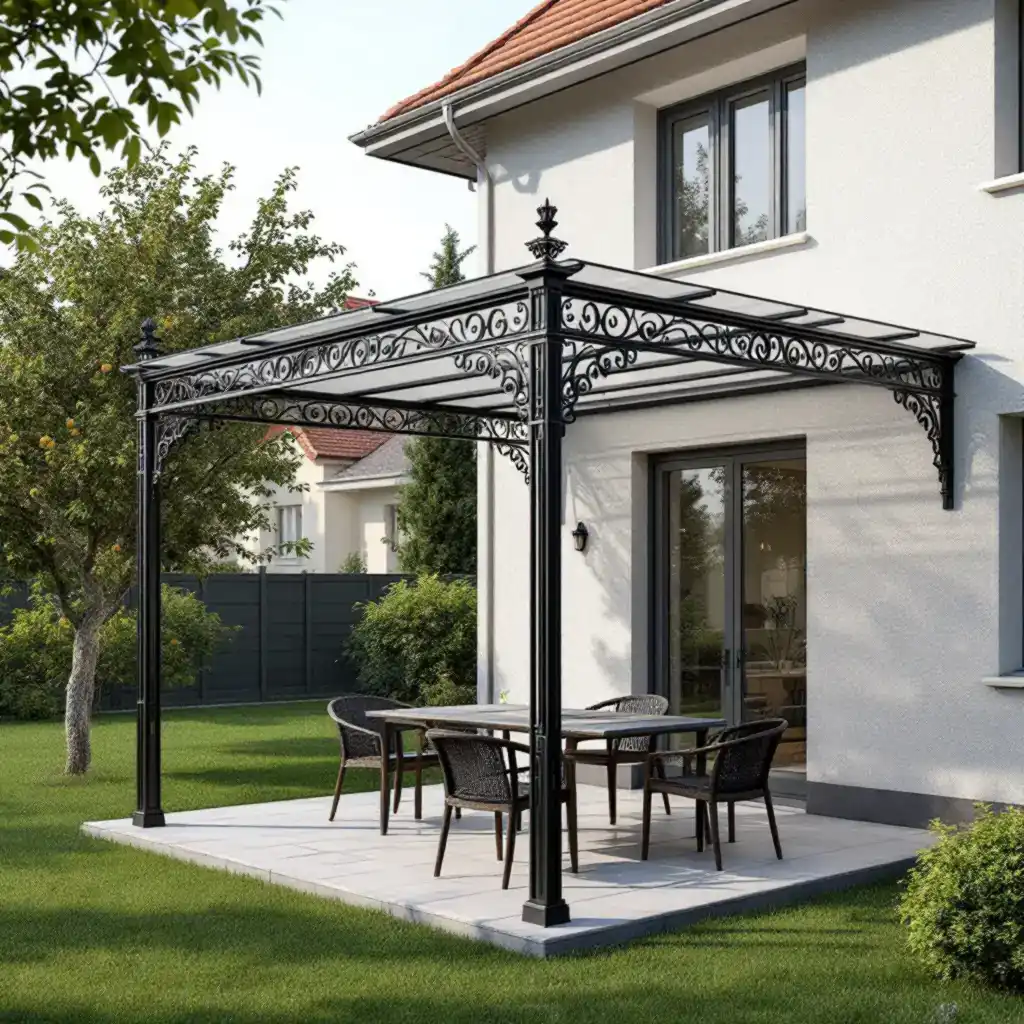
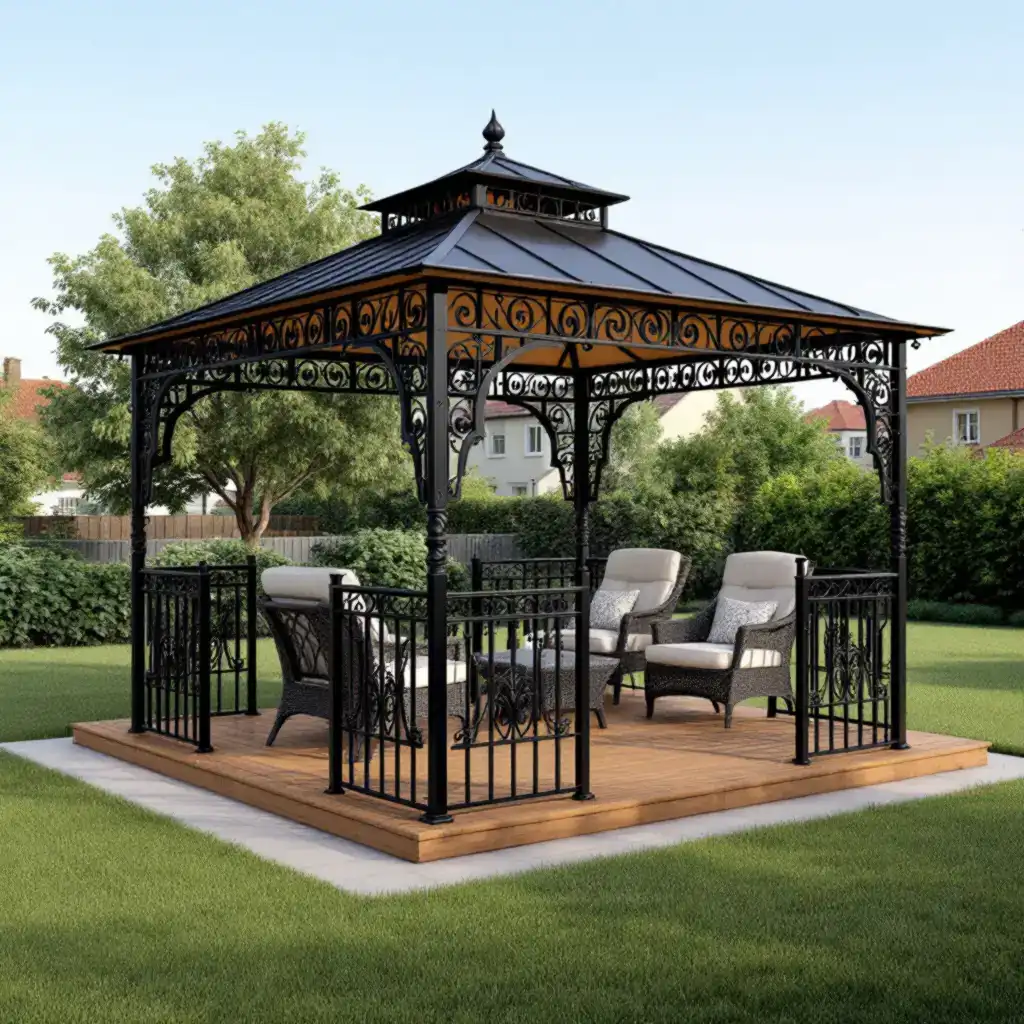
A 3×4 m canopy by the house: support on the wall or on its own posts, roofing made of polycarbonate or metal tiles.
- From 400 000 ₸ for 3×4 m
- Timeframe 10–14 days
- Wall-mounted or freestanding
Advantages:

Forging and wood
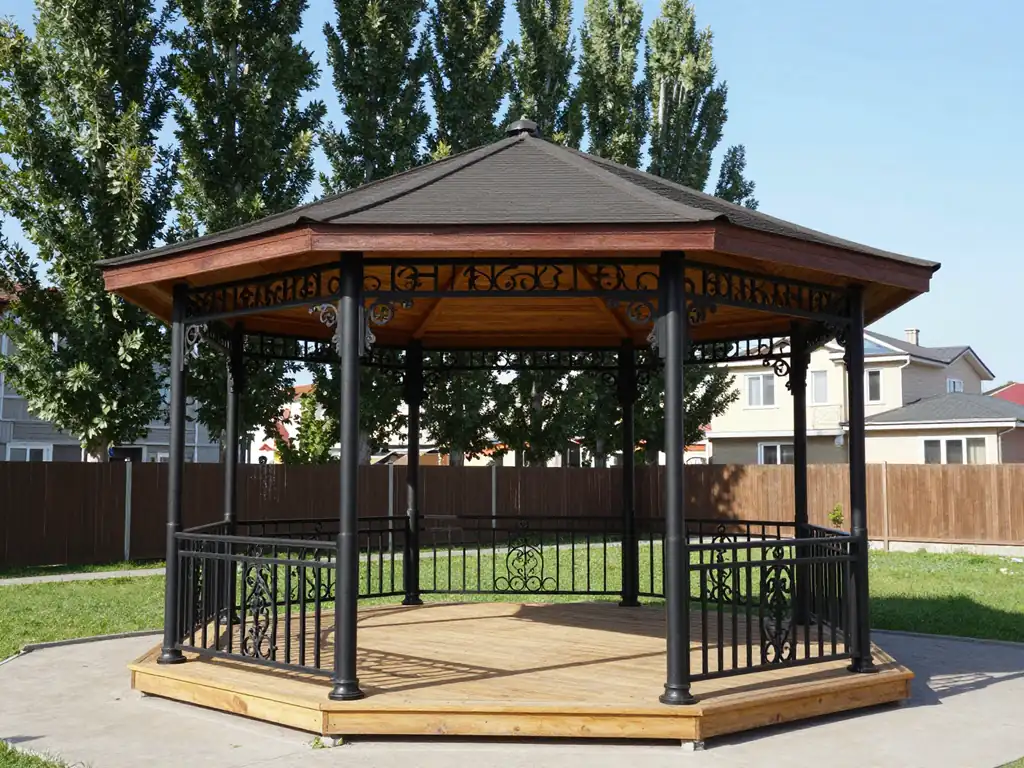
Gazebo 4×4 m: forged frame, wooden floor and railings, soft roofing. Forging and wood paired together.
- From 1 000 000 ₸ for 4×4 m
- Timeframe 18–25 days
- Wooden floor and railings
Advantages:

Signature
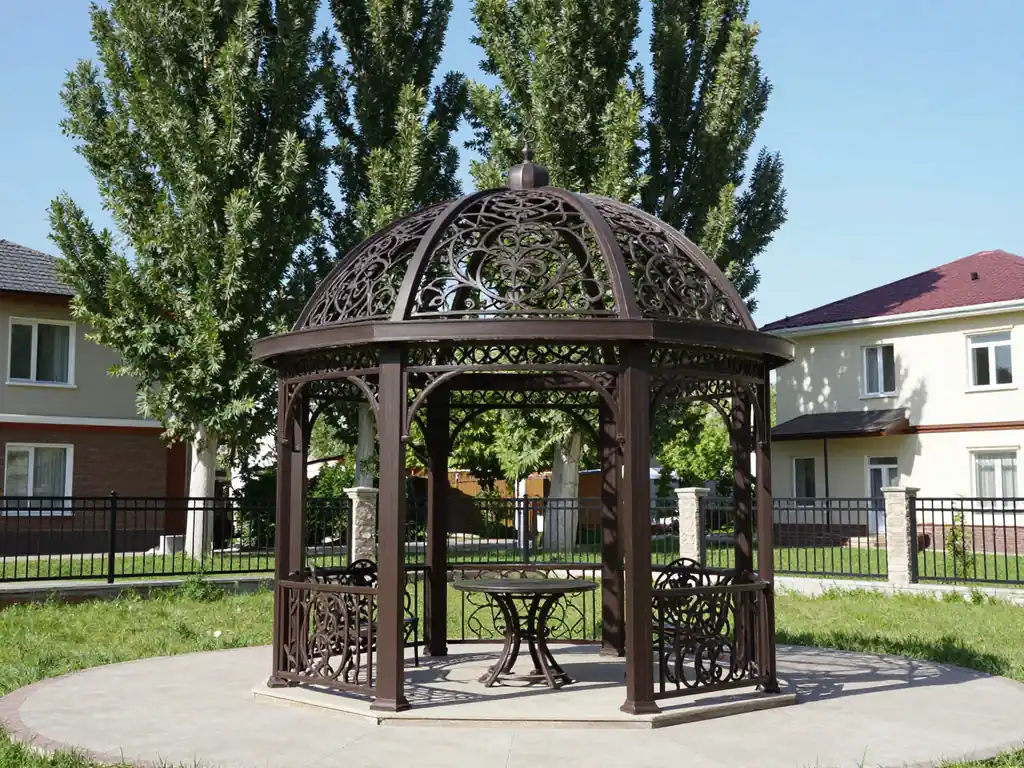
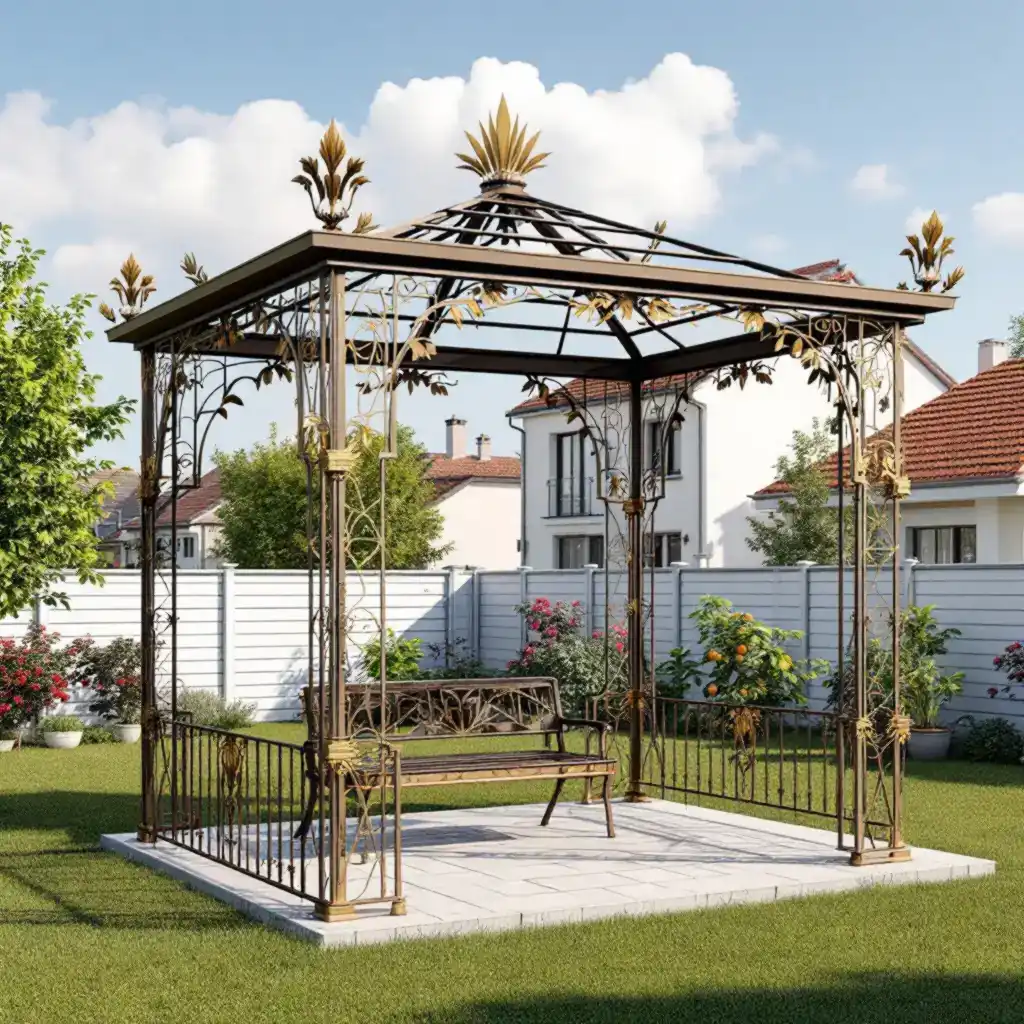
Gazebo 4×4 m with individual hot-forged elements and patina. We make the decor according to a sketch: curls, leaves, baskets, spikes.
- From 1 400 000 ₸ for 4×4 m
- Timeframe 20–30 days
- Individual decor and patina
Advantages:
We'll reply in 15 minutes
Types of forged gazebos
Garden
Light hexagonal gazebo Ø3 m: thin forged arches, polycarbonate dome, benches inside.
- From 480 000 ₸ for Ø3 m
- Timeframe 10–14 days
- Polycarbonate dome
Advantages:
Openwork
Gazebo 3×4 m with openwork forged fencing and metal roofing. The railings are part of the overall forging pattern.
- From 700 000 ₸ for 3×4 m
- Timeframe 14–20 days
- Forged railings around the perimeter
Advantages:
Canopy
A 3×4 m canopy by the house: support on the wall or on its own posts, roofing made of polycarbonate or metal tiles.
- From 400 000 ₸ for 3×4 m
- Timeframe 10–14 days
- Wall-mounted or freestanding
Advantages:
Forging and wood
Gazebo 4×4 m: forged frame, wooden floor and railings, soft roofing. Forging and wood paired together.
- From 1 000 000 ₸ for 4×4 m
- Timeframe 18–25 days
- Wooden floor and railings
Advantages:
Signature
Gazebo 4×4 m with individual hot-forged elements and patina. We make the decor according to a sketch: curls, leaves, baskets, spikes.
- From 1 400 000 ₸ for 4×4 m
- Timeframe 20–30 days
- Individual decor and patina
Advantages:
We'll reply in 15 minutes
we make forged gazebos to dimensions:
We inspect the plot, select the pattern and color
We draw a sketch: forging, roofing, and base
We calculate the estimate: forging, painting, installation
By clicking the button you agree to the terms of the
 Privacy Policy
we make forged gazebos to dimensions:
LEAVE A REQUESTBy clicking the button you agree to the terms of the
We inspect the plot, select the pattern and color
We draw a sketch: forging, roofing, and base
We calculate the estimate: forging, painting, installation
Or call us at
+7 (700) 347-98-76Privacy Policywe make forged gazebos to dimensions:
LEAVE A REQUESTBy clicking the button you agree to the terms of the
We inspect the plot, select the pattern and color
We draw a sketch: forging, roofing, and base
We calculate the estimate: forging, painting, installation
+7 (700) 347-98-76Or call us at
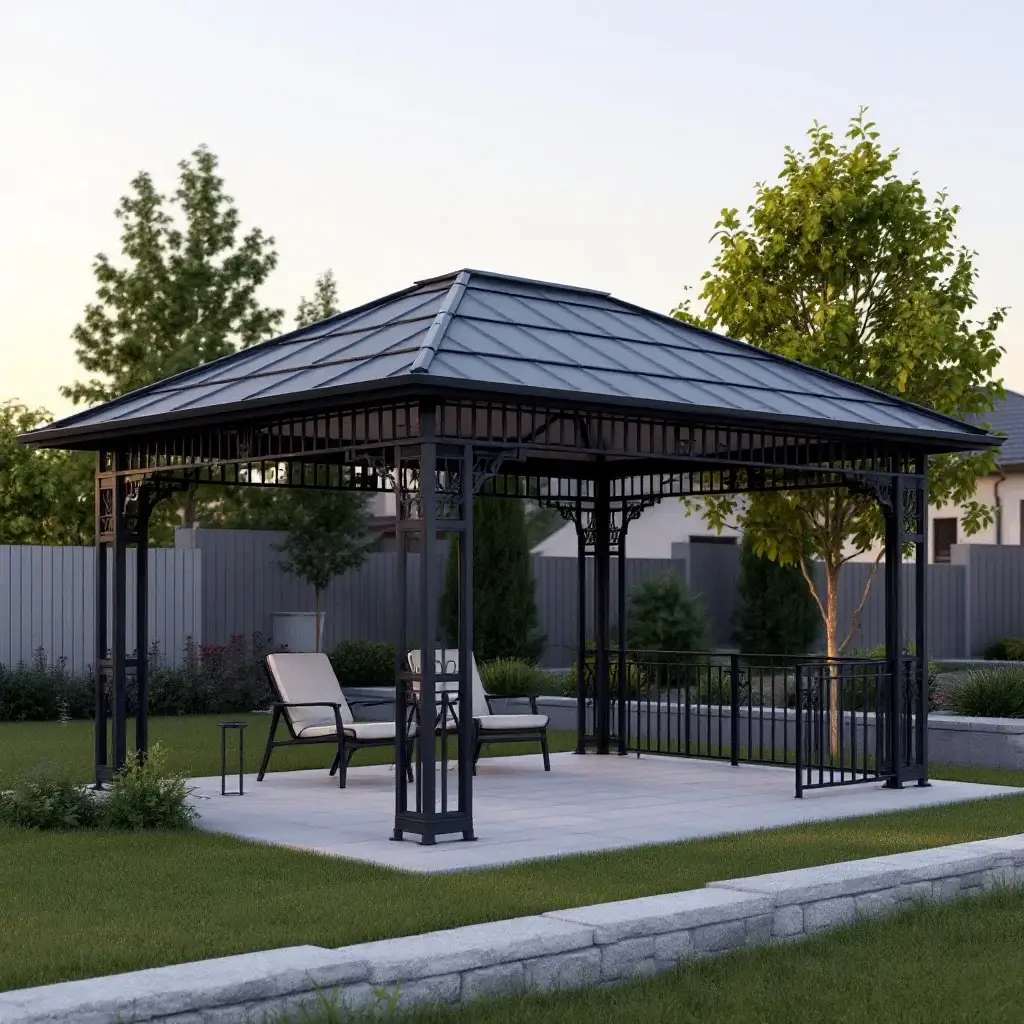
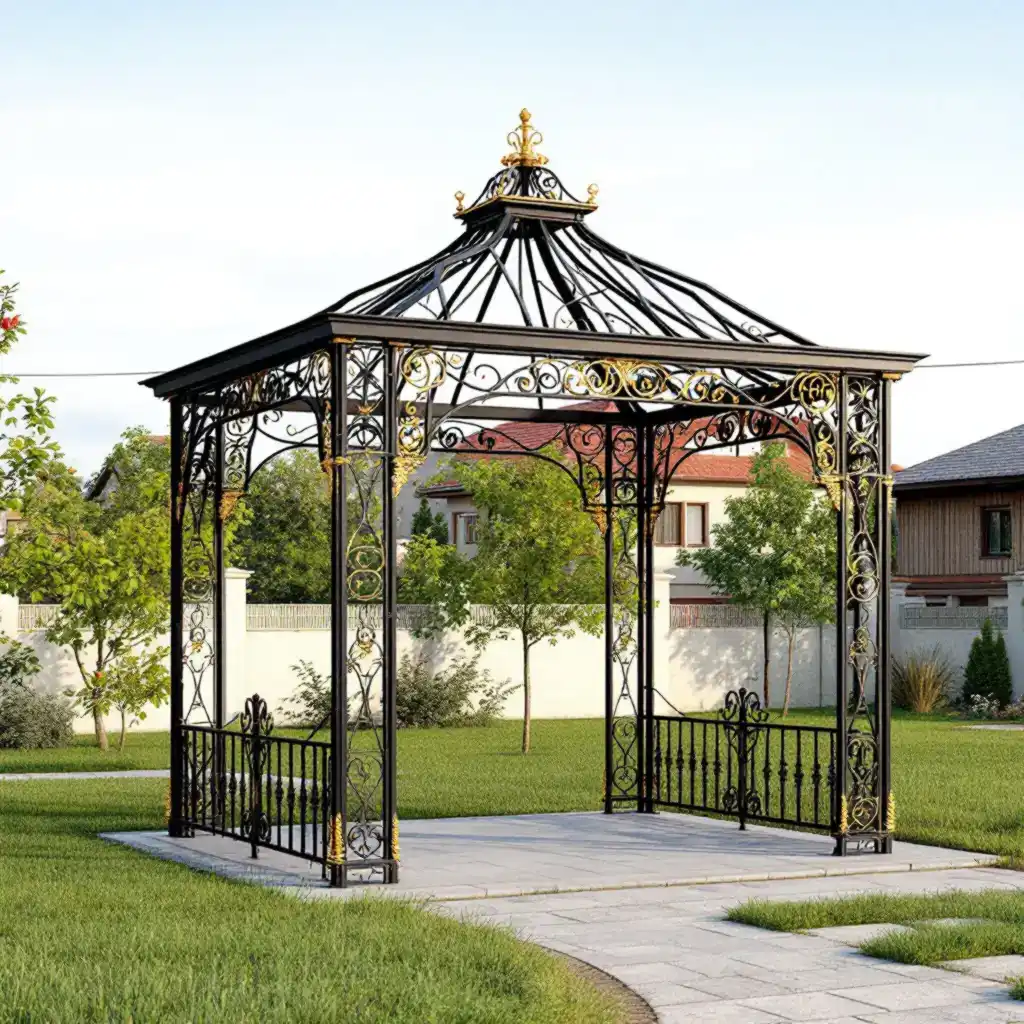
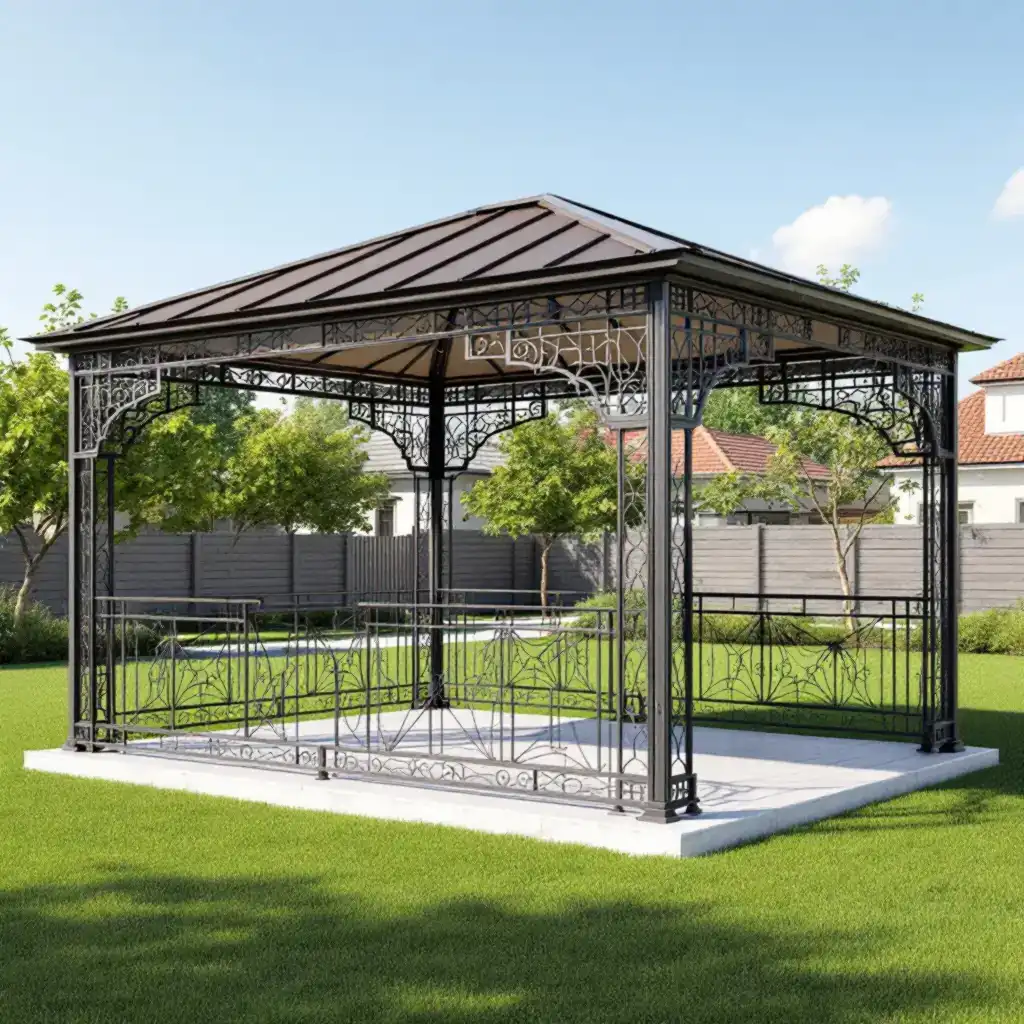
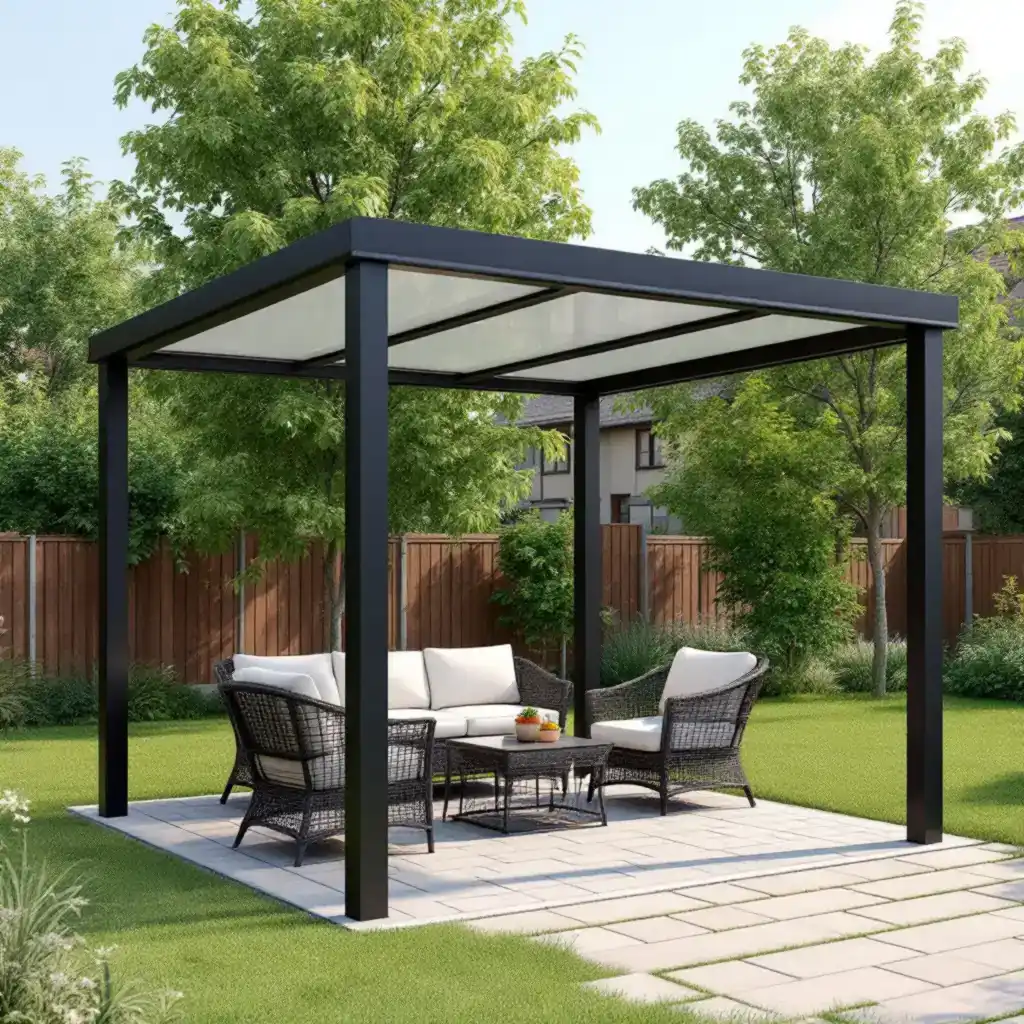
Examples of gazebos
Frame, forging and roofing in various options
Prices for forged gazebos in Almaty
| SERVICE | COST |
|---|---|
| TURNKEY FORGED GAZEBOS | |
| Forged canopy-gazebo near the house, 3×4 m | from 400 000 ₸ |
| Garden hexagonal: light forging, polycarbonate, Ø3 m | from 480 000 ₸ |
| With openwork fencing and metal tile, 3×4 m | from 700 000 ₸ |
| Forging and wood: floor and railings, 4×4 m | from 1 000 000 ₸ |
| With forged fencing, soft roofing, 4×5 m | from 1 200 000 ₸ |
| With hot forging and patina elements, 4×4 m | from 1 400 000 ₸ |
| With hot forging according to a sketch and patina, 4×5 m | from 1 800 000 ₸ |
| FOUNDATION, ROOFING AND DECOR | |
| Foundation on concrete posts | from 45 000 ₸ |
| Monolithic slab 150 mm | from 75 000 ₸ |
| Screw piles, 9 pcs | from 90 000 ₸ |
| Floor made of paving slabs | from 12 000 ₸ per m² |
| Roofing: polycarbonate | from 9 000 ₸ per m² |
| Roofing: metal tile | from 14 000 ₸ per m² |
| Roofing: soft roofing tiles | from 18 000 ₸ per m² |
| Forged fencing and railings | from 28 000 ₸ per linear meter |
| Hot-forged element, per piece | from 15 000 ₸ |
| Patina for forging, per m² | from 6 000 ₸ |
| Powder coating, per m² | from 7 000 ₸ |
| Gazebo lighting | from 45 000 ₸ |
| Electrical connection | from 25 000 ₸ |
| Sketch and project of a forged gazebo | from 30 000 ₸ |
| Delivery across Almaty | from 15 000 ₸ |
| Delivery across the region | from 25 000 ₸ |
How we make a forged gazebo

01.
Measurement
We inspect the plot, house and soil. Site visits in Almaty are free.
02.
Sketch and estimate
We draw the forging and assemblies, calculate materials and installation.
03.
signing the contract
We fix the forging pattern, prices, deadlines, and warranty in the contract.
04.
Manufacturing
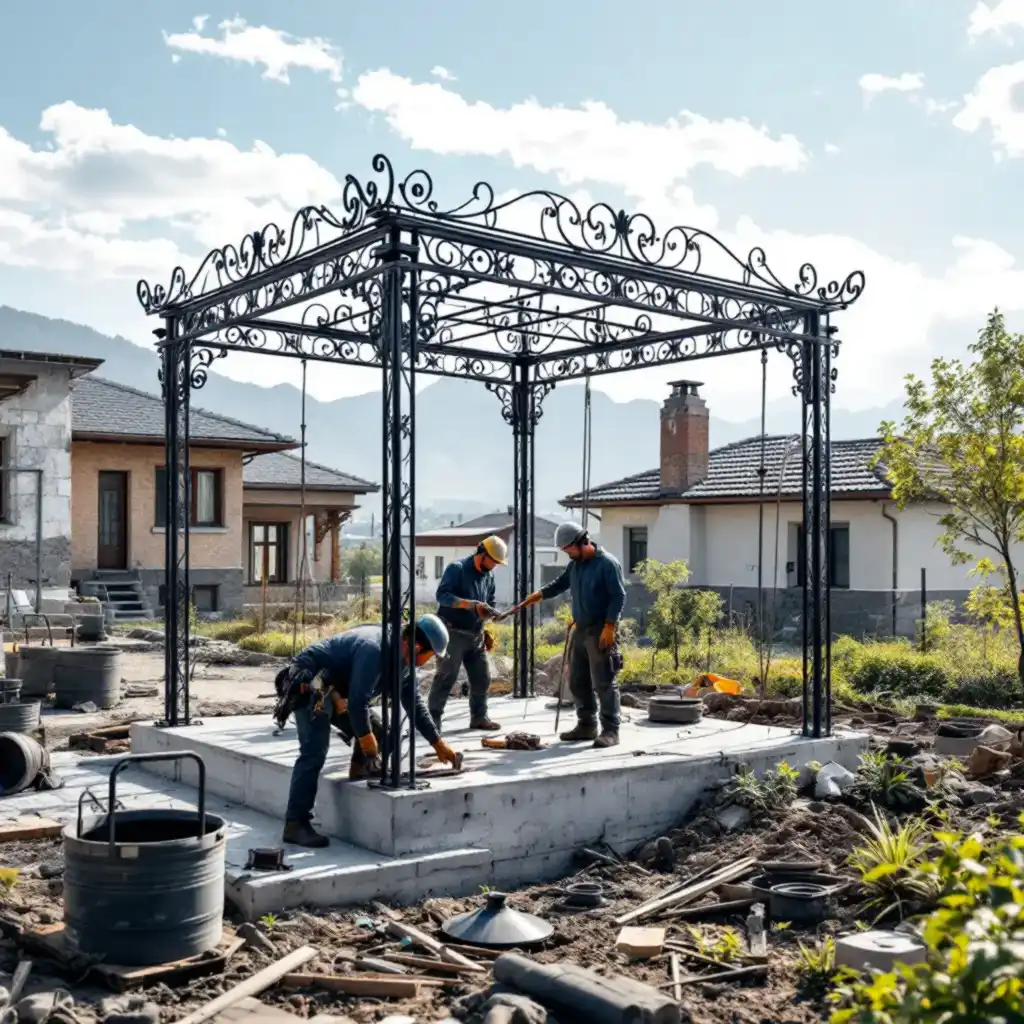
We weld the frame, bend the decor and paint in our own workshop.
05.
Foundation and installation
Posts, slab or embedded anchors, then the frame, roofing and forging.
06.
Handover and warranty
We hand over the gazebo, remove the debris, 5 years warranty on the structure.
How we make a forged gazebo
Measurement
We inspect the plot, house and soil. Site visits in Almaty are free.
01.
Sketch and estimate
We draw the forging and assemblies, calculate materials and installation.
02.
signing the contract
We fix the forging pattern, prices, deadlines, and warranty in the contract.
03.
Manufacturing
We weld the frame, bend the decor and paint in our own workshop.
04.
Foundation and installation
Posts, slab or embedded anchors, then the frame, roofing and forging.
05.
Handover and warranty
We hand over the gazebo, remove the debris, 5 years warranty on the structure.
06.
We'll reply in 15 minutes

Let's calculate a forged gazebo

Thank you! We will contact you within 3 minutes.
By clicking the “Leave a request” button, you agree to the terms
Leave a request — we'll select a forging pattern for your plot and calculate an estimate within 24 hours
Let's calculate a forged gazebo
Thank you! We will contact you within 3 minutes.
By clicking the “Leave a request” button, you agree to the terms
Privacy PolicyLeave a request — we'll select a forging pattern for your plot and calculate an estimate within 24 hours
By clicking the “Leave a request” button, you agree to the terms
Thank you! We will contact you within 3 minutes.
Let's calculate a forged gazebo
Privacy PolicyLeave a request — we'll select a forging pattern for your plot and calculate an estimate within 24 hours
Forged gazebo
PROFI-DOM forged gazebos are a welded frame made of profile pipe, cold forging elements, anti-corrosion treatment, powder coating or patina, roofing and installation on a prepared base. We work as a direct contractor: own production and own crews, free measurement in Almaty, contract and estimate, 5-year warranty on the structure.
Published: 14 · Updated:
Forging that's not "from a catalog": cold, hot and handwork
The client's main fear is getting stamped overlays instead of real work. We break down how cold technique differs from hot, how to tell a bent curl from a stamped one, and what really affects the price of a gazebo.
How cold forging differs from hot forging
Cold forging is bending rod and strip on machines without heating the metal; hot forging is heating the workpiece in a forge and manual shaping with a hammer. Cold techniques use three basic machines: the torsion twists a square into a bundle, the scroll sets a spiral, and the volute forms a large circle with a smooth taper. Hot (artistic) forging takes place at 1100-1250 °C: the craftsman draws out, upsets and welds the metal by hand, so the same sheet will turn out different in the hands of two blacksmiths. For a garden gazebo the difference is visible not in strength but in the plasticity of the lines: cold forging gives a repeatable pattern, hot forging gives unique transitions, so hot forging is used selectively, for 1-2 accent elements. In listings such goods are often labeled briefly — "forged gazebo" — and almost always this means cold technique. So decide in advance which unit will become the accent, otherwise handwork will "spread" across the whole structure and the price will rise without a visible effect.
How to distinguish genuine forging from "catalog" stamping
Stamping is revealed by “perfect” symmetry and thin metal: a bent element feels heavier in the hand, the seam is cleaned rather than filled with a thick layer of paint, and the pattern joins the frame instead of “hanging” over it. In mass-produced sets, peaks and rings are stamped from 1,5-2 mm sheet, while quality decor is bent from 12 mm square rod — such an element does not dent from an accidental impact. Inspect the joint of the curl with the torsion bar: on a bent rod there is a smooth metal transition, while on a stamped one there is a gap or weld bead under the paint. Ask for photos of the blanks before painting: if the craftsman shows bare metal with bending marks rather than finished painted overlays, that is a sign of in-house production, not assembly from a catalog. The rhythm of the pattern on the posts and railings also tells you: in piecework it repeats with a deliberate step, while in stamping it is “perfectly” identical from the first to the last section.
Forging elements: where they are placed and how they are made
| Element | Where it's installed | Technology and labor intensity |
|---|---|---|
| Curl | Posts, railings, arches | Cold bending on a machine, medium |
| Volute | Posts, corners, arches | Cold bending on a machine, high |
| Torsion | Posts, handrails, railing | Cold rod twisting, medium |
| Picket | Fencing, roof ridge | Cold bending and cutting, low |
| Ring | Joints, railings | Cold bending, low |
| Basket | Posts, under the roof | Three-dimensional cold bending, high |
| Baluster | Handrails | Cold bending and assembly, medium |
| Sheet | Curls, arches, railings | Cold bending or hot forging; hot — high |
A forged gazebo to your own sketch — how it works
Such a gazebo is made both according to a standard project and according to your sketch: the surveyor takes the dimensions of the plot, the designer calculates the frame, and the craftsman selects decor to match the pattern. During measurement, the building footprint, post height and strapping scheme are recorded: a standard 3×3 m structure is assembled from four posts and two belts, while in a custom project additional posts are added under the roof overhang or entrance. The pattern is agreed on a scaled sketch: volutes and curls are placed along the axes with a step of 400-600 mm so that the fencing reads as a single composition. The sketch should also include the points from which the gazebo will be seen most often — the path, the porch, the windows of the house: the fencing pattern is evaluated precisely from there. If the plot is in an open wind, add reinforced posts and a solid belt to the project — re-welding a finished structure is more expensive than including this in the sketch.
Frame, joints and fastening of forged decor
The frame holds both the forging and the roofing, so whether the gazebo will stand for ten seasons depends precisely on it. We break down why the base is assembled from profile pipe, and the decor from rod and strip, and how these parts are connected to each other.
Profiled pipe or forged rod: what bears the load
The load-bearing frame of the gazebo is assembled from profile pipe: posts — 60×60 mm with a wall of 3 mm, framing and rafters — 40×40 mm, while 12 mm square rod and 40×8 mm strip are used for decor. This way the structure withstands snow and wind, while the pattern remains light. The pipe works in bending and compression: four posts, perimeter framing and the rafter system withstand the snow load of the foothills of the Trans-Ili Alatau. Forged metal gazebos are designed precisely on this principle: the rod in a curl is beautiful, but as a single load-bearing post it bends under the weight of the roof, so it works only in combination with pipe, not instead of it. Every weld seam is cleaned down to metal — under the decor it still remains functional.
How forged decor is attached to the frame
Curls, volutes and baskets are welded to the frame according to the markings, then each seam is cleaned, because an uncovered seam is the first place where rust appears. Marking is done from the axes of the posts: first the center of each support is laid out, then the pattern is divided on four sides, and only after that the elements are tacked with points and the diagonals are checked. For repeating volutes, a template is convenient: it holds the angle and the spacing between the curls, and the decor on all sides falls into a single rhythm. After welding, the seams are ground, degreased and primed, then powder coating or patina with varnish follows. If the decor is attached "by eye", the pattern on the four sides of the gazebo will not match in rhythm, and this is visible from any corner of the plot.
Combination of forging with wood and polycarbonate
The metal frame combines well with wood for the floor and railings and with polycarbonate for the roof or walls — the metal takes on the load-bearing role, while warm materials soften the look. We assemble the floor from decking boards on joists with a 5 mm gap: larch or WPC do not slip after rain and do not require painting every season. We install 8-10 mm polycarbonate on the roof with a batten spacing of 600-800 mm; for walls we use 6 mm cellular sheet with UV protection — without it the sheet becomes cloudy under the sun within a few seasons. Wood and metal behave differently in the sun, so a gap and a gasket are left at the fastening points — otherwise, when heated, the wood warps and the fasteners loosen.
Protecting metal from rust: primer, painting, patina, and care
The coating on a forged gazebo is responsible not only for color but also for protecting the metal. We break down anti-corrosion treatment, the difference between powder coating and hammer enamel, and the place of patina in the finish.
Why welded seams and scrolls rust
Rust starts where the metal is left without coating: on the weld seam, in the curl cavity and on the rod end, where paint does not reach during ordinary painting. The seam is the most vulnerable spot: the metal there is overheated, covered with scale and spatter, the surface is uneven, so paint adheres worse and corrosion starts earlier than on the main rod. In the curl the situation is different — condensate and moisture accumulate there, and the air in the closed cavity stagnates, so corrosion goes from the inside, and outside it becomes visible only at a late stage. At the rod end the metal is completely open if the cut is not plugged and not primed. Cleaning weld seams to bare metal, degreasing and priming along the seam are more important than the thickness of the finish layer: powder over an unprepared seam peels off together with scale.
Powder coating or hammered enamel
Powder coating gives an even, dense layer over the entire frame, while hammer enamel is chosen when a textured "forged" look is needed. The difference is in the technology: powder is applied electrostatically and baked at 180-200 °C, the layer thickness is 60-120 microns, and it holds stronger than liquid enamel. Hammer enamel is applied with a brush or sprayer, dries at normal temperature, and gives a characteristic "hammered" texture — it masks minor irregularities and welding marks, so it is often chosen for gazebos in a classic style. Enamel is easier to touch up on site, while the powder layer is only painted over with matching enamel on the plot. No coating will "heal" an unprepared seam: without cleaning and primer, both powder and enamel last only a season or two.
Patina gold, copper, silver: where it fits and how it looks
Patina is a decorative finishing coating over the base layer: gold and copper give a warm noble shade, silver gives a cold graphite one, and we apply it to accent elements, not to the entire frame. Technically it is a composition based on metal pigments with lacquer or wax on top; the depth of color depends on how the base was revealed — on a black primer gold goes into bronze, on gray silver looks almost like wet asphalt. Volutes, curls, cones and leaves read more voluminously in patina than in a solid RAL, because the relief catches light on the edges. Patina should not be applied to fencing in an area where hands constantly reach: over time it wears unevenly on protruding points and the pattern becomes "spotty".
Service life and care of a forged gazebo
With high-quality anti-corrosion treatment and powder coating, a forged gazebo serves for decades, and regular inspection of seams and touching up chips extends this period. The 5-year warranty on the structure concerns the load-bearing part: frame, fastening joints, geometry. The paint coating is a consumable, it lives less than the metal: under sun and precipitation the top layer eventually loses its gloss, and chips from branches and tools appear even earlier. Once a year it is enough to inspect the seams and lower joints of the posts at the ground — that is where moisture accumulates, and spot painting takes less time than repairing a rusted joint. Tip: immediately write down the powder color number according to the RAL catalog and buy a jar of enamel of this shade for touching up — matching the color from a photo after a few years will no longer work.
Roofing, floor, and foundation for a forged frame in Almaty conditions
Roofing and foundation are the two points where a forged gazebo meets the climate: the weight of the covering, the snow and wind of the foothills, seismicity and the type of soil on the plot. We will analyze what to choose for a specific frame.
Which roofing to choose so as not to overload the frame
For a light forged frame, polycarbonate or profnastil is more logical, while metal tiles and soft tiles are chosen when the frame is designed for the snow load of the foothills. Polycarbonate 8-10 mm weighs about 1,7 kg per square, profnastil S8 — 3,5-4,5 kg, metal tiles — 4,5-6 kg, and soft tiles with lathing and lining carpet give 8-12 kg. The difference of several times decides what post spacing to lay: under polycarbonate a span of 2,5-3 m is enough, under soft tiles intermediate supports are placed every 1,5-2 m. Wind in the foothills adds windage: a continuous roof works like a sail, so the fastening of sheets and anchoring of posts are calculated with a margin.
Forged canopy-gazebo near the house: when it is more convenient than a closed gazebo
In catalogs, such a structure is called differently: canopy-gazebo, pergola with roofing. The essence is the same — an open structure on forged supports with a roof, and it is chosen when a shady place without blank walls is needed near the house. Such a canopy is installed on 3-4 supports with a roof made of 8 mm polycarbonate or metal tiles, the area is usually 12-18 m², and it does not require glazing and insulation — therefore it is noticeably cheaper than a closed gazebo. A support at the house wall saves one row of posts and 2-3 m² of the plot, but the attachment is to the load-bearing part of the facade, not to the cladding or insulation. Forged supports are installed with a spacing of 2,5-3 m, and the roof overhang is extended beyond the dimensions by 400-600 mm so that slanting rain does not flood the recreation area. Attachment to the wall is calculated separately, otherwise the load from the roof goes to the facade, not to the posts.
Is a foundation needed and how to take into account the seismicity and snow of the foothills
One of three foundations is placed under a forged gazebo: point concrete columns, a monolithic slab, or screw piles. A solid foundation is not always needed, but the fastening units are in any case calculated for the seismicity of Almaty. Columns with a cross-section of 300×300 mm for each post are buried 1 m deep — below the soil freezing depth. A slab 150 mm thick with reinforcement in two meshes is used for heavy roofing and a dense floor. Screw piles help on a site with a slope or filled soil, where digging and concreting are inconvenient. At the pouring stage, 200×200×8 mm embedded plates are placed in the concrete (for piles, the head plays the role of the embedded plate), the post is fastened with M12-M16 — anchors; during an underground shock, it is this unit that holds the structure. The snow load is taken according to the norms for the site area, and the post spacing and profile cross-section are calculated for it. What is more dangerous is not the shock itself but the loss of anchoring: if the post is not fixed to the embedded plate, during movement it comes out of the unit, so the fastening is checked before roofing installation.
Floor and base at the dacha: forged gazebos for the dacha
For a dacha, we more often install lightweight structures on point columns with a floor of paving slabs or decking boards — this is faster and cheaper than a solid slab. Paving slabs on a sand-gravel base cost less than a concrete slab and are laid faster; larch or WPC decking boards on joists provide an even deck without wet spots after rain. Point columns under the supports are placed separately from the floor: the decking rests on its own base, the posts — on concrete, so soil settlement in spring does not pull the frame with it. Assembling such a structure with your own hands is realistic only with welding and ready-made elements: without calculating the nodes and anchoring, it loses the very point for which it is chosen — stability and a long service life.
What the cost consists of: a standard gazebo and one made to a sketch
The estimate is assembled from several independent blocks, and each is calculated separately. That is why a standard gazebo and a project based on a sketch give different prices for the same area — the difference is in the labor intensity of the decor.
What's included in the turnkey price of a forged gazebo
Price lists often have one line "forged gazebo price from ...", but it is hard to understand what you are paying for. In the PROFI-DOM estimate, the cost is assembled from six blocks: frame, forging, roofing, painting, foundation and installation — each is calculated separately, so you can see what exactly adds to the price. The frame made of 60×60 and 40×40 mm profile pipe sets the base cost, forging is counted by the number of elements: volutes on the posts, brackets, curls in the railing, canopy over the entrance. Roofing — from polycarbonate to soft tiles, the difference is in weight and fasteners. Painting includes primer, powder layer and patina, foundation — concrete posts, slab or screw piles, installation — crew work on site. What drives the estimate up most is not the metal, but the density of decor and the complexity of the roof: a dozen volutes on the posts weighs more in labor intensity than switching from corrugated sheet to metal tile.
Standard gazebo or custom design: what to choose and how to buy a forged gazebo
A standard project is calculated faster and costs predictably, while an estimate based on a sketch grows with unique elements — but it is the sketch that provides fit for a specific site. Standard projects are designed for a flat area and standard sizes 3×3, 3×4 or 4×4 m. An individual project takes into account slope, view from several points, binding to the house and fence, roof shape for the site size. At PROFI-DOM, the structure is made both according to a ready-made drawing and according to a sketch agreed with the customer. If the site has a slope or the gazebo is visible from several points, savings on a standard project are often eaten up by rework during installation — the sketch pays off already at the foundation stage.
Production timelines and stages of work
The timeline depends on the density of the forging and roofing: a typical gazebo goes through production faster than a custom one with a large amount of decor, while installation takes separate days on site. The work proceeds in stages: measurement and sketch, frame fabrication, bending of forged elements, priming and painting, drying, delivery to the site, and assembly on the prepared foundation. Painting and drying set the pace: the frame and decor can be painted in separate batches so you don't have to wait for the last curl to be ready. At PROFI-DOM, the frame and decor are made in our own production, so the stages do not depend on another workshop's queue. A forged gazebo with a dense pattern requires more passes of welding and seam cleaning, which directly lengthens the cycle.
How to choose a contractor: marketplace, workshop or direct contractor
A forged gazebo reaches the customer in three ways: a ready-made collapsible kit from a marketplace, the work of a small workshop, or a turnkey structure from a direct contractor. We break down how these paths differ in responsibility for the result.
Ready-made prefab gazebo from a marketplace: what's important to know
A ready-made collapsible gazebo from a marketplace comes as a kit without installation and without connection to the soil, so the buyer takes on the foundation, anchoring and assembly. The description of such items usually indicates dimensions, package weight and profile thickness, but almost never — the steel grade, the type of soil under the covering and the method of connecting the nodes. Cards with the title "forged gazebo buy with delivery" on marketplaces are, as a rule, exactly such kits: galvanized profile with decorative overlays is cheaper than custom work. But the decor in such sets is often stamped and thin, and the coating is ordinary enamel: in the second or third season, seams and joints begin to bloom, and no one gives a warranty for this. Before paying, ask the seller for the steel grade, rod thickness and coating type — if there is no answer, you are buying not a gazebo, but packaging.
Workshop or construction company: where responsibility ends
The workshop is responsible for the forging, but not for the foundation and installation, while PROFI-DOM as a direct contractor handles the entire cycle — from measurement and sketch to installation and warranty. Forged gazebos from a narrow workshop come out with strong decor: the blacksmith invests in the scrolls and pattern because that is his specialty. Then the junction zone begins — the foundation for the posts, anchoring, roofing, drainage. When forging, foundation and roofing are done by different contractors, at the first problem each points at the neighbor: the blacksmith says it warped because of the foundation, the installers say the frame geometry was inaccurate. A single contractor removes this dispute because it is responsible for the structure as a whole, not for a separate unit.
Contract, estimate and warranty: how we fix the terms
До начала работ PROFI‑DOM выезжает на бесплатный замер по Алматы, фиксирует договор и смету, а на конструкцию даёт гарантию 5 лет. В смете важно видеть отдельными строками металл, покрытие, кровлю, основание и монтаж — если всё слито в одну сумму «под ключ», при споре невозможно доказать, что именно входило в цену. Гарантийный срок на металл и покрытие в договоре прописывается отдельно от срока на монтаж: покрытие может держаться дольше, чем шов, и наоборот. Проверяйте, что в договоре указаны марка стали, тип грунта и краски, толщина прутка декора — эти три строки закрывают большинство будущих претензий.
Conclusion
We've gathered the main things that determine how such a structure will behave on the plot after five and ten seasons. Below are five conclusions that most often come up in conversations with customers from Almaty and its suburbs.
- Metal determines durability: a profile pipe with honest wall thickness and anti-corrosion treatment keeps the structure standing for decades, while thin decor and stamping lose ground already in the second or third season.
- The foundation matters more than the decor: concrete posts, a slab, or screw piles are selected based on the soil and the weight of the structure — a mistake here costs more than any savings on forging.
- Roofing and climate: in the foothills with their snow and wind, the canopy is calculated by loads, not by beauty — otherwise the very first season will show the distortion.
- The price consists of metal, coating, roofing, foundation and installation: the more transparent the estimate for these items, the fewer surprises during the process.
- A single contractor removes disputes: when forging, base and roofing are the area of one executor, responsibility for the result is not blurred between crews.
 Айдос БаймуханбетовGate installation masterExperience 21 years · Rating 4,62 (81 reviews)About the author
 Dilshot SaparovForeman of installersExperience 15 years · Rating 4,7 (100 reviews)About the author
 Bakhitshat KhamraevGate installerExperience 16 years · Rating 4,88 (65 reviews)
 Bakhtiyar D.WelderExperience 12 years · Rating 4,5 (58 reviews)
 Vladimir ShkurkoMetal structures masterExperience 20 years · Rating 4,88 (75 reviews)
 Dauren TleukulMetal structures welder-assembler23 years of experience · Rating from 4,96 (50 reviews)
 Edil NugmanovGate installerExperience 15 years · Rating 4,63 (28 reviews)
 Kosylbek KurmangazhievGate installer23 years of experience · Rating from 5,0 (60 reviews)