Asphalt and asphalt concrete: composition, types and application by PROFI-DOM in Almaty
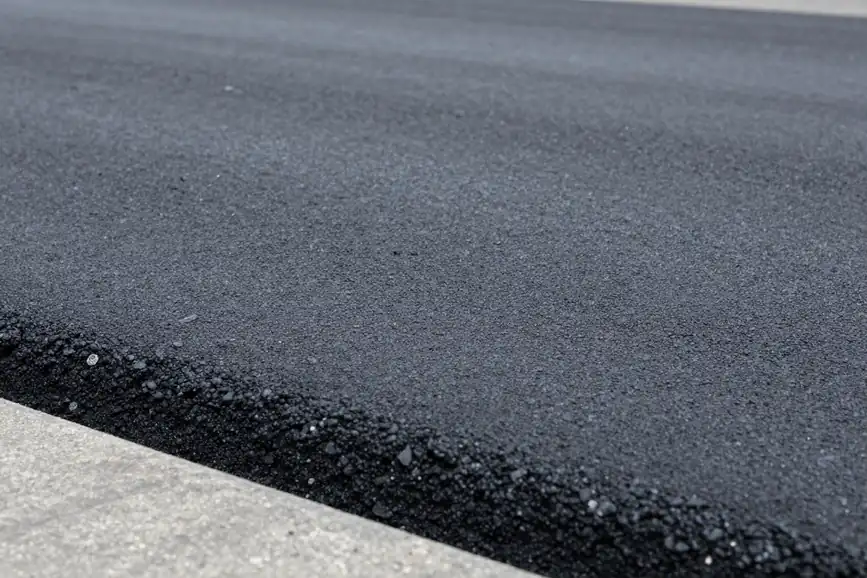
Asphalt and asphalt concrete are essentially the same pavement: in everyday life, "asphalt" refers to an asphalt concrete mix of crushed stone, sand, mineral powder and bitumen. PROFI-DOM in Almaty lays hot mix from the plant onto a prepared base: yards and paths — 4–5 cm, driveways and parking — 6–7 cm.
Published: 25
What is asphalt: coating composition
In everyday life, any black surface in a yard is called "asphalt," but what is laid on a plot is specifically an asphalt concrete mix. Asphalt is a material based on a bitumen binder, while asphalt concrete is an artificial mix of mineral aggregates with bitumen. Let's look at how they differ and which composition is considered working.
How asphalt differs from asphalt concrete
Asphalt is a natural or artificial material based on a bitumen binder. Asphalt concrete is an artificial mixture of mineral aggregates with bitumen, which is what is laid on roads and in yards. Natural asphalt occurs as rock impregnated with bitumen and is almost never used in private construction. Artificial asphalt concrete is prepared at a plant: the mineral part — crushed stone, sand, powder — is mixed with bitumen heated to 140-160 °C and delivered to the laying site hot. That is why the mix cannot be "held" on site: in 40-60 minutes it cools and loses its workability. When talking to a contractor, it is important to clarify not the word "asphalt" but the type of mix and the layer thickness — these determine how the surface will behave under load.
What asphalt concrete consists of: crushed stone, sand, mineral powder, bitumen
- Crushed stone of various fractions: the stone framework of asphalt concrete, coarse grain 10-20 mm bears the parking load, fine 5-10 mm gives evenness to yard paths.
- Sand: fills the gaps between the gravel and adds plasticity to the mix during laying and compaction with a roller.
- Mineral powder: a finely ground filler that, together with bitumen, forms the binder and increases the density of asphalt concrete.
- Bitumen: a petroleum-based binder that binds the mineral part into a monolith and gives the surface water resistance and elasticity; it is the key component that determines the properties of the mix.
- Additives: adhesion and polymer additives in certain grades improve bitumen bonding with granules and extend service life.
Why mineral powder is in the mix and how to read the composition
Mineral powder is a finely ground filler that, together with bitumen, forms a binder, fills the voids between grains of crushed stone and sand and makes asphalt concrete denser and more resistant to water. Its share in the composition is small — usually 5-10% by mass, but it is precisely this that turns loose mineral aggregate into bound asphalt concrete. There is even less bitumen in the composition — 4-7%, and the elasticity of the coating depends on its amount: an excess gives plasticity and ruts in summer, a deficiency — brittleness and cracks in winter. In dense fine-grained grades such as B and C, which are most often used for yards, the ratio is selected for moderate loads. If there is little filler or bitumen in the composition, the coating loses cohesion faster and begins to peel at the edges — this is noticeable already in the first season.
Types of asphalt: how the options differ
Asphalt types are distinguished by grain size, laying temperature and purpose, while types are determined by composition and area of application. Below are three sections of one classification and a summary table that makes it easier to choose an option for a specific site.
Classification of mixtures by grain size and temperature
By grain size, mixes are divided into coarse-grained, fine-grained and sandy, and by laying temperature — into hot, warm and cold; for private properties in Almaty, hot mix is used. The coarse-grained mix contains crushed stone of a fraction up to 40 mm and goes into the lower layers of driveways and parking lots, the fine-grained one — grain of 10–20 mm for the top layer of the yard, the sandy one consists almost entirely of sand with mineral powder and bitumen. The hot mix is prepared at the plant at 140–160 °C and laid on the day of delivery while it has not cooled; the warm option is mixed at 90–120 °C, and the cold one is supplied ready-made in bags. The cold compound is convenient for pothole repair in small batches, but a capital yard surface is not made from it — it is inferior to the hot one in density and durability.
Comparison of options: what it consists of, what it is suitable for, what to consider
| Option | What it consists of | What it is suitable for | What to consider |
|---|---|---|---|
| Coarse-grained asphalt concrete | coarse aggregate crushed stone, sand, mineral powder, bitumen | driveway to the house, parking (layer 6–7 cm) | requires a dense gravel base |
| Fine-grained asphalt concrete | fine crushed stone, sand, mineral powder, bitumen | yard, paths (layer 4–5 cm) | level compacted base |
| Sandy asphalt concrete | sand, mineral powder, bitumen | paths, small areas | lower load-bearing capacity |
| Hot asphalt | factory-mixed, laid on the day of delivery | all types of private properties | dry weather, not freezing |
| Cold asphalt | ready-mix without heating | pothole repair, small areas | not for permanent courtyard paving |
| Asphalt crumb | recycled coating | temporary and budget coating (8–10 cm) | lower density and durability |
Asphalt concrete is a mix prepared at a plant and laid hot, so the table lists both the temperature and the purpose of each option.
Which option is used on a private plot
PROFI-DOM selects the option for the site: a fine-grained mixture with a layer of 4–5 cm is used for the yard and paths, a coarse-grained mixture with a layer of 6–7 cm for the driveway and parking, and 8–10 cm chips are laid as a budget solution. At the entrance with a slope of 1–2% from the house, coarse grain holds the load from wheels better than fine, while on the pedestrian path to the gate there is no point in overpaying for load-bearing capacity. Chips win where coverage is needed quickly and cheaply — for example, on a utility area by the fence or a temporary driveway during construction. On one site, two options are often combined: the entrance and parking are made with coarse grain, and pedestrian paths with fine grain, so as not to overpay for load-bearing capacity where it will not be needed.
How to choose an option and prepare the site for the coating
Choosing a coating is inseparable from preparing the site: the same material behaves differently on a compacted base and on loose fill. Below — base layers, thickness for different zones, and water management.
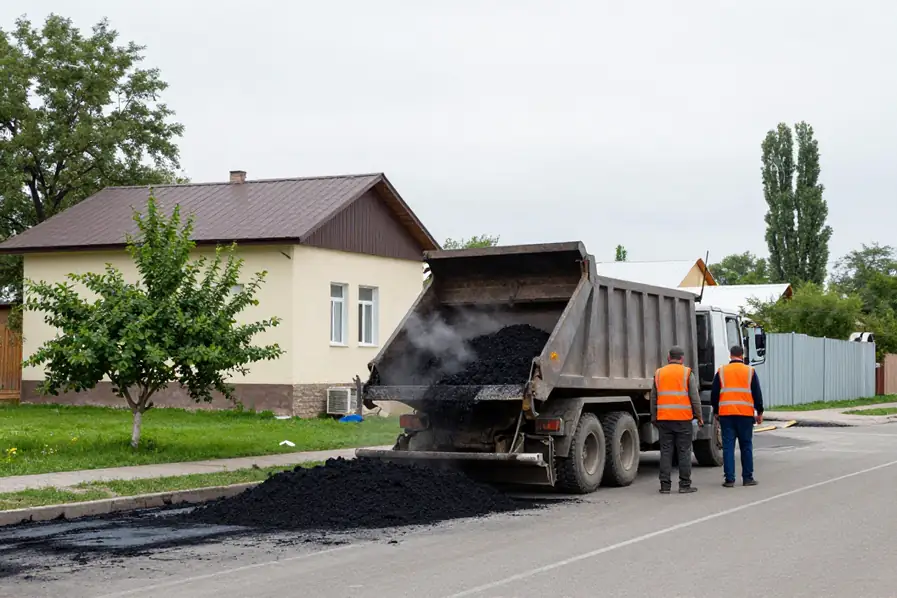
Base layers: soil, geotextile, sand, crushed stone
- Compacted soil: we remove the topsoil and run a plate compactor — on loose ground any top layer shifts and cracks.
- Geotextile: we lay it over weak soil so the crushed stone doesn't sink into the base and lose its load-bearing capacity.
- Sand cushion of 10 cm: levels the surface and distributes the load down to the crushed stone; we compact it layer by layer as well.
- Crushed stone base 15–20 cm: fraction with wedging, compaction with a vibratory roller until refusal — the load-bearing layer that supports the coating.
- Emulsion primer: bitumen emulsion binds the crushed stone to the hot mix and prevents the top layer from peeling off.
What thickness is needed for a yard, driveway and parking
PROFI-DOM lays hot asphalt in a layer of 4–5 cm in yards and on pedestrian paths, and 6–7 cm on driveways and parking lots where the load is higher. Asphalt chips are laid in a single layer of 8–10 cm and remain a temporary solution for an entrance or a service passage. The difference is explained by the nature of the load: a passenger car in a parking lot exerts point pressure on the contact patch, while a truck turning at the gate spreads it over the area. Thickness only works together with a compacted base: a thin layer on loose crushed stone will settle faster than a normal layer on a properly prepared bed, so there is no point in saving on the base for the sake of an extra centimeter on top.
Slope, curbs and drainage channels
We form a slope of 1–2% from the house and, if necessary, install drainage trays and curbs so that water drains from the surface and the edge does not crumble. The drainage direction is set from buildings toward the street or a drainage ditch — if the plot slopes toward the house, a linear tray is added across the entrance. The curb keeps the edge of the surface from shifting and prevents grass from growing around its perimeter. The slope is made at the base stage — it cannot be corrected on a finished surface without redoing it, so the drainage direction is thought out before laying, not after the first rain with a puddle at the gate.
How the work is performed in stages
The technological chain follows a strict order: measurement and surveying, soil removal, sand cushion, crushed-stone base under a vibratory roller, emulsion priming, laying the hot mix and final compaction. Below we analyze the three stages where defects most often occur.
Bitumen emulsion priming: why it is needed
PROFI-DOM applies a bitumen emulsion prime coat before paving: it dedusts the base and ensures the crushed stone bonds with the hot mix. The emulsion is bitumen dispersed in water with an emulsifier; after it breaks, the water evaporates and a thin bitumen film coats each fraction of crushed stone and binds it to the top layer of the pavement. We apply it with an asphalt distributor or a hand sprayer at an air temperature of at least +5 °C, using from 0,3 to 0,6 liters per square meter depending on the porosity of the crushed stone. On a dense base the film dries in 20-40 minutes, on a loose one it takes longer, and the mix must not be laid on a "wet" surface. Without a prime coat, the pavement layer sits on dust and holds worse — under load, delamination and edge shifting appear.
Laying and compacting the hot mix
PROFI-DOM delivers the hot mix from the asphalt plant on the day of laying and compacts it with a vibratory roller while the mix retains its working temperature. The material is laid with a paver or manually on small areas, leveled with a rule and compacted in two passes: first a light vibratory roller, then a heavy smooth-drum roller. The key window is 120-140 °C: at this temperature the mix is still plastic and compacts to the design density, while below 80 °C the roller no longer works but "rolls" the cooled layer. On a private house parking area, a layer thickness of 6-7 cm requires three to four passes along one track. Compaction can be checked by the absence of roller marks and by a even edge — loose areas and "waves" under the rule indicate insufficient compaction.
Weather restrictions: when hot mix is not laid
In rain and frost we do not lay the hot mix: water and cold interfere with adhesion and compaction, so work is postponed to dry weather. Moisture on the crushed stone turns into a film between the base and the mix, the emulsion does not set, and the coating gets a 'pocket' that opens up as a crack in spring. At temperatures below +5 °C, the bitumen in the mix cools faster than the roller can compact the layer: the mix arrives at the site from the plant already at the lower limit of the working window, and on site it loses another 15-20 °C in the first minutes of unloading. It is better to plan the coating for the warm season — this way the mix has time to compact before cooling, and the base remains dry.
How to evaluate the result and what to look at during acceptance
Acceptance begins not with inspecting the black fabric, but with the estimate and hidden works — the base that can no longer be seen under the coating. We break down which lines to check in the document and how to assess compaction and evenness.
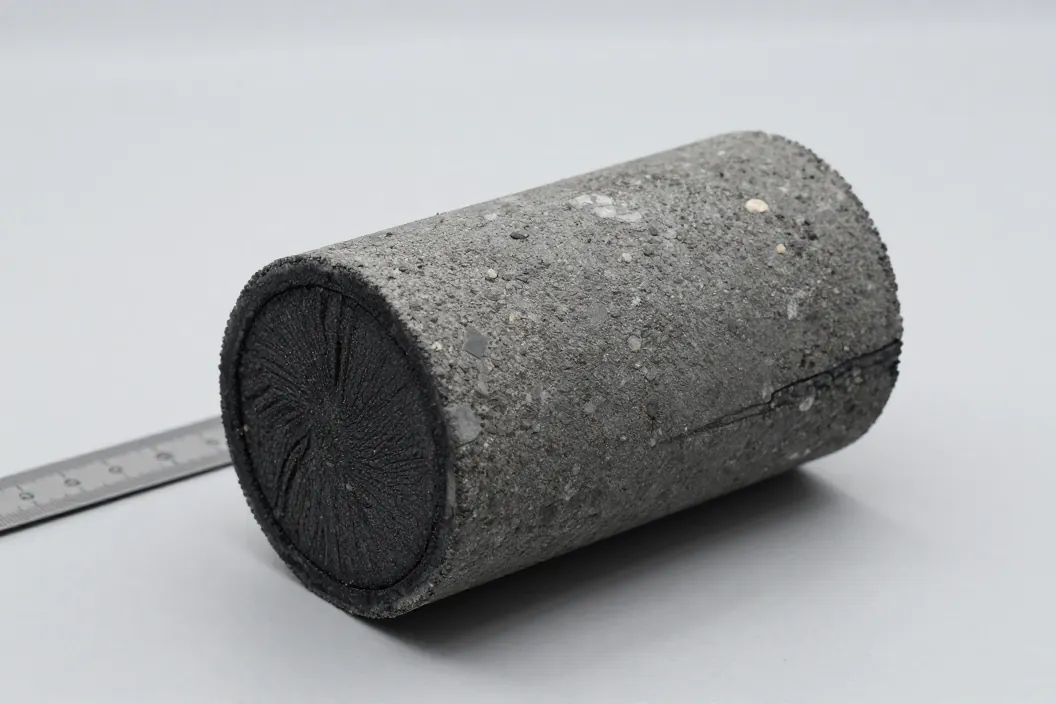
What the estimate consists of and how to read it
- Base preparation: soil removal, a 10 cm sand cushion and a 15–20 cm crushed stone base — if these lines are missing, the base is either not included in the price or will be done at the expense of thickness.
- Demolition and curbs: removing the old surface, installing curb stones and drainage channels — most often these 'pop up' as extra charges after the start.
- Prime coat: treating the base with bitumen emulsion before paving — without it, the top layer peels off the crushed stone in a single season.
- Materials and work: hot mix thickness (4–5 cm for paths, 6–7 cm for driveway and parking) and compaction with a vibratory roller are specified in separate lines.
- Removal: disposal of excavated soil and old surfacing — in the PROFI-DOM estimate this line is fixed in the contract, and the price does not change after signing.
How to check compaction and evenness of the surface
Evenness is checked with a rule and visually along the edges, and compaction — by the absence of loose areas and signs of sinking underfoot in warm weather. Place a three-meter rule against the surface in several directions: the gap under it should not exceed a few millimeters, and there should be no crumbling grains or cavities on the edge. Compaction quality is read from the edge — a dense, even edge without peeling indicates that the vibratory roller made enough passes, while a loose edge with crumbled gravel betrays haste. The slope of 1–2% from the house is checked with a level: after watering, water should flow toward the drain, not stand in puddles at the gate. Small irregularities on a fresh surface are best seen in oblique light — it is worth inspecting the area in the morning or evening, not at noon when the sun is at its zenith and hides the differences.
Typical mistakes: why the surface sags and cracks
The main reason is a thin layer of mixture on uncompacted base. We analyze four typical mistakes that appear in the second or third season and how to prevent them.
Why the coating settled and cracked
- The first mistake is weak soil without geotextile: after rain, the clay cushion loses its bearing capacity, and the fabric sags where a void has formed beneath it.
- The second mistake — an uncompacted base: a 15–20 cm layer, watered and rolled with a vibratory roller for 3–4 passes, holds the load, while a hastily poured layer spreads under the weight of a car driving in.
- Mistake three — too thin a layer of mix: 4–5 cm for a yard and 6–7 cm for a driveway is the working minimum, while a finish at 2–3 cm cracks along the wheel track within a season.
- Mistake four — no slope: water standing on the surface after rain seeps into cracks, freezes at night and opens them up in a single winter.
How to avoid mistakes at the preparation stage
PROFI-DOM starts with a free site visit for measurement and inspection: on site we determine the soil type, whether geotextile is needed and what layer thickness suits the object. On areas with loess-like loam, a separating material under the cushion is almost always laid — without it, weak soil subsides after the first rainy season. On a dense gravel base with a slope of 1–2% from the house, the standard pie is sufficient: sand 10 cm, gravel 15–20 cm under a vibratory roller, hot mix 4–7 cm depending on the zone. Inspection before the estimate is cheaper than any rework: weak soil and slope are visible on site, not in correspondence, and they determine which pie will withstand the load.
Conclusion
The final check boils the whole article down to five points: what is hidden behind the word "asphalt", how to select the mix for the load, and why the base matters more than the surface itself.
Key takeaways
- Terminology: in everyday use, asphalt and asphalt concrete mean the same thing — an artificial mixture of crushed stone, sand, mineral powder and bitumen laid hot or cold; this is the common name for such a surface.
- Choosing the mix: coarse grain is used for the entrance and car parking, fine and sandy — for the yard and pedestrian paths.
- Base: layer thickness works only on a compacted pie — sand cushion, crushed stone and passes of the vibratory roller are more important than the grade of the mixture itself.
- Engineering: slope, curbs and drainage trays are laid at the preparation stage; after paving they cannot be redone without opening the surface.
- Acceptance: sagging and cracks come from a weak base and a thin layer, so the estimate and pie are checked before the crew arrives on site.