Glossy or matt metal roof tiles: which is better for a roof in Almaty
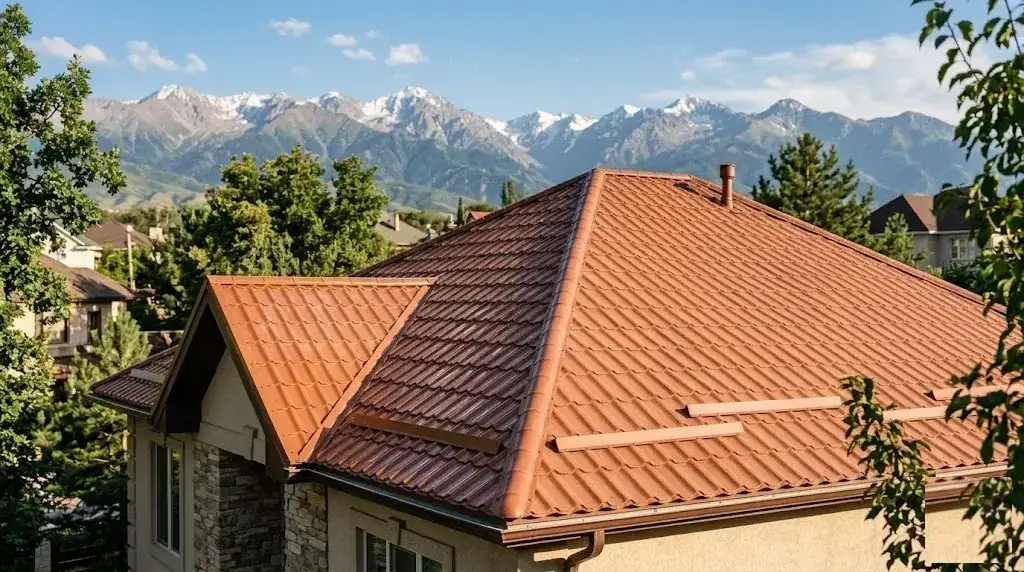
The choice between glossy and matte metal roof tiles depends on your priorities. Glossy is more affordable, shines brightly in the sun, but fades faster and shows scratches more readily. Matte is more expensive, does not glare, retains its colour longer and is more resistant to mechanical damage. For Almaty's bright sun, matte is the more practical choice.
How glossy metal roof tiles differ from matte
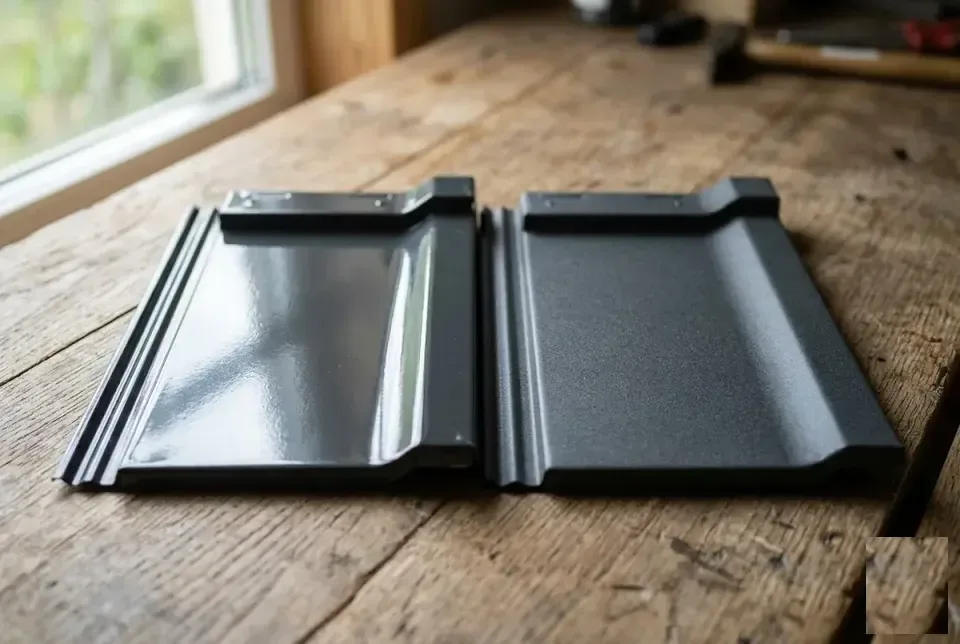
Which is better, glossy or matte metal roof tiles, is a common question, so let us examine it in detail. We will look at what both coatings are made of, how their structure differs and how this affects appearance and performance. The main difference lies in the thickness of the polymer layer and the degree of gloss.
What is glossy polyester
Glossy polyester is a polymer coating based on polyester paint with a gloss level of 60–80%, applied to galvanised steel 25 microns thick. Such a layer gives a characteristic mirror-like sheen, especially noticeable in the sun - which is why glossy material is often chosen for modern high-tech style houses. On the Almaty market glossy polyester is considered a budget solution: it is 15–20% cheaper than matte equivalents, but lasts on average 10–12 years. Due to the thin coating it masks micro-unevenness of the metal poorly - on gloss even small scratches from transport or installation are more noticeable.
What is matte polyester and Pural
Matte polyester is a coating with a gloss level of 20–30% and a thickness of 35 microns, while Pural is its reinforced version with added polyurethane, 50 microns thick and with increased resistance to UV and scratches. The matte effect is achieved through special matting additives in the paint, which scatter light — that is why the roof does not glare even under direct rays. Under the city's bright sun this is a serious advantage: a matte surface heats up less and creates no uncomfortable glare for neighbouring houses. Pural, in turn, adds elasticity — such a coating does not crack with temperature swings from −40 to +120 °C, which is relevant for a sharply continental climate.
The main differences in the coating structure — table
| Parameter | Glossy polyester | Matt polyester | Pural |
|---|---|---|---|
| Coating thickness | 25 µm | 35 µm | 50 µm |
| Degree of gloss | 60–80% | 20–30% | 20–30% |
| Base | Polyester paint | Polyester paint + matting additives | Polyester paint + polyurethane |
| Scratch resistance | Low | Medium | High |
| Fading resistance | Medium | High | Very high |
A difference in coating thickness of 10–25 microns seems insignificant, but it is precisely this that determines how soon scratches appear and fading begins. For Almaty's climate with abundant UV radiation, matte polyester or Pural is a more reliable choice: they retain their colour 3–5 years longer than gloss.
Resistance to fading and scratches
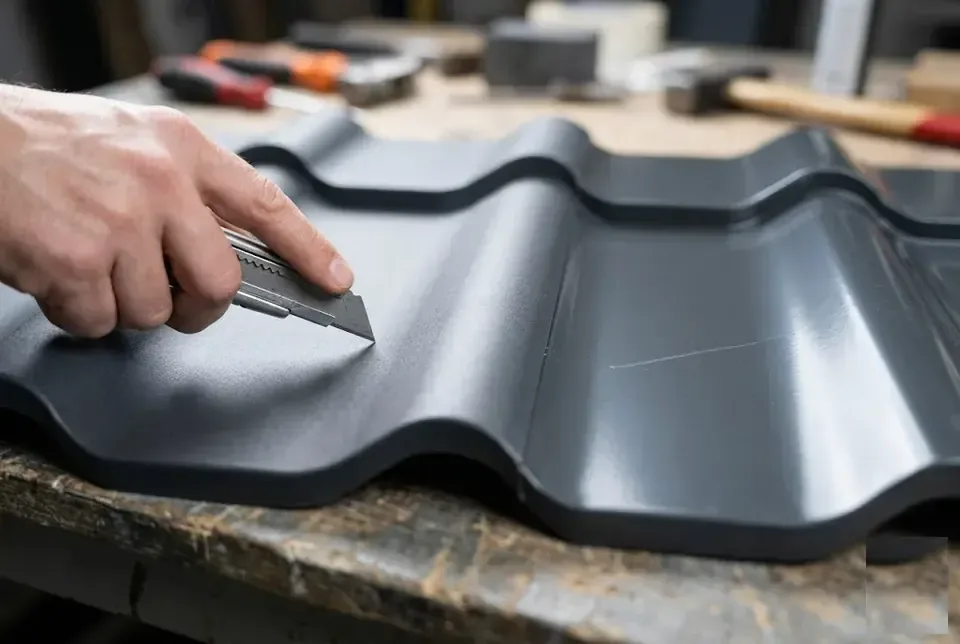
The difference between matte and glossy metal roof tiles is a frequent question, so let us examine it in detail. We will look at how glossy and matte coatings behave under the Almaty sun and under mechanical loads — installation, snow sliding off and hail.
Which metal roof tile fades less
Matte metal roof tiles fade more slowly than glossy: noticeable fading of gloss occurs after 5–7 years, of matte - after 10–12 years, provided quality UV stabilisers are present in the composition. The difference in the rate of polymer degradation is explained by the structure of the coating: glossy polyester is thinner (25 microns) and lets UV rays penetrate deeper, while the matte layer 35 microns thick contains scattering particles that reflect part of the radiation. In Almaty's bright sun, where the UV index reaches 8–9 in summer, even a quality matte coating shows a slight change of shade after 8–10 years - this is not fading but natural ageing of the polymer. Dark colours fade faster than light ones regardless of coating type - on southern slopes this is especially noticeable, so matte pastel shades are worth choosing for them.
Which metal roof tile scratches less
Matte metal roof tiles are considerably more resistant to scratches thanks to the greater coating thickness (35 microns versus 25 microns for gloss) and a more elastic polymer structure. During installation, micro-scratches from roofers' footwear, tools and accidental movement of sheets are left on a glossy sheet - in the sun they show up as thin light streaks. Matte coating, by contrast, hides such defects: its texture scatters light, and a scratch up to 10 microns deep does not read visually. When snow slides off a glossy roof, ice and rime leave micro-scratches that accumulate over time and become noticeable - on matte coating such defects are less visible visually.
How coating thickness affects wear resistance
A polymer coating thickness of 35 microns or more is considered good — this is the standard for matte polyester; 25 microns for gloss is the minimum acceptable, 50 microns for Pural is optimal for maximum protection. The difference of 10 microns between the gloss and matte layers gives an increase in abrasion resistance of 30–40%: under linear wear from sand and dust, a thin layer wears through to the galvanised steel faster. For Almaty's conditions with frequent winds and dust storms (up to 50–60 days a year) this is critical — matte metal roof tiles with 35 microns last 5–7 years longer before the first signs of corrosion appear. Coating thickness is directly linked to corrosion resistance: the thicker the layer, the longer moisture and oxygen take to reach the galvanised steel, especially at cuts and scratches.
Which colour fades less — dark or light
Light colours fade more slowly than dark ones regardless of the type of coating — beige, grey and light brown retain their richness 30–40% longer than dark green or cherry. This is due to the physics of light absorption: dark surfaces heat up more (up to 70–80 °C in the sun in Almaty), which accelerates the destruction of polymer bonds, while light ones reflect up to 60% of the radiation. Under Almaty's bright sun dark matte coatings heat up more, which accelerates polymer degradation — for southern regions light tones are twice as practical.
How gloss and matt look on a roof
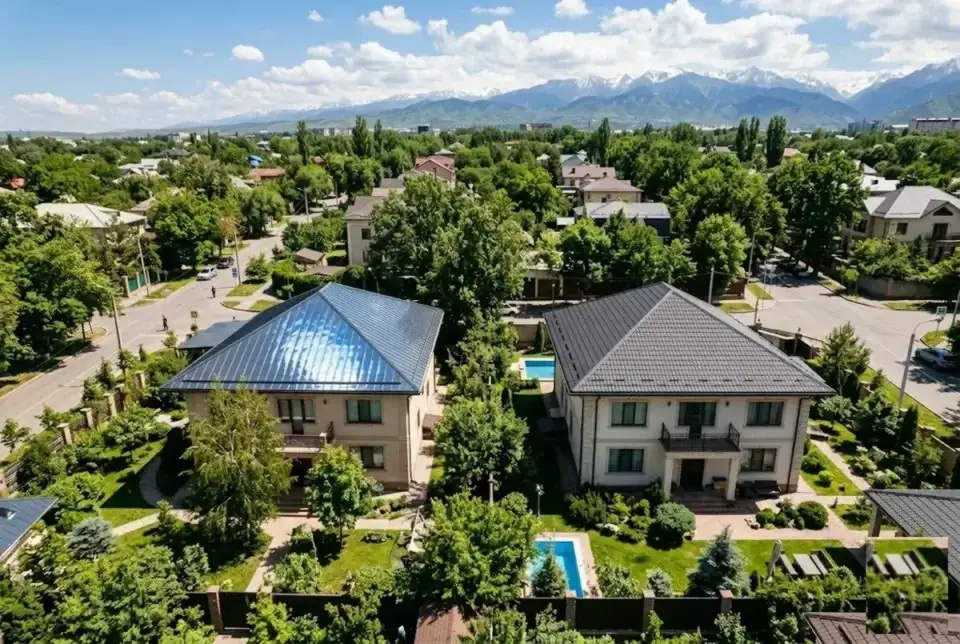
The appearance of the roof is one of the main selection criteria. Let's see how gloss and matte look at different times of day and which facades they pair well with.
Glossy coating: how it looks on a house
Glossy metal roof tiles give a bright mirror-like shine that is at its most pronounced in sunny weather - the roof “plays” and draws attention, but on a cloudy day it looks dull and flat. A polyester coating 25–35 microns thick reflects up to 80% of incident light, creating a “glass” surface effect. On the southern side of the slope the glare is especially intense from 11 to 16 o'clock when the sun is high. In dense developments - cottage towns “Akbulak”, “Miras”, “Alma-City” - neighbouring plots may end up in direct glare. On houses with a simple gable roof the gloss emphasises the geometry, while on a complex mansard roof it breaks up into numerous blinding spots. Glare from a glossy roof can dazzle neighbours and passers-by - in dense developments this is worth taking into account, especially if the neighbouring house's windows face your slope.
Matt coating: how it looks on a house
Matte metal roof tiles have a noble velvety shade without glare — visually they resemble natural clay tiles and look more expensive, especially in dark and rich colours. Matting additives in the polyurethane or polyester coating (thickness 35–50 microns) scatter light at an angle of 60–80°, so the colour stays uniform both at noon and at sunset. On roofs of complex configuration — with attics, valleys and dormer windows — the matte finish creates no visual noise: all the slopes look like a single sheet. In the colours RAL 8017 (chocolate), RAL 6005 (moss green) and RAL 9005 (anthracite) the “velvet” effect is especially noticeable — the coating seems thicker than it actually is. The “velvet” effect is achieved through light scattering by the matting additives — as a result the colour appears deeper and more uniform, with no variations in brightness across the slopes.
Combination with the facade and architectural style
Matte metal roof tiles in dark brown or green shades combine best with red brick and classical facades — they do not compete with the texture of the wall; gloss looks more organic with modern plaster and siding. For houses in hi-tech and minimalist style glossy metal roof tiles add a technological feel, while for cottages in a classical or chalet style matte creates the effect of a “warm” natural roof. In practice the following pairs are popular in Almaty: white plaster + graphite matte (RAL 7024) — for Scandinavian style; terracotta brick + green matte (RAL 6005) — for chalet; light beige siding + brown gloss (RAL 8017) — for modern classicism. If the facade has a bright colour (blue, burgundy), gloss will clash with it, whereas matte will mute and balance it. When choosing the roof colour, focus on the tone of the facade: dark roofs suit light walls, light ones suit dark walls, and matte gives more options in this scheme without the risk of oversaturating the look.
Can glossy and matt metal roof tiles be combined on one roof
Combining glossy and matte metal roof tiles on one roof is technically possible, but visually it rarely looks harmonious - the difference in shine creates a “patchwork” impression. Even if you take one colour from the same RAL palette, the glossy sheet will seem two or three shades lighter than the matte one because of sky reflection, especially in clear weather. In Almaty projects such a combination occurs only in isolated cases - usually on houses with large attics, where the upper tier is meant to stand out. If you really want to combine them, it is better to use matte on the main slopes and gloss on small architectural elements (canopies, bay windows) where the shine will not dominate.
What is stronger and more durable
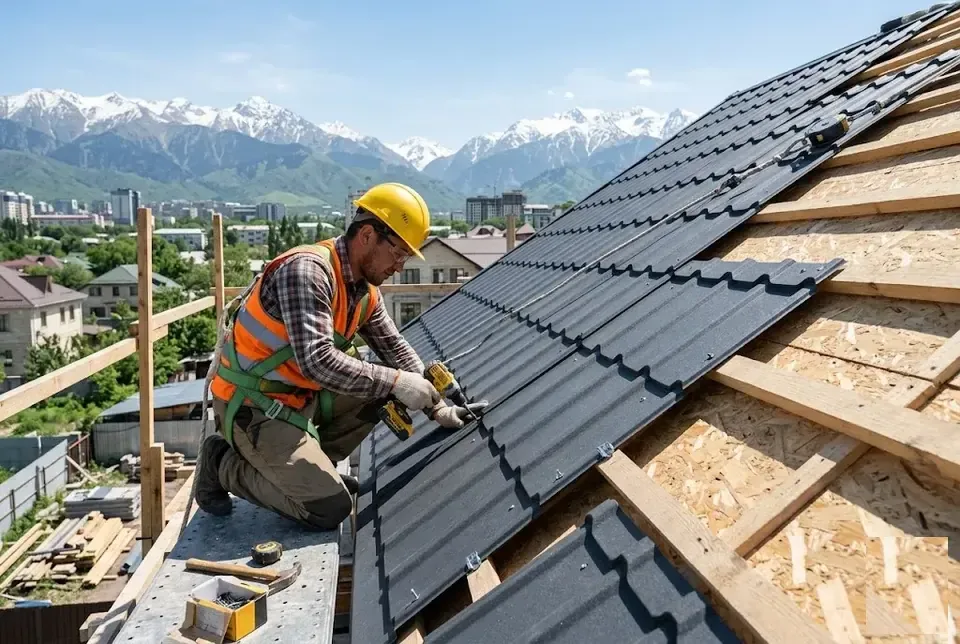
Service life and real strength only become apparent after several years of use. Let us compare how long both coatings last and what owners say.
How long glossy metal roof tiles last
Glossy polyester-based metal roof tiles last on average 15–20 years, but noticeable fading and micro-scratches appear after just 5–7 years, especially on southern slopes. The thickness of the glossy polymer layer is 25–35 microns, and it is more porous than matte: ultraviolet penetrates deeper, destroying the pigment faster. In Almaty's conditions, where solar activity is above the average for Kazakhstan, gloss on a southern slope can lose up to 30% of its colour saturation in the first 5 years - this is visible to the naked eye when compared with a sample. After 10 years the coating often begins to chalk: a white mark is left on your hands when touched, signalling degradation of the polymer. The actual service life of gloss depends greatly on installation quality - scratches left during laying become centres of corrosion and shorten the roof's life by 3–5 years, so every damaged area must be immediately touched up with repair compound.
How long matt metal roof tiles last
Matte polyester metal roof tiles last 20–25 years, while Pural lasts up to 30–35 years, provided the coating is quality and installation is correct. The difference in durability is explained by layer thickness: for matte polyester it is 35–50 microns, for Pural - up to 50 microns, plus UV stabilisers are added to the composition, which slow fading 2–3 times compared with gloss. On the Almaty market, matte metal roof tiles in the premium segment most often come with a Pural coating - its abrasion resistance is higher, so scratches do not form when snow slides off or when brushing with branches. Owners of matte roofing in Almaty note after 5–7 years that the colour remains virtually unchanged, and small scratches from branches and hail are visually unnoticeable - this is the main advantage over gloss, especially if the roof faces south.
What owners' reviews say after 3–5 years
In owners' reviews after 3–5 years, matte metal roof tiles receive higher ratings for colour retention and scratch resistance, while glossy tiles are more often criticised for fading and visible defects. On Almaty homeowners' forums, a typical complaint about gloss is “after 4 years the roof became dull, even though we washed it once a year”, with fading especially noticeable on the southern slope and the ridge. Owners of matte roofing, on the contrary, write: “after a winter with hail, not a single noticeable scratch, the colour is like new” — this is because the matte surface diffuses light and hides micro-scratches, which on gloss turn into noticeable white streaks. Many owners of glossy roofing after 5 years regret saving money — the difference in price at purchase is offset by the need to touch up scratches and put up with faded colour, whereas a matte roof requires no such hassle.
How to check coating quality when buying
- Uniformity of colour: the coating must be homogeneous, without drips, light spots or orange peel — this is a sign of stable polymer application.
- Sheet edges: there should be no chips or peeling of the polymer at the cut - defects on the cut line accelerate metal corrosion.
- Nail test: run a nail across the sample — a mark will remain on the glossy surface, but not on a quality matte one, which indicates the hardness of the coating.
- Certificate: request a document for the polymer coating stating the thickness and type of polymer — for matte at least 35 microns, for glossy 25 microns.
- Bend test: bend a sample — a quality coating will not crack or turn white at the bend, whereas a defective one will crack immediately.
Price difference
Price is one of the main arguments when choosing. Let us look at how much glossy and matte metal roof tiles cost and whether the extra charge for matte is justified.
How much glossy metal roof tiles cost
Glossy polyester-coated metal roof tiles are the most budget option, priced 20–30% lower than matte with the same metal thickness (0,45–0,5 mm) and profile (for example, “Monterrey” or “Cascade”). Due to the thinner layer - 25 microns versus 35 microns for matte polyester - manufacturers save on raw materials, which gives the difference of 500–800 KZT per square metre on the Almaty market. At the same time, glossy polyester is available in dozens of RAL colours, including the most popular shades RR-23 (red) and RR-32 (dark grey). Saving on gloss can turn into extra costs after 5–7 years - touching up scratches and replacing faded sheets on southern slopes often consumes all of the initial saving.
How much matt metal roof tiles cost
Matte metal roof tiles cost 20–30% more than glossy ones because of the thicker coating (35 microns versus 25 microns) and the additives that provide the matte effect and UV protection. In the price lists of Almaty suppliers the difference is 500–1200 KZT per square metre, depending on the steel manufacturer — ArcelorMittal or the Russian Severstal. Within the matte segment there is also a gradation: matte polyester is cheaper than Pural (polyurethane-polyamide) by 15–20%, but Pural offers twice the resistance to scratches and fading — for a climate with intense sun this is the best choice, despite the price of 3500–4500 KZT per square metre.
Is it worth paying extra for matte metal roof tiles
Paying extra for matte metal roof tiles is justified if you plan to live in the house for more than 5–7 years — over that time the difference of 500–1200 KZT per square metre is offset by colour retention and no spending on coating repairs. In practice we see that owners of houses with matte coatings in the villages of the Alatau district (for example, Kokzhiyek and Irgeli) do not encounter fading even after 10 years, whereas glossy sheets on southern slopes lose their richness by the fourth season. If the budget is limited, you can save on the profile and the thickness of the metal by choosing 0,45 mm instead of 0,5 mm, but not on the coating — cheap glossy polyester will lose its appearance under Almaty's bright sun within just 3–4 years.
Summary: what to choose for your needs
Let us bring all the parameters together into a single picture and help you decide — which type of coating suits which house, budget and climatic conditions.
When to choose glossy metal roof tiles
Glossy is worth choosing on a limited budget, for houses in shade or with north-facing slopes, and also if you plan to sell the house within the next 5–7 years. Under Almaty's bright sun, glossy polyester (25 microns) begins to fade noticeably after 5 years - on southern slopes the difference in tone between different sides of the roof becomes visible to the naked eye by the fourth season. The mirror shine 60–80% creates strong glare: if the windows of a bedroom or attic face south, at sunny midday the room will be uncomfortable without heavy curtains. On the other hand, on northern slopes and in regions with a cloudy climate the drawbacks of gloss (fading, glare) manifest minimally - here the saving is most justified, and the price difference of 20–30% against matte coating becomes a clear win.
When to choose matt metal roof tiles
Matte is worth choosing for southern regions with bright sun (Almaty, Shymkent), for houses with classical architecture and if you plan to live in the house for more than 10 years. A coating thickness of 35 microns (50 microns for Pural) gives the “velvet” effect — the matte surface scatters light, and the roof looks uniformly noble even under direct rays at noon. For houses with panoramic windows and terraces a matte roof is preferable — the absence of glare will not disturb your rest and will not create discomfort in double-height rooms. What is more, matte polyester lasts 20–25 years without fading, and Pural up to 35 years, which fully covers the term of a mortgage or of living in the house until the next major renovation.
Comparison table — glossy vs matte by key parameters
| Parameter | Glossy metal roof tiles | Matt metal roof tiles |
|---|---|---|
| Price per m² | Low (basic option) | Higher by 20–30% |
| Degree of gloss | 60–80% (mirror) | 20–30% (velvet) |
| Coating thickness | 25 µm | 35 µm (50 µm for Pural) |
| Fading resistance | Medium (5–7 years until noticeable fading) | High (10–12 years) |
| Scratch resistance | Low | High |
| Glare in the sun | Strong, can be dazzling | None |
| Service life | 15–20 years | 20–25 years (up to 35 years for Pural) |
| Recommendation for Almaty | Only for northern slopes | Optimal choice |
Conclusion
Let us sum up the key differences between gloss and matte in simple points — so that you can make a decision without unnecessary doubts.
Key takeaways
The choice between glossy and matte metal roof tiles is a trade-off between price and durability. Glossy coating is cheaper but fades faster, scratches more easily and creates glare - it suits northern slopes and a limited budget. Matte coating is more expensive but retains its colour longer, is more resistant to mechanical damage and does not glare - for Almaty's bright sun this is the more practical solution. If you plan to live in the house for a long time, the extra cost of matte pays off through the absence of repair and touch-up expenses. The main thing is not to skimp on the quality of the coating and installation, and then the roof will delight you for decades.