
Metal roof tiles or flexible shingles: which is better for a house roof
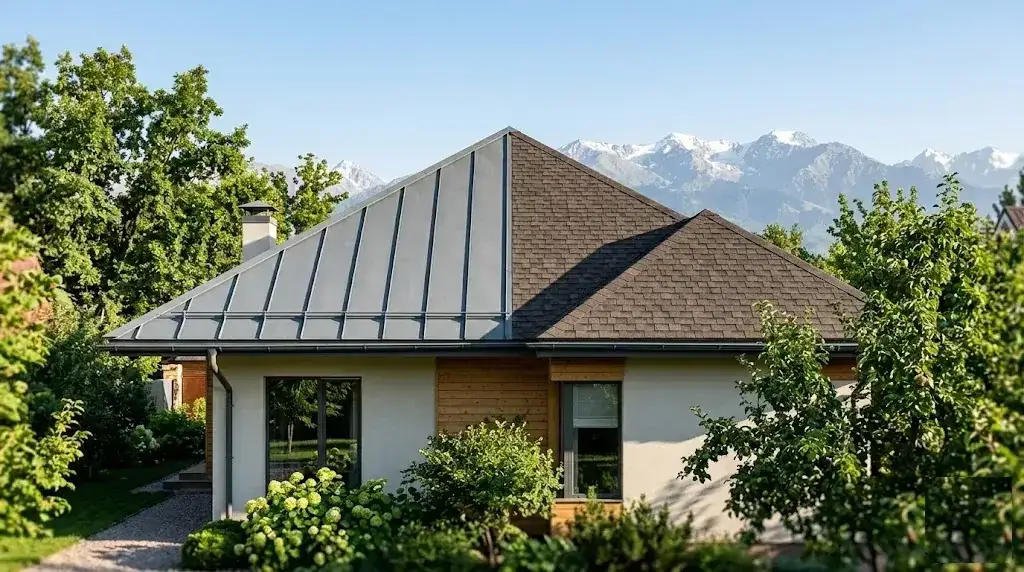
The choice between metal roof tiles and flexible shingles depends on the roof shape, budget and noise requirements. Metal roof tiles are lighter, cheaper and easier to install on simple pitches. Flexible shingles are quieter, produce less waste on complex roofs and do not require snow guards. Both materials last 25–50 years when installed correctly.
Metal roof tiles and flexible shingles — what's the difference
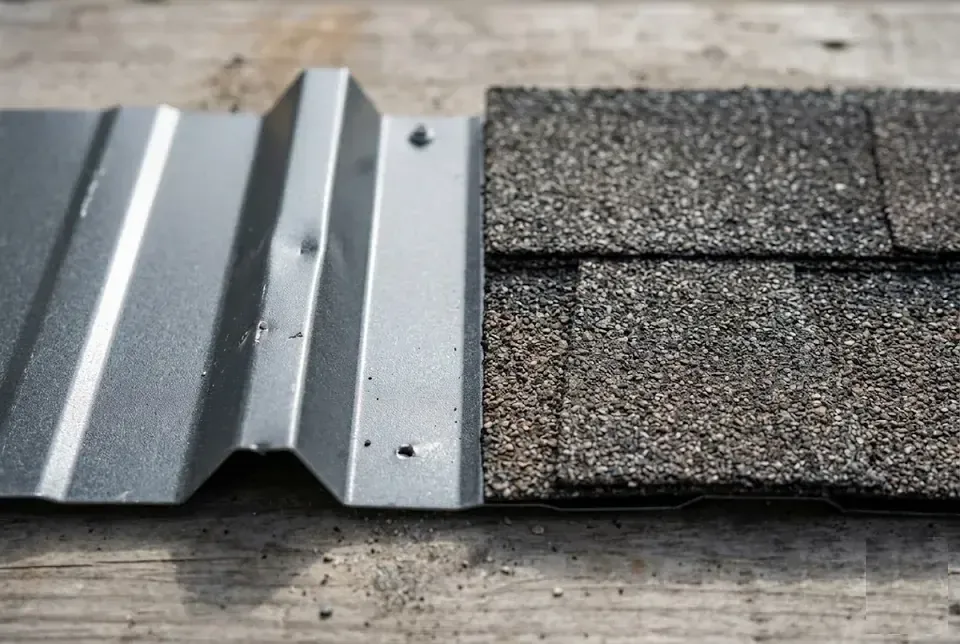
Which is better, metal roof tiles or flexible shingles, is a common question, so let us look at it in detail. To choose between these materials, you need to understand what they are made of and how they are constructed. Let us look at the construction, composition and key features of each option.
What metal roof tiles are made of
Metal roof tiles are profiled sheets of galvanised steel 0,4–0,5 mm thick with a multi-layer polymer coating. The steel base is cold-stamped to create a relief imitating natural tilework. A primer is applied over the galvanising, then the polymer - polyester 25 microns, matt polyester, Pural or plastisol; each gives a different resistance to scratches, fading and corrosion. The underside of the sheet is coated with a protective varnish. The Kazakh manufacturer Armada produces sheets up to 6 m long; the Russian Metal Profile and Grand Line offer different steel thicknesses and lock types. The polymer coating determines colour fastness: polyester lasts 10–15 years, Pural up to 25 years, so on southern slopes, where the sun is more aggressive, it is worth choosing Pural or matt polyester - they fade less and do not crack with temperature changes.
What flexible shingles are made of
Flexible shingles are bitumen shingles based on a fibreglass mat, coated with basalt granules, with a self-adhesive layer for installation. The fibreglass mat serves as the reinforcing core - it does not rot or stretch, and the bitumen impregnation makes the shingle waterproof and elastic even at sub-zero temperatures. On top, basalt granules are pressed in - coloured stone chips that create a rough texture when fused. On the underside there is a self-adhesive bitumen layer protected by a silicone film - it is removed before laying. Popular collections on the market include “TechnoNICOL” (Shinglas), “Katepal” and “CertainTeed” with different cut shapes - shingle, beaver tail, hexagon. The basalt granules serve three functions: they protect the bitumen from ultraviolet light, give colour and create a rough surface that holds snow - on steep Almaty pitches this is an advantage, while on shallow ones (up to 15°) it requires a mandatory underlayment carpet over the entire area, otherwise meltwater seeps under the shingles.
Comparison of materials: table
| Parameter | Metal roof tiles | Soft tiles |
|---|---|---|
| Base | Galvanised steel 0,4–0,5 mm | Fibreglass mat impregnated with bitumen |
| Protective layer | Polymer coating (polyester, Pural) | Basalt granules |
| Form of supply | Sheets up to 6 m long, 1,1–1,2 m wide | Shingles 1 m long, 0,3–0,4 m wide |
| Weight of 1 m² | 4–7 kg | 8–12 kg |
| Type of base | Spaced battens (35–50 cm pitch) | Solid decking made of OSB boards or plywood |
| Number of layers | A single layer of sheets | 2–3 layers of overlapping shingles |
What is a roofing pie and why it matters
The roofing assembly is a multi-layer structure comprising a vapour barrier, insulation, waterproofing and a ventilation gap, and it is the same for both materials. When installing a pitched roof in the Almaty climate - with sharp temperature swings and snow loads - the order of the layers is mandatory: from the inside, the vapour barrier protects the insulation from moisture from the room, then mineral wool 150–200 mm, on top a superdiffusion membrane, and above that a counter-batten creating a ventilation gap of 40–50 mm. Without ventilation, condensation destroys the rafters and halves the service life of the insulation. The only difference is that under flexible shingles an underlayment is mandatory across the entire roof slope, whereas under metal roof tiles it is laid only in the valleys and at the eaves, which saves about –3000 KZT per 100 m² of roofing.
Which roofs each is suitable for
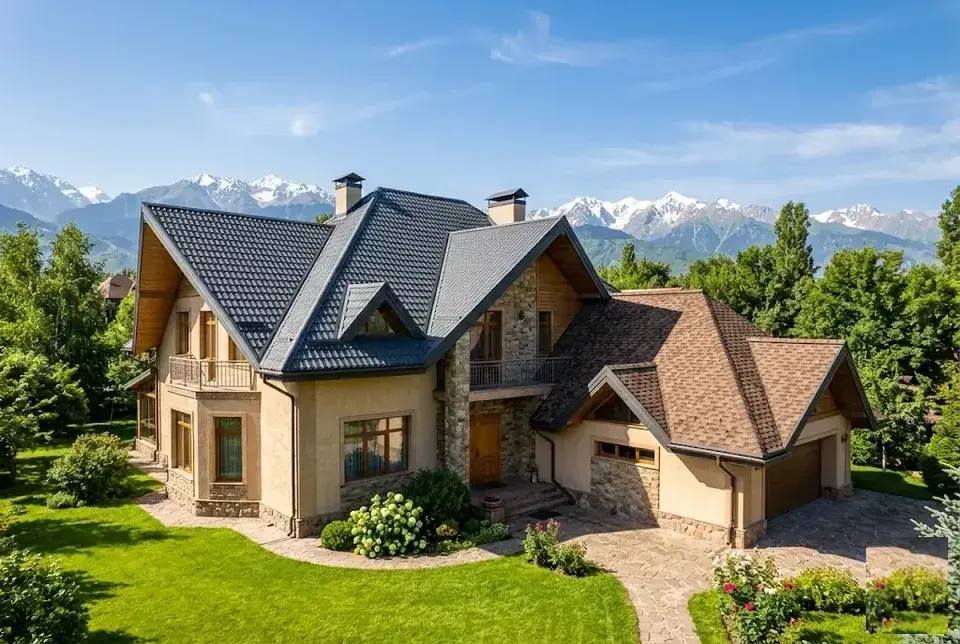
The difference between flexible shingles and metal roof tiles is a common question, so let us examine it in detail. The shape of the roof is the main factor determining which material will suit better. Let us look at what to choose for simple gable, complex hip and attic roofs.
Simple gable roof — metal tiles or flexible shingles
For a simple gable roof with a pitch from 15°, metal tiles are the most cost-effective option: waste is minimal (3–5%), installation is fast and the price is lower. The sheets are ordered exactly to the length of the slope, so on a standard gable roof with an area of 100 m² no more than 3–5 m² of offcuts remain, and laying takes 1–2 days with a crew of two. Flexible shingles on the same roof produce the same 3–5% waste, but require a solid base of OSB or plywood, which adds 300–400 KZT per m² to the cost of the roofing system. On a simple roof, metal tiles can be ordered in sheets of exact length for the slope — this eliminates transverse joints and speeds up installation 2–3 times compared with flexible shingles.
Complex hip roof — what to choose
For a hip and multi-gable roof, flexible shingles are preferable: waste amounts to 5–10% versus 15–20% for metal tiles. On a hip roof with an area of 150 m² with four slopes, valleys and dormer windows, metal tiles produce up to 25–30 m² of offcuts because each sheet is cut to the triangular shape of the slope, while flexible shingles produce 10–15 m², since the shingles are cut with an ordinary knife and fitted on site. Installing metal tiles on such a roof takes 4–6 days because each sheet must be precisely cut for each slope. On a complex roof, every valley and abutment with metal tiles requires cutting the sheets, which increases waste and installation time, whereas flexible shingles are cut with an ordinary knife and laid without gaps.
Attic roof — which material is better
For an attic roof, flexible shingles are the better choice because they absorb the noise of rain and hail, which is critical for a living space under the roof. Metal tiles in an attic without good soundproofing cause discomfort: the noise of rain reaches 40–50 dB, which is comparable to a loud conversation, and insulation reduces it only to 25–30 dB. Flexible shingles, thanks to their bitumen base and stone granules, dampen sound down to 20–25 dB — that is the level of a whisper. On an attic roof, Almaty homeowners often insulate the slopes with mineral wool 200–250 mm thick, but for metal tiles this is not enough — soundproofing membranes have to be added, which increases the budget by 800–1000 KZT per m².
Low-pitch roof (10–15°) — what will work
For a roof with a pitch of 10–12°, only flexible shingles are suitable, while metal tiles can be installed at a pitch from 12–15° with mandatory sealing of the transverse joints. On a low-pitch roof, metal tiles require reinforced waterproofing and solid sheathing in the joint areas, otherwise water seeps under the sheets during slanting rain. Flexible shingles at a pitch of 10° are laid on a solid base with an underlayment carpet over the entire area — their tightness is ensured by the self-adhesive layer of the shingles, which fuses into a single whole when heated by the sun.
Which is quieter and more comfortable in the rain
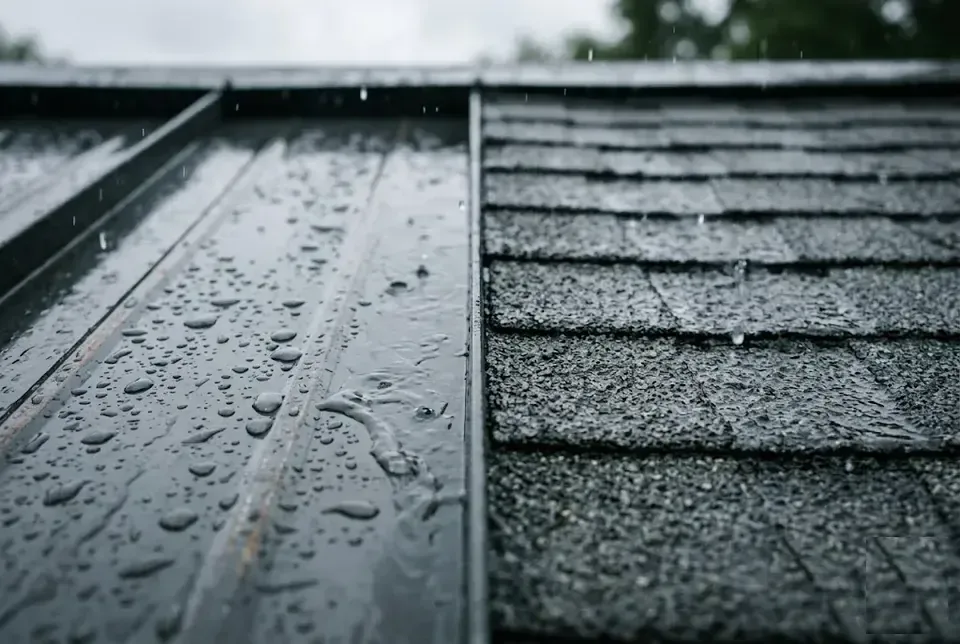
The noise of rain on the roof is one of the main fears when choosing metal roof tiles. Let us look at how critical the difference in noise is and how it can be reduced.
How noisy metal roof tiles are in the rain
Metal roof tiles create noise of 40–50 dB during rain - this is the level of a loud conversation or a running vacuum cleaner. During a heavy downpour with hail (more than 30 mm of precipitation per hour) peak values reach 55–60 dB, comparable to the noise of a busy motorway. Sheet thickness is critical: a 0,5 mm profile rattles noticeably more quietly than 0,4 mm, and a Pural polymer coating with filler partially dampens the vibration of the metal - the difference reaches 5–8 dB. The pitch angle also plays a role: on shallow roofs (15–25°) the drops strike almost vertically, creating a sharper sound than on steep ones (35–45°), where the impact is glancing. Noise in an uninsulated attic during rain can wake light sleepers - at a level of 45 dB and above, the waking threshold is reached after 10–15 minutes of continuous downpour.
Flexible shingles — are they really quiet
Flexible shingles create noise of 20–30 dB in the rain - that is the level of quiet conversation or rustling leaves, which is 2–3 times quieter than metal roof tiles. The bitumen base and basalt granules act as a multilayer sound absorber: a raindrop first meets the hard mineral granules, which dissipate the impact energy, and then the resilient bitumen dampens the residual vibration. Even hail up to 1,5 cm in diameter does not create sharp sounds - only a dull “slapping” sound is heard, not exceeding 35 dB. In our measurements in a standard attic with flexible shingles, a whispered conversation (20 dB) was heard more clearly than the rain outside the window. That is why for attic bedrooms soft roofing is the preferred option without additional soundproofing work.
How to reduce the noise of metal roof tiles
The noise of metal roof tiles can be reduced to 25–30 dB with high-quality roof insulation (mineral wool 200–250 mm) and correct installation with a vibration-isolating tape. A layer of 150 mm gives a reduction only to 35–40 dB - this is enough for an uninhabited attic, but not enough for a bedroom in the loft, where the comfortable threshold is below 30 dB. A vibration-isolating tape under the battens, clamped between the rafters and the metal, breaks the rigid connection - without it, sound travels through the wooden frame like a drum, and insulation loses up to 40% of its effectiveness. An additional technique is the installation of a solid base (OSB-3 or 9–12 mm plywood) under the metal roof tiles on complex roofs with valleys: it dampens vibration at the sheet joints. The final difference between “quiet” metal roof tiles with full insulation and flexible shingles without any improvements is only 5–10 dB, which is almost imperceptible to the ear.
Which roofing is not afraid of hail
Flexible shingles with basalt granules withstand hail better - they absorb the impact, whereas metal roof tiles can get dents from large hail from 2 cm in diameter. The basalt granules act as a shock absorber: when a hailstone strikes, the energy is dissipated across the surface, and the elastic bitumen returns to shape - even after intense hail no visible damage remains. Metal roof tiles 0,4–0,5 mm thick deform when struck by hail 2,5–3 cm in diameter: dents up to 2–3 mm deep form, which do not break the seal (the polymer coating rarely cracks) but spoil the appearance and over time can lead to corrosion at the point of deformation. In Almaty conditions, where hail occurs 2–4 times per season, over 5–7 years a noticeable “ripple” accumulates on metal roof tiles on the southern and western pitches - this reduces the reflective capacity of the coating and the aesthetics of the facade.
Waste and installation complexity
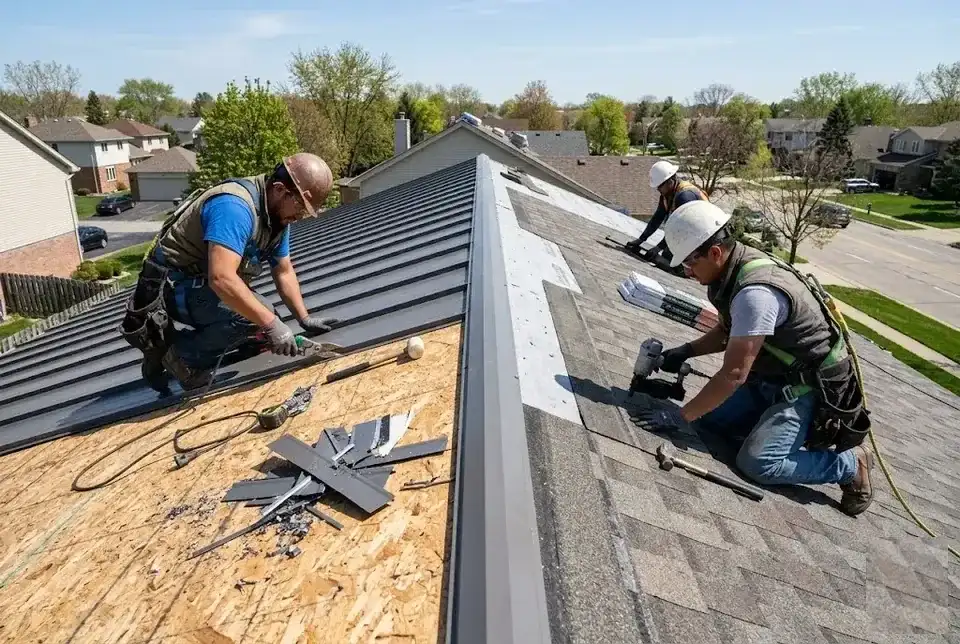
Comparing soft roofing and metal roof tiles is a common question, so let us look at it in detail. Flexible shingles or metal roof tiles, which to choose, is a common question, so let us look at it in detail. The amount of waste and the complexity of installation directly affect the final cost of the roof. Let us look at how much material is lost as waste on different roofs and what conditions are needed for installation.
How much waste metal tiles produce on a simple and a complex roof
On a simple gable roof, metal roof tile waste is 3–5%, while on a complex hip roof it is 15–20% because of cutting sheets at valleys and abutments. The problem is that a standard sheet has a fixed length of up to 6–8 metres and cannot be cut lengthwise - only across the corrugation. On a hip or pyramid roof, triangular and trapezoidal slopes require individual cutting of each sheet, and offcuts less than 50 cm long generally go to waste, because they cannot be used on another slope due to the direction of the profile. When ordering for a complex roof, it is worth allowing a reserve of 15–20% — - this is not just insurance against defects, but a real consumption confirmed by measurements on site.
How much waste flexible shingles produce on different roofs
Flexible shingles produce 3–5% waste on a simple roof and 5–10% on a complex one, because the shingles are easy to cut and fit on site with no length restrictions. Each shingle about a metre long can be cut with a knife into fragments of any shape - triangles for valleys, strips for ridges, wedges for junctions with dormer windows. Offcuts of shingle around 15–20 cm long often go into additional elements, such as ridge-and-eaves shingles, so there is almost no real waste. Savings on waste on a complex roof can amount to 10–15% of the material cost - this partly offsets the higher price of flexible shingles compared with metal roof tiles, and in practice the difference in the final estimate often turns out to be smaller than it appears when comparing prices per square metre.
Can flexible shingles be installed in winter
Flexible shingles can be installed in winter only at temperatures above +5°C, otherwise the self-adhesive layer does not activate and the shingles do not seal. The bitumen layer on the underside of the shingle requires solar heat or at least a positive temperature to melt and bond with the underlayment carpet - below zero it remains hard and does not form a watertight bond. In addition, at temperatures below 0°C the bitumen becomes brittle, and when you try to bend a shingle at the ridge or valley it cracks instead of bending, which makes installation on complex sections practically impossible. Winter laying is possible only using a heat gun to warm each shingle, which slows the work by 2–3 times and increases the cost - on the Almaty market crews charge 30–50% more for winter installation than for summer.
Can metal roof tiles be installed in winter
Metal roof tiles can be installed in winter at temperatures down to -15°C, but with limitations: the sheets become brittle, and the polymer coating may crack when cut or struck. Galvanised steel 0,45–0,5 mm thick retains its ductility down to -10°C, but at lower temperatures even careful cutting with roofing shears can produce microcracks at the cut edge, which will become centres of corrosion in summer. In winter this material must not be cut with an angle grinder - sparks damage the polymer coating, and at sub-zero temperatures the damage leads to corrosion faster than in summer, because of condensation under the snow. We recommend using only manual roofing shears or electric nibblers - and at temperatures below -10°C moving the cutting indoors to avoid chipping the polymer along the cut line.
Which is more durable and cheaper
Service life and maintenance cost are key parameters when choosing roofing. Let us compare how long the materials last, how they are repaired and which is ultimately more cost-effective.
How long metal tiles last and what the service life depends on
The service life of metal roof tiles is 20–50 years depending on the steel thickness (0,4–0,5 mm) and the type of polymer coating: polyester lasts 10–15 years, Pural - up to 25 years, and PVDF (polyvinylidene fluoride) coating retains colour for up to 30–35 years. The quality of the zinc layer also plays a role - premium manufacturers apply zinc to the EN standard of 10143 (275 g/m² on both sides, while budget brands may be one and a half times thinner, which shortens the time to corrosion by 8–10 years. On the Almaty market, 0,45 mm steel with a Pural coating is popular - such material lasts 20–25 years without visible changes. The real service life of this coating is most often limited not by steel corrosion but by fading and breakdown of the polymer layer - repainting may be required after 15–20 years, and this should be taken into account when calculating a budget over a decade.
How long flexible shingles last and what the service life depends on
The service life of flexible shingles is 25–60 years depending on the quality of the bitumen, the thickness of the fibreglass mat and the grade of basalt granulate. Oxidised bitumen (as in budget ranges) begins to crack after 15–20 years, whereas SBS-modified bitumen (styrene-butadiene-styrene) retains its elasticity for up to 40–50 years even with temperature swings from −40 °C to +50 °C, typical of Almaty's climate. Basalt granulate varies by grade: coarse-grained (0,5–1,5 mm) is embedded more densely in the bitumen and sheds less than fine crumbs. Flexible shingles lose granulate after 10–15 years - this does not affect watertightness, but it worsens the appearance and reduces UV resistance, so it is important to choose a material with dense granulate embedding, especially on southern slopes with intense sun.
Which is easier to repair in case of a leak
Flexible shingles are easier to repair: a damaged shingle can be replaced locally without dismantling the entire roof, whereas metal roof tiles require replacing a whole sheet that is fastened to the neighbouring ones with screws. In practice, with a leak on metal roof tiles it is often enough to seal the joint or replace the fastener if the problem is a loosened screw with a rubber gasket - this takes 15–20 minutes. With flexible shingles it is more complicated: a leak usually means damage to the underlayment carpet, and to access it you need to open up 2–3 shingles, re-glue the bitumen mastic and restore the surfacing - an hour to an hour and a half of work, allowing for the mastic to cool. Metal roof tiles win in situations where the leak is caused by mechanical damage to the sheet (a branch strike, hail) - replacing one sheet by unscrewing 8–12 screws is done faster than dismantling and re-gluing the shingles.
Which roofing requires less maintenance
Both materials require minimal maintenance: it is enough to inspect the roof once a year and clear it of debris, but metal roof tiles need the fasteners and snow guards checked. On metal roof tiles, screws with rubber washers dry out over time - 5–7 years after installation they should be tightened, and loose ones replaced, to avoid leaks at the fixing points. Flexible shingles do not require snow guards - the rough granular surface holds snow, whereas on metal roof tiles snow guards are essential for safety and must be checked after every winter: the fastenings to the batten loosen under snow load, and a single torn-off element can damage the sheet. On complex roofs with valleys and abutments, maintenance of flexible shingles is simpler - ice dams that could damage the joints form on it less often.
Comparison of durability and cost: table
| Parameter | Metal roof tiles | Soft tiles |
|---|---|---|
| Service life | 20–50 years | 25–60 years |
| Material price per m² | Lower by 15–30% | Higher by 15–30% |
| Cost of the base | Lower (spaced battens) | Higher (OSB board) |
| Waste on a simple roof | 3–5% | 3–5% |
| Waste on a complex roof | 15–20% | 5–10% |
| Snow guards | Mandatory | Not required |
| Repair in case of leaks | Sheet replacement | Local replacement of shingles |
The difference in material price (15–30%) is often offset by the cost of a solid base under flexible shingles and of snow guards for metal roof tiles. On a simple gable roof with an area of 100 m², metal roof tiles are more economical by 15–20%, while on a complex hip roof with several valleys flexible shingles turn out cheaper thanks to less waste.
Conclusion: which to choose
Let us bring all the parameters together into a single picture and give clear recommendations for different situations. The choice depends on the roof shape, the budget and priorities regarding noise.
When to choose metal roof tiles
Metal roof tiles are worth choosing for simple gable roofs with a pitch of 15° or more, when the budget is limited and noise is not critical - for example, with an uninhabited attic or good sound insulation. On a spaced batten with a pitch of 350 mm the material is installed in 1–2 days; the minimal overlap of sheets gives a consumption exactly equal to the roof slope area with no allowances. Local crews charge 15–20% less for installing such coverings than for laying flexible shingles, and the cost of the material itself per square metre is lower by 25–35% with brands such as Grand Line or Ruukki. At the same time, on a simple roof the waste does not exceed 3–5%, and snow guards are needed only above entrances. If the roof is simple and the house has no attic, this option gives savings of 20–30% compared with flexible shingles at the same service life - it is the most rational choice for standard designs.
When to choose flexible shingles
Flexible shingles are worth choosing for complex hip and attic roofs, for houses with a habitable attic, and also for roofs with a low pitch — from 10°. On a hip or multi-gable roof, metal tile waste reaches 15–25%, whereas flexible shingles on a solid OSB board base produce only 3–7% offcuts — the price difference between the materials shrinks to 5–10%. In an attic, flexible shingles dampen the sound of rain down to 30 dB, which is comparable to the level of a quiet conversation, and do not require additional ceiling soundproofing. At the same time, the minimum pitch of 10° allows covering shallow slopes, on which metal tiles leak due to water rising under the capillary effect. On a complex roof, the price difference between the materials shrinks to 5–10% thanks to less waste and the absence of snow guards, and the comfort of silence in the rain becomes the decisive argument.
Step-by-step selection algorithm
- Step 1 — roof shape: simple gable or single-pitch with an angle from 15° → metal roof tiles; complex hip, multi-gable or pyramidal → flexible shingles; low-pitch (10–15°) → flexible shingles only.
- Step 2 — presence of an attic: habitable loft → flexible shingles (quieter in rain without extra soundproofing); uninhabited attic → metal roof tiles (cheaper by 20–30%).
- Step 3 — budget: limited on a simple roof → metal roof tiles; medium on a complex roof → flexible shingles (less waste and fewer extra costs for trim elements).
- Step 4 — climate of the area: strong winds (outskirts of Almaty) → flexible shingles (the rough surface holds snow and is not torn off); calm zone → metal roof tiles.
- Step 5 — final check: if after four steps the choice is not obvious - give preference to flexible shingles: they are more versatile, quieter and easier to repair, although more expensive on simple roofs.
Typical mistakes when choosing
The most common mistake is choosing a material solely by price, without taking into account the roof shape and noise, which leads to overspending on waste on a complex roof or to discomfort in an attic under metal roof tiles without sound insulation. The second most common mistake is saving on the base: under flexible shingles you cannot use a spaced batten, otherwise waves appear on the shingle within a year; and under metal roof tiles you cannot use a solid deck without a ventilation gap, which causes corrosion on the inside within 3–5 years. The third is ignoring the snow load: on steep slopes (from 45°) metal roof tiles shed snow in an avalanche, whereas flexible shingles with a basalt granule coating hold it and reduce the risk of canopies collapsing. When ordering material, check the fire safety certificates - cheap flexible shingles without a glass fibre mat have a flammability class of G4, not G2, which is critical for houses with stove heating.
Conclusion
We have covered the key differences between flexible shingles and metal roof tiles. Let us bring the parameters together into a checklist that will help you make a decision without the risk of getting it wrong.
Key takeaways
- Metal roof tiles - for simple gable roofs with a limited budget. They are cheaper in material, do not require a solid base and produce less than 5% waste on rectangular slopes. The downside is noise during rain, which will require additional sound insulation in the attic.
- Flexible shingles - for complex hipped and multi-gabled roofs. They are silent, watertight at any bend and produce 3–7% waste versus 15–20% for metal on such shapes. The downside is the mandatory continuous base of OSB or plywood, which makes the roofing pie more expensive by 20–30%.
- Durability is comparable: 25–50 years with proper installation. The decisive factor is not the service life, but the shape of the roof and the presence of a habitable attic under the roof.
- Noise is a hidden criterion that shows up once you move in. If metal roof tiles without good sound insulation (mineral wool 200+ mm) are above a bedroom, every rain will become a discomfort.
- The final choice comes down to three questions: the shape of the roof, whether there is an attic, and what the budget is. By answering them in advance, you will get a clear recommendation with no overspending.