
Corrugated sheet or metal roof tiles: which is better for a roof — full comparison
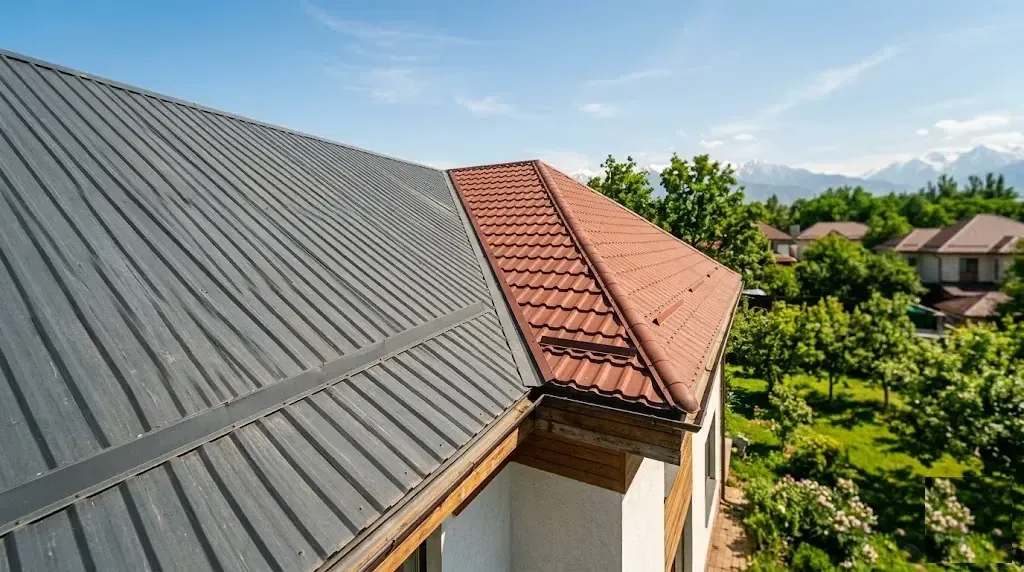
Choosing between corrugated sheet and metal roof tiles is a compromise between price, aesthetics and practicality. Corrugated sheet is cheaper, easier to install and produces less waste. Metal roof tiles are more aesthetically pleasing, better suited to complex roofs and have a longer service life when installed correctly. The decision depends on the roof shape, budget and architectural preferences.
Corrugated sheet and metal roof tiles — what is the difference
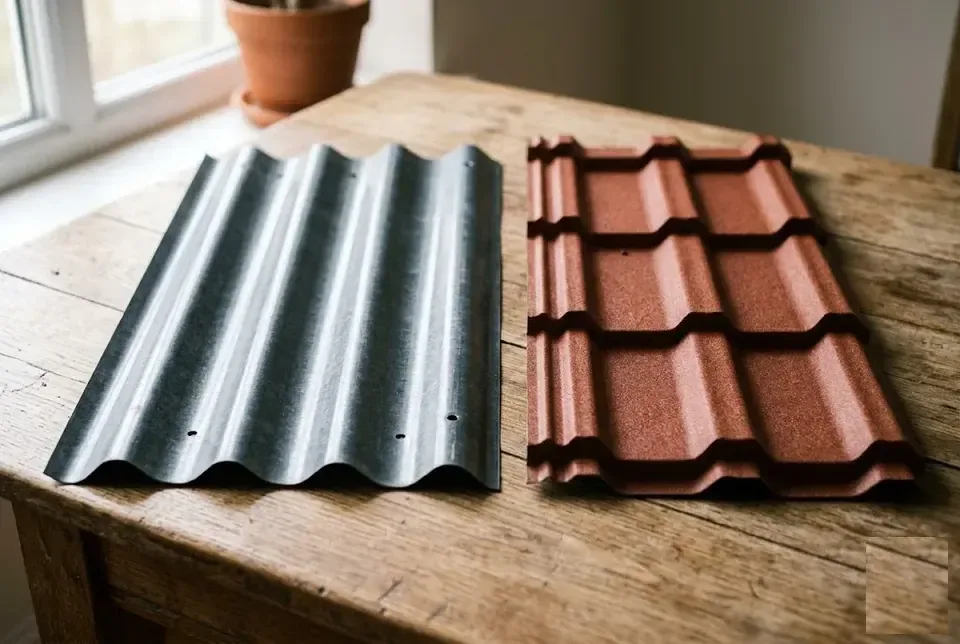
Which is better, corrugated sheet or metal roof tiles, is a common question, so let us examine it in detail. Both materials are profiled galvanised metal with a polymer coating, but they differ in profile shape, purpose and aesthetics. Let us work out the key difference between these coverings and what to choose for your roof.
What corrugated sheet is: profile, purpose, types
Corrugated sheet is profiled steel sheet with a trapezoidal profile, produced with a wave height from C8 (wall) to H75 (load-bearing) and used for roofing, fences, facades and floors. The height of the trapezoid determines stiffness: grades C8–C21 are used for fencing and walls, NS35–NS44 — for pitched roofs with batten pitch up to 500 mm, and H60–H75 — for flat roofs and load-bearing structures. In the city, private houses most often use NS35 and NS44 at a pitch from 8°: they withstand snow loads of up to 180 kg/m² without solid battens. For roofing, material of grades NS35, NS44 or H60 — is chosen — they have sufficient stiffness for snow loads and a batten pitch of 500 mm, which saves up to 30% of sawn timber compared with metal roof tiles.
What metal roof tiles are: profile, types, features
Metal roof tiles are profiled steel sheet with a wave-like profile imitating natural tiles, with a wave pitch of 350 mm, and are produced in the Monterrey, Cascade, Andalusia and Shanghai profiles. Monterrey is the most popular in Kazakhstan, giving a classic "tiled" pattern; Cascade has clear geometric steps suited to standing seam roofing; Andalusia has an asymmetrical wave for the Spanish style. The wave height is fixed for all profiles — 25–30 mm — so the rigidity of the sheet is not adjusted by grade, only by steel thickness (0.4–0.5 mm). Because of the fixed wave pitch (350 mm), the batten spacing under metal roof tiles is always 350 mm, which increases timber consumption by 30–40% compared with corrugated sheeting — on a roof of 100 m² this means an extra 2–3 m³ of lumber.
Main differences between corrugated sheeting and metal roof tiles: comparison table
| Parameter | Corrugated sheeting | Metal roof tiles |
|---|---|---|
| Profile shape | Trapezoidal | Wavy (imitation of tiles) |
| Profile height | 8–75 mm (depends on the grade) | ~25–30 mm (fixed) |
| Batten spacing | 500 mm | 350 mm |
| Minimum slope | 8° | 12° |
| Waste on a simple roof | 5–10% | 10–15% |
| Waste on a complex roof | 10–15% | 20–40% |
| Appearance | Strict, industrial | Classic, “tile-like” |
| Price per m² | Lower by 15–25% | Higher |
These figures are averages for the Almaty roofing materials market at the start of the season. The choice between the strict geometry of corrugated sheet and the classic wave of metal roof tiles comes down to three things: budget, roof complexity and the desired facade.
What corrugated sheet and metal roof tiles have in common
Both materials are made from galvanised steel sheet 0.4–0.5 mm thick with a polymer coating (polyester, Pural, PVDF), have a service life of 20–50 years and are installed on battens with self-tapping screws with an EPDM washer. For the dry continental climate with swings from –30°C in winter to +40°C in summer, polyester 25 microns thick is optimal — it withstands 15–20 seasons without corrosion at the cut line if the zinc is at least 140 g/m². The quality of the zinc coating (140–275 g/m²) and the type of polymer affect durability more than the shape of the profile — which is why cheap corrugated sheet with thin zinc may last less than high-quality metal roof tiles with a PVDF coating.
What is stronger and more durable: corrugated sheet or metal roof tiles
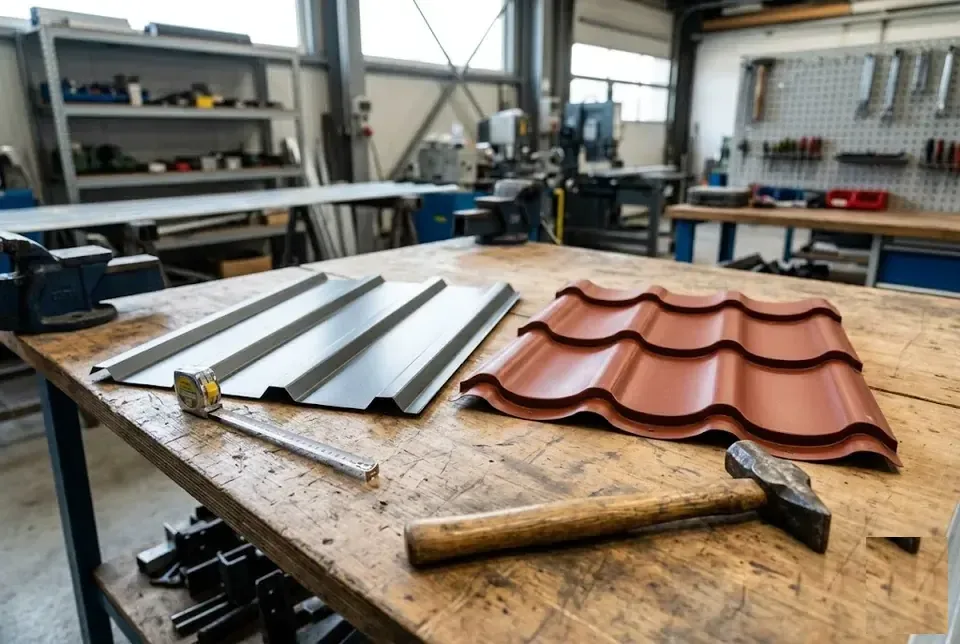
The strength and durability of a roof are determined not by the name of the material but by three parameters: the profile grade, the metal thickness and the type of polymer coating. Let us look at the impact of each factor using specific examples.
What is stronger: corrugated sheet NS35 or metal roof tiles
Corrugated sheet NS35 with a profile height of 35 mm is stronger than metal roof tiles at the same metal thickness, since a trapezoidal profile provides greater bending stiffness than the wave-shaped profile of metal roof tiles. Monterrey metal roof tiles have a profile height of about 25 mm, and the rounded wave shape performs worse in bending than a trapezoid — at a sheet thickness of 0.5 mm the difference in distributed load reaches 15–20% in favour of NS35. This is critical for regions with heavy snowfall: in the foothill areas up to 200–300 kg of snow can press on a square metre of roof, and here NS35 provides a margin of strength without reinforcing the battens. If NS35 and Monterrey are compared at the same thickness of 0.5 mm, corrugated sheet withstands a 15–20% greater load — a direct consequence of the profile geometry, not of any material magic.
What lasts longer: corrugated sheet with polyester or metal roof tiles with Pural
Metal roof tiles with a Pural (polyurethane) coating last longer — up to 40–50 years, whereas corrugated sheeting with ordinary polyester lasts 20–30 years, but the difference is determined not by the profile shape but by the type of polymer coating. Pural is applied in a 50 micron layer and is resistant to UV radiation and scratches during installation, whereas polyester (25 microns) fades over time and is more easily damaged by hail or branches. On the Almaty market, the same coatings are available for both materials: polyester, Pural, PVDF and plastisol — the price difference between polyester and Pural is 30–40% per square metre. When choosing between the materials, focus on the coating: Pural on corrugated sheeting will last the same 40–50 years as Pural on metal roof tiles, while polyester on any profile will give a maximum of 25–30 years before the first signs of corrosion at the cut edges.
Which corrugated sheet profile is better for roofing: C20 or NS35
For a roof, NS35 is better than C20, since a profile height of 35 mm provides sufficient rigidity for snow load and allows a batten spacing of up to 500 mm, whereas C20 (height 20 mm) requires more frequent battens. With a batten spacing of 500 mm, C20 material under snow load may sag between the supports, especially on shallow slopes with a pitch of 15–20°. In the foothill areas of Almaty (Medeu, Kamenka) the design snow load reaches 150–200 kg/m² — for such conditions installers recommend NS35 as the minimum option for private houses. Corrugated sheet C20 is acceptable only for roofs with a pitch of more than 20° and in regions with low snow load; in most private houses in snowy regions the minimum recommended grade is NS35.
Monterrey or Cascade metal tiles — which is better in terms of strength
In terms of strength, Monterrey and Kaskad are practically identical, as both have the same metal thickness (0.4–0.5 mm) and wave pitch of 350 mm; the only difference is the geometry of the wave — Kaskad's is more rectangular, Monterrey's is rounded. When installed on standard battens with a pitch of 350 mm both profiles behave identically: load-bearing capacity is determined by sheet thickness, not by wave shape. In practice Kaskad has a slightly greater effective sheet width (1130 mm versus 1100 mm for Monterrey), which saves 2–3% of material on a slope 6 metres long. The choice between Monterrey and Kaskad is a matter of aesthetics rather than strength: Monterrey gives a classic “tile” look, Kaskad a stricter geometric pattern suited to modern houses.
Comparison of strength and durability: table
| Parameter | Corrugated sheet HC35 (0.5 mm) | Monterrey metal tiles (0.5 mm) |
|---|---|---|
| Profile height | 35 mm | ~25 mm |
| Bending stiffness | High (trapezoid) | Average (wave) |
| Service life (polyester) | 20–30 years | 20–30 years |
| Service life (Pural) | 40–50 years | 40–50 years |
| Resistance to snow load | High (with H35+) | Average (requires reinforced lathing) |
| Resistance to wind load | High (high profile) | Medium |
Difference between corrugated sheet and metal roof tiles in price and cost-effectiveness
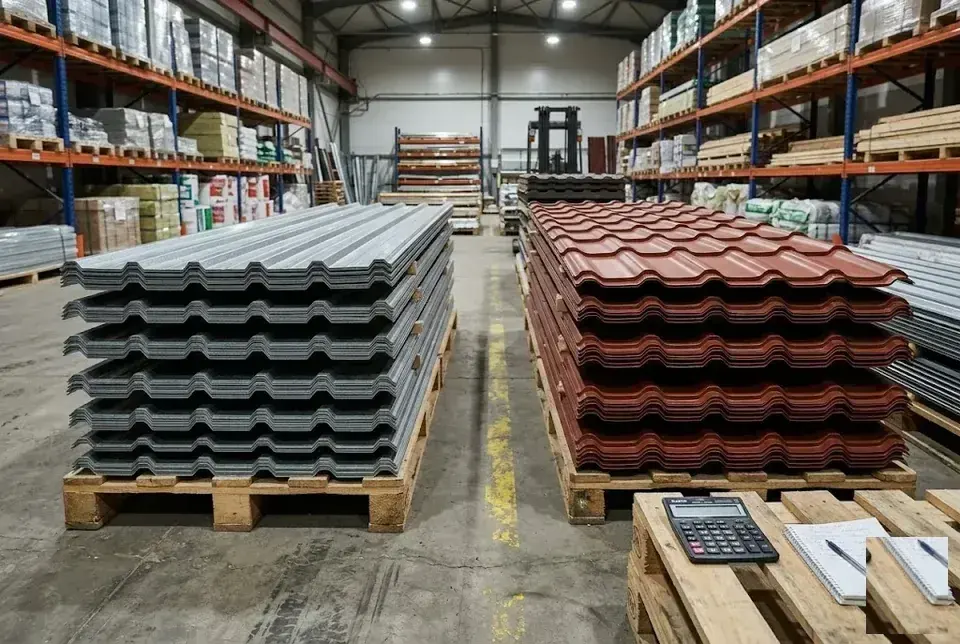
The price of the material is only the tip of the iceberg: the full cost of the roof is made up of the battens, the trim pieces and the cutting waste, which can change the final budget by 20–40%.
What is cheaper: corrugated sheet or metal roof tiles - a comparison of material cost
Corrugated sheet is cheaper than metal roof tiles by an average of 15–25% per square metre with the same metal thickness and coating type, since its production is simpler and does not require complex stamping of a wave-shaped profile. At the Bars market in Almaty the price per m² of corrugated sheet NS35 0.4 mm thick with a polyester coating starts from 1 800 KZT — 400 KZT lower than Monterrey metal roof tiles of the same thickness and coating (from 2 200 KZT); on a roof of 150 m² the difference gives 60 000 KZT of savings on material alone. When the thickness increases to 0.5 mm and the coating changes to matt polyester, the gap remains: 2 300–2 500 KZT for corrugated sheet versus 2 800–3 200 KZT for metal roof tiles from Metall Profil and Arsenal Stal. The difference can reach 30–40% when comparing budget corrugated sheet with polyester (0.4 mm) and premium metal roof tiles with Pural (0.5 mm) — but such a comparison is incorrect, the materials must be of the same class.
Hidden costs: lathing, flashings, fasteners
Because of the different batten spacing (500 mm for corrugated sheet versus 350 mm for metal roof tiles), the cost of timber for metal roof tiles is 30–40% higher, which adds 200–400 KZT per m² of roofing. For a standard gable roof of 100 m², 0.6 m³ of 25×150 mm boards will be needed for corrugated sheet (spacing 500 mm) and 0.85 m³ for metal roof tiles (spacing 350 mm); at a timber price of 180 000 KZT per cubic metre at Altyn Orda, the difference in battens is 45 000 KZT. Additional elements (ridge, valley, eaves) for metal roof tiles are 10–20% — more expensive because they follow the wavy profile, whereas corrugated sheet accessories are simpler in geometry. Plus, 15–20% more screws are used for metal roof tiles (7–8 pieces per m² versus 5–6 for corrugated sheet) - at a price of 3–5 KZT per piece this adds a further 500–1 000 KZT per 100 m².
Saving on waste: why corrugated sheet is more cost-effective on complex roofs
On complex roofs (hipped, multi-gable) waste of metal roof tiles reaches 20–40% due to the fixed wave pitch of 350 mm, whereas corrugated sheet produces 10–15%, giving a material saving of 10–25%. Metal roof tiles cannot be cut arbitrarily — the cut must fall into the trough of the wave, otherwise the sheet loses its jointing geometry; on a hipped roof of 100 m² with four slopes this means 20–40 m² of unusable offcuts against 10–15 m² for corrugated sheet, which can be cut anywhere on the profile. On a simple gable roof the difference in waste is minimal (5–10% for corrugated sheet versus 10–15% for metal roof tiles), so for simple roofs waste is not a decisive factor.
Total cost of corrugated sheet and metal roof tiles for 100 m² of roof
| Cost item | Corrugated sheet (HС35, 0.5 mm) | Metal tiles (Monterrey, 0.5 mm) |
|---|---|---|
| Material (100 m²) | 180 000–220 000 Kzt | 220 000–280 000 Kzt |
| Battens (board) | 30 000–40 000 Kzt | 45 000–55 000 Kzt |
| Additional elements | 25 000–35 000 Kzt | 30 000–40 000 Kzt |
| Fasteners and sealants | 8 000–12 000 Kzt | 10 000–15 000 Kzt |
| Waste (complex roof) | 10–15% | 20–40% |
| Total (simple roof) | 243 000–307 000 Kzt | 305 000–390 000 Kzt |
| Total (complex roof) | 267 000–353 000 Kzt | 366 000–546 000 Kzt |
On a hipped roof of 100 m² the savings on corrugated sheet reach 80 000–120 000 KZT — mainly thanks to less waste and cheaper accessories rather than just the difference in the price of the sheet itself.
What is cheaper, corrugated sheet or metal roof tiles: installation and waste
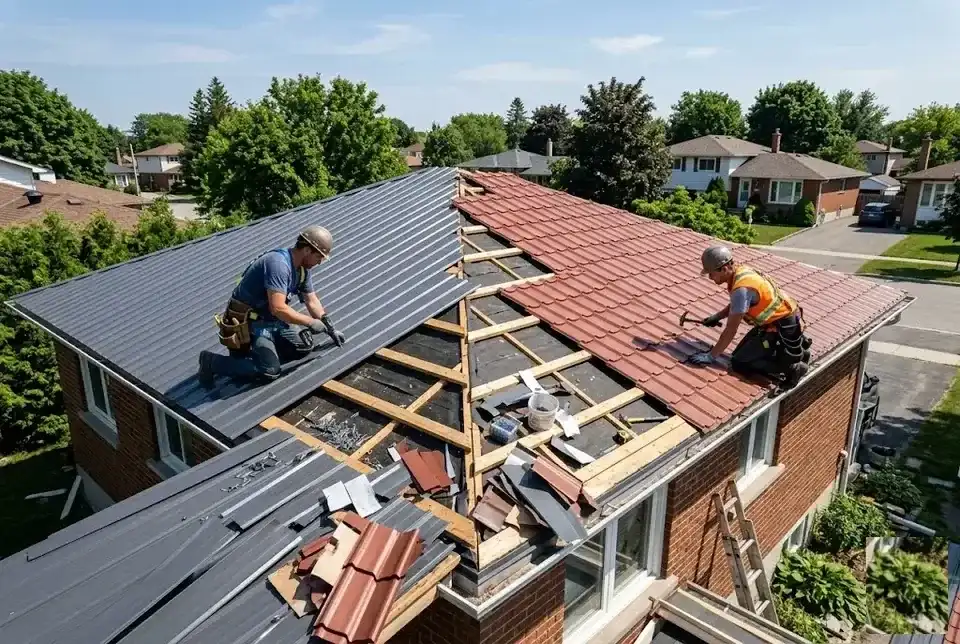
Comparing the price of material from H2-03 — is only half the picture: the final cost of the roof depends heavily on the complexity of installation, the volume of waste and the skill of the crew.
What is easier to install: corrugated sheet or metal roof tiles
Corrugated sheet is easier to install: it is produced in sheets up to 12 metres, which allows a slope to be covered without transverse joints, and its trapezoidal profile is less demanding on batten pitch — standard 500 mm versus a fixed 350 mm for metal roof tiles. When installing this material the longitudinal overlap is 150–200 mm, while for metal roof tiles it is 200–250 mm, which on a slope of 6 metres gives an additional consumption of 3–5% for the overlap alone. Metal roof tiles require a more highly qualified roofer, as each sheet must be precisely aligned along the wave, and an error in batten pitch of 5–10 mm makes installation impossible without redoing it — in Almaty crews such cases lead to downtime of 1–2 days.
Which material is better for a complex roof: hipped, multi-gable
For a complex roof - hip, multi-gable or pyramidal - corrugated sheet produces 2–3 times less waste: 10–15% versus 20–40% for metal roof tiles, as it can be cut in any direction without being tied to the wave pitch. On a hip roof with an area of 150 m², metal roof tile waste amounts to 45–60 m² (30–40%), whereas for corrugated sheet it is 15–22 m² (10–15%); the difference in material cost on the Almaty market is 60 000–100 000 KZT. At the same time, metal roof tiles visually win on complex roofs thanks to their three-dimensional pattern, but on multi-gable structures every valley and ridge requires individual cutting, which increases installation time to 3–5 days versus 2–3 days for corrugated sheet.
Which material is easier to cut and fit on site
Corrugated sheet is easier to cut and fit: its trapezoidal profile does not require matching waves — the sheet can be cut at any angle, and the joints are less noticeable than with the wave-shaped relief of metal roof tiles. When cutting metal roof tiles it is important not to damage the polymer coating at the cut — otherwise corrosion will begin, and the cut must be treated with special paint, which increases installation time by 15–20%. In our practice on sites in Almaty, crews working with metal roof tiles spend an extra 1–2 hours treating cuts on a roof of 100 m², whereas corrugated sheet is cut with ordinary tin snips or electric shears without subsequent treatment.
Is there a difference between installing corrugated sheet and metal tiles: a step-by-step comparison
There is a difference in installation: corrugated sheet is fixed into the lower wave of the trapezoid with a spacing of every other wave, while metal roof tiles are fixed into the lower part of the wave at a wave pitch of 350 mm, and for both materials self-tapping screws with an EPDM washer are used at a rate of 6–8 pieces per square metre. For corrugated sheet the longitudinal overlap is 150–200 mm, while for metal roof tiles it is 200–250 mm, which with a slope length of 6 metres gives additional metal roof tile consumption of 3–5% due to the greater overlap. Both materials require an anti-condensation underlay to reduce noise, but for corrugated sheet it is mandatory at any slope, whereas for metal roof tiles it is only required at a slope of less than 20 degrees, which saves 150–200 KZT per square metre on simple slopes.
Table: comparison of installation of corrugated sheeting and metal roof tiles
| Installation parameter | Corrugated sheeting | Metal roof tiles |
|---|---|---|
| Installation speed (100 m²) | 1–2 days | 2–3 days |
| Difficulty of fitting | Low | Medium |
| Waste on a simple roof | 5–10% | 10–15% |
| Waste on a complex roof | 10–15% | 20–40% |
| Skill requirements | Average | High |
| Need to treat cut edges | No | Yes (anti-corrosion paint) |
| Batten spacing | 500 mm | 350 mm |
| Length overlap | 150–200 mm | 200–250 mm |
On a simple gable roof the difference in installation speed is minimal (1–2 hours), but on a complex roof corrugated sheet can be installed in 2–3 days, while metal roof tiles take 3–5 days, which at a crew rate of 15 000–20 000 KZT per day gives savings of 15 000–40 000 KZT on labour alone.
Corrugated sheet vs metal roof tiles: aesthetics and roof types
The aesthetics of a roof are a subjective factor, but objectively the choice between these materials is dictated by the shape of the roof, the architectural style of the house and the colour scheme of the facade.
Appearance of corrugated sheeting: strict, industrial, modern
Corrugated sheet has a strict industrial look with clear trapezoidal lines that goes well with modern high-tech, minimalist and loft-style houses, as well as with utility buildings. In Almaty's Triumfalny and Greenville residential complexes this material is used specifically to emphasise the geometry of the facade, combined with panoramic glazing and concrete surfaces. The available colours according to RAL — from graphite (RAL 7024) to terracotta (RAL 3013) — allow you to match the tone to any project, while the matt coating masks dust, which is relevant for the city's southern districts with wind loads. Thanks to the large sheet format (up to 12 m) it creates a minimum number of horizontal joints, which visually makes the roof more monolithic and “clean” — a plus for modern architectural solutions.
Appearance of metal roof tiles: classic, tiled, traditional
Metal roof tiles imitate natural tiles and have a classic "tiled" appearance that suits traditional houses, chalet-style cottages, Mediterranean and country styles. Different profiles give different visual effects: Monterrey — the classic wave, Cascade — a geometric pattern, Andalusia — an S-shaped wave, Shanghai — an Asian profile; the choice of profile changes the perception of the house. In the Almaty market, the colours "Chocolate" (RR 32) and "Wenge" (RAL 8017) are popular — they visually reduce the massiveness of the roof on two-storey cottages, while light shades such as "Ivory" (RAL 1015) suit houses in the Provence style. Different profiles give different visual effects: Monterrey — the classic wave, Cascade — a geometric pattern, Andalusia — an S-shaped wave, Shanghai — an Asian profile; the choice of profile changes the perception of the house.
Which roofs corrugated sheeting suits: simple, gable, with a shallow slope
Corrugated sheet is suitable for simple gable and mono-pitch roofs, as well as for roofs with a low pitch from 8°, including flat roofs with organised drainage, which makes it versatile for utility buildings, garages and canopies. In Almaty this material is often chosen for private houses in the Aigerim-2 and Aksai-3 districts, where simple gable roofs predominate — installation is fast and waste is minimal (2–5% versus 10–15% for metal roof tiles). With a pitch of less than 10° solid battens and reinforced waterproofing are mandatory, since water lingers at the joints between waves; for corrugated sheet this is critical because of its lower wave height compared with metal roof tiles.
Which roofs metal roof tiles suit: complex, hipped, with a steep slope
Metal roof tiles are suitable for complex pitched roofs — hipped, pyramidal and attic roofs — with a slope from 12° to 90°, where aesthetics and modular laying matter, since each sheet imitates an individual tile. On cottages in the "Almaty-City" and "Izumrudny" communities, they are installed with the Monterrey profile on hipped and pyramidal structures with a 25–35° slope — this gives a classic look without visible horizontal joints, but requires precise cutting at valleys and abutments. On complex roofs with many valleys and abutments, this material produces more waste (up to 15–20%) than corrugated sheeting, but its decorative quality justifies the extra consumption for houses with architectural flourishes.
Summary: what to choose for your needs
We bring together all the key parameters — strength, price, installation, aesthetics and waste — into a single table so that you can choose the material for your specific task.
Summary comparison table of corrugated sheet and metal roof tiles
| Parameter | Corrugated sheeting | Metal roof tiles |
|---|---|---|
| Strength | Higher (stiffening rib, thickness up to 1,2 mm) | Average (depends on the profile, thickness 0,4–0,5 mm) |
| Price per m² | Lower (20–30% cheaper) | Higher (complex profile, more waste) |
| Waste during installation | 2–5% (simple roofs) | 5–15% (complex roofs up to 20%) |
| Ease of installation | High (large sheets up to 12 m) | Average (modular sheets, more joints) |
| Aesthetics | Strict, industrial | Classic, tile-like |
| Minimum slope | 8° | 12° |
| Durability | 30–50 years (with proper coating) | 30–50 years (with proper coating) |
| Sound insulation | Lower (extra layer required) | Lower (extra layer required) |
For a simple garage or shed roof, this material is the optimal choice in terms of price and ease; for a residential house with architectural features, metal roof tiles will provide better aesthetics and durability.
Calculation method: how to make a decision in 3 steps
Reach a decision in 3 steps: 1) determine the roof shape — simple (gable, mono-pitch) → corrugated sheet, complex (hipped, pyramidal) → metal roof tiles; 2) assess the budget — if it is limited, corrugated sheet will save 20–30%; 3) check the pitch — if it is less than 12°, corrugated sheet is mandatory. On a simple gable roof of 100 m² in Almaty, corrugated sheet will save 150–200 thousand KZT compared with metal roof tiles thanks to less waste and cheaper installation. If you are building a residential house and want a classic look but the budget is limited, consider sheets with a polymer coating that imitates tiles (for example, Printech) — it gives the aesthetics of metal roof tiles at the price of that coating.
Conclusion
We have covered the key differences between the two materials: strength, price, installation, aesthetics and hidden costs. Let us sum up the findings in five short points — tailored to your specific task.
Key takeaways
- Corrugated sheet is the choice for simple roofs (garages, sheds, canopies) with a pitch from 8°, where strength, low price and minimal waste (2–5%) matter.
- Metal roof tiles are the choice for residential houses with complex pitched roofs (hipped, pyramidal) with a slope from 12°, where the priority is aesthetics and a classic look.
- Corrugated sheet is stronger thanks to its stiffening ribs, but for standard roofs both materials are sufficient.
- Waste is a hidden cost factor: on complex roofs metal roof tiles produce up to 15–20% waste, corrugated sheet 2–5%.
- Aesthetics are subjective: the strict industrial style of corrugated sheet or the classic tile pattern of metal roof tiles — choose to suit the architecture of your house.