Asphalt paving technology from PROFI-DOM: how the surface is laid in Almaty
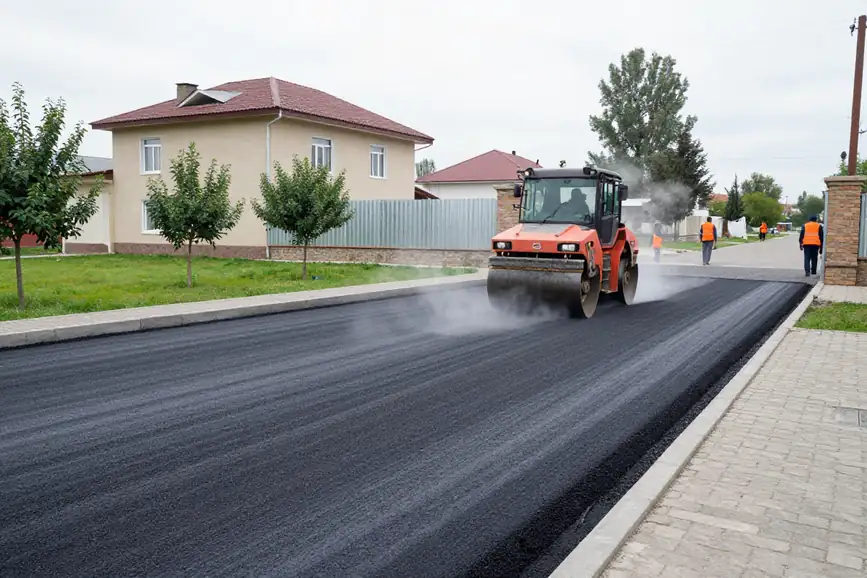
The asphalt laying technology at PROFI-DOM is a full cycle: compacted soil, geotextile over weak soil, a sand cushion of 10 cm, a crushed stone base of 15–20 cm, priming with bitumen emulsion and a hot mix of 4–5 cm for the yard and paths or 6–7 cm for the driveway and parking. The mix is delivered from the plant on the day of laying, and each layer is compacted with a vibratory roller.
Published: 25
What asphalt pavement is and what the layers consist of
Asphalt pavement is not a single layer of black mix but a multi-layer structure where each element bears the load and drains water. Whether the yard sags after a season or stands without cracks depends on the composition of this pie.
What layers the turnkey coating consists of
- Compacted soil: the load-bearing base of the entire structure; the vibratory plate passes over the area to a density at which no footprint remains underfoot.
- Geotextile: a separation layer over weak soil — it prevents crushed stone from sinking into clay and stops water from rising through capillaries.
- Sand cushion 10 cm: levels the area and distributes the wheel load evenly onto the soil.
- Crushed stone base of 15–20 cm: a load-bearing layer compacted with a vibratory roller in several passes until the crushed stone is immobile.
- Bitumen emulsion prime coat: bonds the base to the asphalt so the top layer doesn't peel off at the first frost.
- Hot asphalt 4–5 cm or 6–7 cm: a finishing layer for paths and the yard, or for a driveway and parking with vehicle load.
- PROFI-DOM crews: install paving on private plots from soil compaction to rolling the hot mix on the day it is delivered from the plant.
How hot asphalt differs from cold asphalt and chips
The hot mix is laid at high temperature and compacted immediately, the cold one is suitable for small potholes by hand, and asphalt chips are a separate coating with a layer of 8–10 cm, not asphalt. The hot material is delivered from the asphalt plant on the day of laying: while the mix has not cooled, the roller closes the pores, and the coating gains strength throughout its thickness. Cold asphalt from a bag is convenient for spot repairs — to patch a puddle at the porch or a hole at the driveway, but under the moving load of the entrance and parking it crumbles at the edges faster than hot asphalt. Chips are recycled material laid in a layer of 8–10 cm and compacted; they are cheaper and appropriate for utility areas, but are not considered a full replacement for asphalt. For the entrance and parking, cold asphalt in bags is not considered an equivalent replacement for hot asphalt: under regular wheel traffic, the patch lasts a season or two.
Coating options and how they differ
The same yard, driveway, parking lot and garden paths require different layer thicknesses, and sometimes even different materials — this depends on the load, the soil and the purpose of the surface.
Comparison of coating options for a private territory
| Option | What it consists of | What it is suitable for | What to consider |
|---|---|---|---|
| Hot asphalt 4–5 cm | sand cushion 10 cm, crushed stone 15–20 cm, primer, mix | yard, pedestrian paths | pedestrian and passenger car load only |
| Hot asphalt 6–7 cm | same base, thicker mix layer | driveway to the house, parking | a margin for load and slope is needed |
| Asphalt crumb 8–10 cm | crushed stone in a layer, without hot mix | temporary or budget coating | lower evenness, periodic renewal |
| With geotextile | geotextile over weak soil plus standard pie | weak, frost-heaving soil | without it the base "sinks" into the ground |
The contractor selects the option based on the load on a specific area of the plot, not on the principle of «the thicker, the more reliable»: an extra layer on the path does not save from subsidence if the base underneath is not compacted.
Why the thickness on the parking lot and on the path is different
Parking and driveway take the weight of a car on a limited area, while a path takes only a pedestrian, so the mix layer on the roadway is made thicker. A passenger car wheel transmits a point load to the surface several times higher than a person's step distributed over the foot — and a thin layer of 4–5 cm at the entrance is pressed through and cracks already in the first season. On a pedestrian path the same thickness works for decades because dynamic load there is minimal. Practice shows: saving on centimeters specifically in the entrance and parking zone results in local repair faster than anywhere else on the plot. Therefore, when marking up the estimate, we calculate the area of the roadway and pedestrian part separately — with different mix thickness.
Choosing the location and preparing the base
Proper asphalt laying begins with preparation for asphalting: at this stage the slope, drainage and load-bearing base are established. Preparation for asphalting includes marking, demolition of the old layer and density control of each layer. A mistake in preparation cannot be fixed by asphalt thickness — it shows up as subsidence after a season or two.
Marking, demolition, and slope away from the house
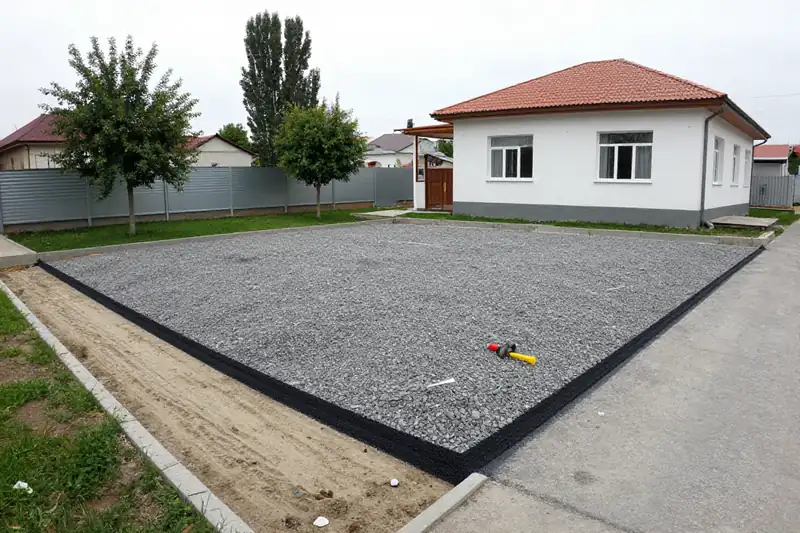
During preparation the crew marks out the plot, if necessary removes the old surface and creates a slope of 1–2% from the house so that water flows to drainage channels rather than standing at the foundation. The marking is tied to the threshold and entrance gate marks: a longitudinal slope is drawn from them, and across the yard 1–2 cm per meter is added toward the channel or drainage ditch. Curbs are set on a concrete lock with embedding to a third of their height — they hold the asphalt edge and prevent it from crumbling under wheels. Demolition of the old surface is done if the base has subsided or there are voids beneath it: the top layer is removed, problem areas are opened up and the base is refilled. A slope of less than one percent on small areas hardly works — water stagnates in micro-depressions, and the surface deteriorates from moisture faster than from load.
Sand cushion, crushed stone and geotextile on weak soil
- Sand cushion: a 10 cm layer is leveled and watered so the sand compacts and does not draw moisture from the fresh mix.
- Crushed stone base: 20–40 mm fraction, 15–20 cm layer under the yard and paths, 20 cm under the driveway and parking, compacted with a vibratory roller in 3–4 passes.
- Geotextile on weak soil: a dense fabric is laid on the soil under the sand as a separator, with an overlap of 15–20 cm, so that crushed stone does not sink into clay and loam.
- Level control: after compaction, check with a straightedge and level — deviation over 2 m must not exceed 1 cm, otherwise the asphalt will lay in waves.
- Emulsion priming: the base is dusted off and poured with bitumen emulsion before the hot mix to bond the layers.
How the work is carried out in stages: from priming to rolling
The technology of asphalting roads and areas follows a strict sequence: skipping the primer, rolling the edge or rushing the load become visible not on the handover day but after a season of use — through cracks and subsidence.
Priming with bitumen emulsion and laying hot mix
PROFI-DOM treats the base with bitumen emulsion and lays the hot mix delivered from the asphalt plant on the day of work — so the mix does not cool before rolling. The emulsion is applied to a cleaned crushed-stone base blown free of dust: dust acts as a separator, and the bitumen bonds to dirt rather than stone. The hot asphalt mix is laid at a temperature not below plus five — ideally from plus ten — distributed along guide lines and leveled to the design thickness: 4–5 cm on yard driveways and paths, 6–7 cm on the entrance and parking. The prime coat is not a 'gloss impregnation' but adhesion: without it, the top layer does not bond to the crushed stone and peels at the edges at the first temperature change.
Rolling with a vibratory roller and compaction in hard-to-reach places
- Layers in order: first the 15–20 cm crushed stone base is rolled, then the 10 cm sand cushion — each layer separately, to a density at which the roller stops leaving tracks.
- Passes with a vibratory roller: from the edge to the center, overlapping the strip by a third so that no uncompacted strips remain between passes.
- Junctions and edges: near curbs, drainage channels and gates the vibratory roller cannot reach — there they work with a manual plate compactor and tamper, otherwise a loose seam remains.
- Seam control: the joint between old and new pavement is treated with emulsion and compacted separately, otherwise a crack will run along the joint line in the very first winter.
- Checking the result: an under-rolled edge is the most vulnerable spot, and it is precisely along the edges and joints that water gets under the coating, so PROFI-DOM accepts the work based on the density of each layer, not on appearance.
Weather restrictions and when you can go
In rain and frost, the hot mix is not laid: water and cold interfere with adhesion and compaction, so work is postponed to dry weather. Frost below plus five makes the mix unusable — it cools faster than it can be leveled and rolled, and a wet base prevents the bitumen emulsion from setting. Summer heat also makes a correction: at plus thirty and above, the mix sets faster, so the crew reduces the time from unloading to rolling. Even on a dry day, a fresh layer does not gain strength instantly — the load on the surface is applied gradually, and exact timing depends on the weather and layer thickness. In practice, a pedestrian path is opened earlier than a car entrance — if you need to drive into the yard immediately, tell us before work starts, and the crew will plan the stages around your schedule.
How to evaluate the result and what to look at during acceptance
Acceptance is not a formality at the end of work: a few simple checks show whether the layer was laid according to the rules or "by eye", and these same checks will be useful later after a season when the first cracks appear.
What to check upon acceptance: thickness, evenness, slopes, joints
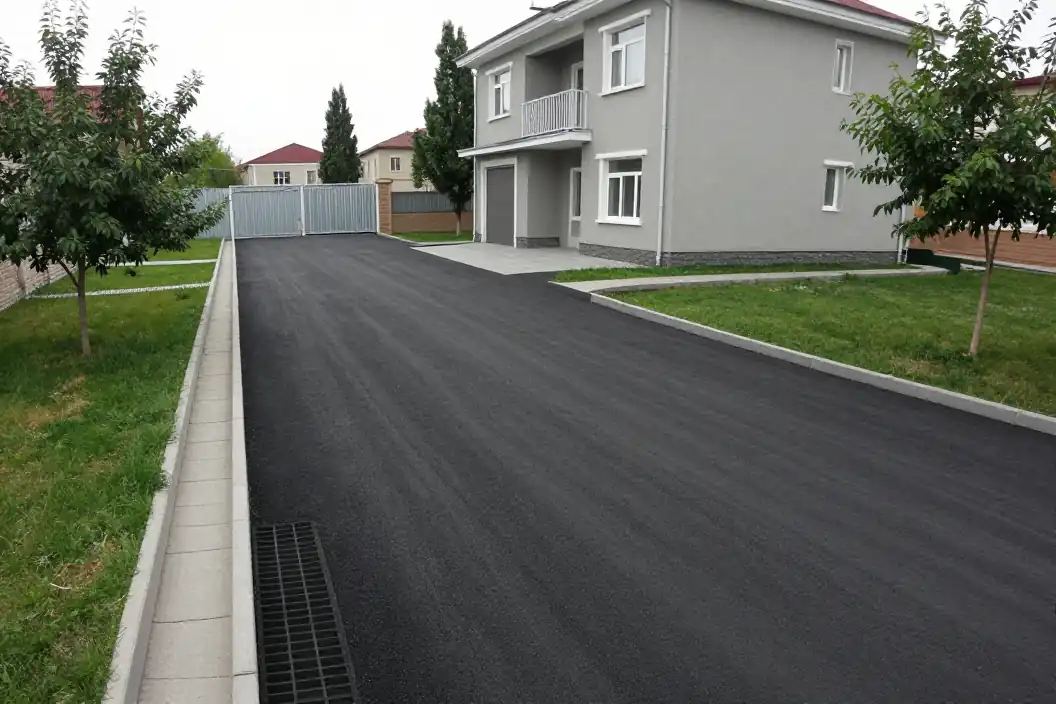
- Layer thickness: measured along the edge at the curb or in a control pit — for yards and paths it is 4–5 cm, for driveways and parking 6–7 cm.
- Evenness: a three-meter rule is applied lengthwise and crosswise — the gap beneath it must not exceed 5 mm, otherwise water will stand on the surface.
- Slope towards drainage: checked with a level or a staff with an inclinometer — 1–2% from the house to the gutter; with a reverse slope, a puddle will remain at the foundation.
- Joints with the curb: the seam must be filled with the mix without voids, the curb must stand on a concrete cushion and not wobble underfoot.
- Edges and abutments: the edge at gates, blind areas and hatches is the weakest point — that is where they check whether the layer is compacted and whether there are any voids.
The estimate in the contract and why contractors have different figures
The estimate is fixed in the contract before work begins and does not change: it includes dismantling of the old surface, a sand cushion and crushed-stone base, priming with bitumen emulsion, hot mix, curbs and debris removal, not just a "layer of asphalt". The difference in price per m² among contractors is most often exactly here: some count the full build-up, others only the top layer, while the base, geotextile over weak soil and removal surface as an extra charge during the work. In Almaty practice a common story is a yard where the estimate had one layer, and on site it turned out that the old crushed stone was pressed down and needed replacement. It is worth requesting the estimate line by line with the thickness of each layer and the removal volume — it shows exactly what you are being charged for.
Contractual warranty and work timeline
The warranty is given under the contract, and the work period is fixed in the same contract — specific dates depend on the volume and location and are determined at the measurement. The contract should specify not only the handover date but also weather caveats: the hot mix is delivered from the plant on the day of laying, and in rain and frost work is not carried out, and this should not turn into a shift without warning. A warranty case differs from an operational defect in only one thing — the description of the structure: if the document records the layers, their thickness and the base material, the dispute about the cause of subsidence is resolved by fact, not by memory. Require that the appendix with the pie structure be signed together with the main contract — without it, the warranty remains a promise.
Mistakes and how to avoid them
Most coating defects are not accidental but the result of specific violations during preparation and laying. Some are treated locally, while others require complete replacement of the layer.
Why asphalt cracks and subsides
- Uncompacted base: soil and crushed stone rolled in one pass settle under load — the surface sags along with them.
- Thin mix: yard paving thinner than 4 cm cannot support even passenger vehicles and cracks along the wheel tracks.
- Lack of drainage: without a 1–2% slope and gutters, water stagnates, softens the base and accelerates destruction.
- Weak soil without geotextile: the clay base "floats" after rains, and the asphalt follows its movements.
- Saving on crushed stone: a base of 10 cm instead of 15–20 cm sags under point load at the entrance.
Pothole repair: when to repair and when to fully replace
Pothole repair is the local restoration of individual sections following the same layer logic, and it is justified when defects are isolated and the surrounding base is intact; with a continuous network of cracks, the coating needs replacement. How to properly perform pothole repair of asphalt is analyzed step by step below. Isolated potholes up to half a meter in size at the entrance or parking lot are closed with a patch, while an area where cracks run in a 'web' over more than a couple of square meters is pointless to patch — the base under the entire zone is already destroyed. Pothole repair of asphalt: the technology assumes a scheme of cutting → cleaning → priming → laying → compaction, but specialists will honestly say if in a specific case it is cheaper to remove the layer entirely. If a pothole is filled without cutting the edges and cleaning, the patch holds on a wing and a prayer — water enters along the seam and knocks it out in one season.
Work sequence for patching potholes
- Contour cutting: the edges of the pit are cut strictly vertically with a tool, with a margin of 5–10 cm beyond the visible boundary of destruction — there is always a hidden weakened zone under the edge.
- Cleaning and drying: debris, dirt and water are removed from the cavity — the emulsion will not set on a dusty base.
- Priming: the walls and bottom are treated with bitumen emulsion so the mixture bonds with the cold edge.
- Laying hot mix: fill in layers of 4–5 cm and level with a slight excess above the surface level.
- Compaction: a vibratory plate or roller settles the patch flush with the surface, without a step at the edge.
Conclusion
The analysis of laying comes down to a few basic principles that are more important than any details: the right pie, thickness selected for the load, diverted water and honest acceptance.
Key takeaways
- Pavement structure: compacted soil, 10 cm cushion, 15–20 cm crushed stone, primer and 4–5 or 6–7 cm hot mix — skipping any element becomes visible after a season.
- Thickness for load: yards and garden paths are made thinner, driveways and car parking require a top layer of 6–7 cm and reinforced crushed stone.
- Water and slope: a slope of 1–2% from the house and organized drainage protect the surface from subsidence no worse than an extra centimeter of asphalt.
- Repair or replacement: pothole repair is justified for spot defects up to 10–15% of the surface, a continuous network of cracks is a reason to re-lay the entire card.
- Acceptance and estimate: thickness, evenness under a three-meter rule, slopes and joints are checked before signing the act, and the full list of works is fixed in the estimate in advance — so dismantling and gravel removal don't come up as a surprise.