Laying cold asphalt yourself: what you can handle and where you need a PROFI-DOM crew in Almaty
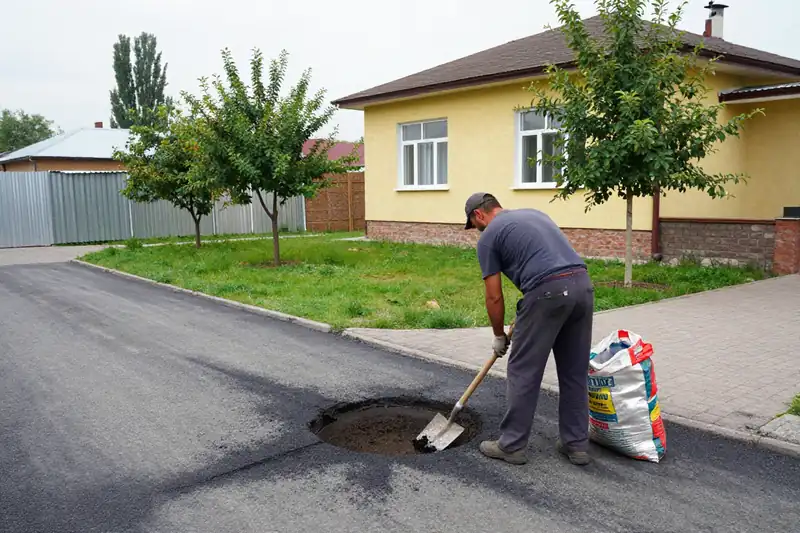
Laying cold asphalt yourself is realistic for small potholes, paths and patching — where manual tamping is sufficient. PROFI-DOM in Almaty takes on areas that require hot asphalt, a vibratory roller and a prepared base: yards, driveways, parking lots. The boundary runs along area, load and layer thickness.
Published: 25
What asphalt pavement is and what it consists of
Asphalt pavement is not a single top layer but a multi-layer structure where each tier bears the load and drains water. We will break down the layers from bottom to top and explain why saving on the lower layers costs the most.
Coating pie: from soil to top layer
Laying cold asphalt starts not with the mix itself but with preparation: the pavement is built from the bottom up — compacted soil, geotextile on weak soil, a 10 cm sand cushion, a 15–20 cm crushed stone base, a bitumen emulsion prime, and a top asphalt layer of 4–5 cm for yards and paths or 6–7 cm for driveways and parking. The sand cushion levels the surface and distributes the load, the 15–20 cm crushed stone acts as a load-bearing frame, and the bitumen emulsion bonds the base to the hot mix delivered from the asphalt plant on the day of laying. PROFI-DOM prepares this type of base on private plots in Almaty and the suburbs, including geotextile on weak soil and a vibratory roller on crushed stone. A skipped or uncompacted lower layer is invisible from the outside for the first months — subsidence shows up later, when redoing it costs more than proper preparation upfront.
Why geotextile, slope and drainage are needed
Geotextile on weak soil prevents crushed stone from sinking into the ground, and a slope of 1–2% away from the house drains water so it doesn't pool in the yard. Weak soil — loam, fill, or waterlogged — "eats" crushed stone under load, and the separating fabric preserves the base thickness for the entire service life. The slope is formed at the sand cushion stage, not after laying: water flows along the 1–2% plane toward drainage channels laid on the low side of the site. Water is the main enemy of the surface: if the slope is directed toward the house or a dead end, puddles erode the edge and accelerate destruction, so channels and curbs are installed before asphalt, not after.
How much strength cold asphalt gains
Cold asphalt does not 'dry' like concrete — it compacts and gains strength gradually, under load and at positive temperatures. The mix in bags remains plastic due to the cold bitumen emulsion, which after laying and compaction with a vibratory plate gradually stabilizes: it stays soft for the first day, gains working density within 3–5 days, and full strength as moisture evaporates from the emulsion. This material is used for small pits, potholes and paths where hot mix from the plant is not needed. In the first days, it is better not to drive heavy machinery over the fresh surface: the mix has not yet stabilized, and a wheel track will remain for a long time.
Coating options and how they differ
Four options most often considered for a yard, entrance and parking — and each has its own boundary between "do it yourself" and "call a crew".
Comparison of options: cold, hot, crumb
| Option | What it consists of | What it is suitable for | What to consider |
|---|---|---|---|
| Cold asphalt | Ready-mix in bags | Pits, paths, pothole repair | Layer thickness, compaction, weather |
| Hot asphalt 4–5 cm | Factory mix, primer, base | Yard, pedestrian paths | Delivery on the day of paving, machinery |
| Hot asphalt 6–7 cm | Mix, reinforced base | Driveway, parking | Load, slope 1–2% |
| Asphalt crumb 8–10 cm | Crushed stone, compaction, curb | Yard, budget surface | Compaction with a vibratory roller, curb |
The choice is dictated not by the price of the bag, but by the load: where a car enters every day, a thin layer of any material will quickly crack.
Where cold asphalt works and where it doesn't
Cold asphalt holds up in small potholes and on pedestrian paths, but over a large area under cars and on a weak base it crumbles and gets squeezed out. The mix in bags is convenient for do-it-yourself pothole repair: pour, level, tamp — and after a day you can walk on the path. At the same time, the ready-made compound gains strength through compaction rather than thickness, so a 3–5 cm layer on uncompacted soil turns into loose mush after the very first winter. At the driveway entrance where a car is parked, such a mix gets squeezed out by the wheels within a season. If the pothole is deeper than the layer thickness, the material is laid in two passes with compaction of each — otherwise the lower part will remain loose and the top will sag.
Why hot asphalt cannot be laid without equipment
The hot mix is delivered from the asphalt plant on the day of paving, and it must be spread and compacted with a vibratory roller quickly — doing this manually over a large area is unrealistic. A dump truck pours the mix at about 150 degrees, a paver levels the strip, the roller makes 4–6 passes, and all of this must fit into the short time before the mix cools. Through PROFI-DOM, the hot mix is delivered from the plant on the day of paving and the entire cycle is covered — from priming with bitumen emulsion to final compaction. The mix cools and loses workability, so the working window is short; that is exactly why hot asphalt is a job for a crew, not a DIY weekend project.
Choosing the location and preparing the base
Before calculating the volumes of the mix, you need to understand where and on what we are laying — this determines both the layer thickness, the need for a crew, and the final estimate.
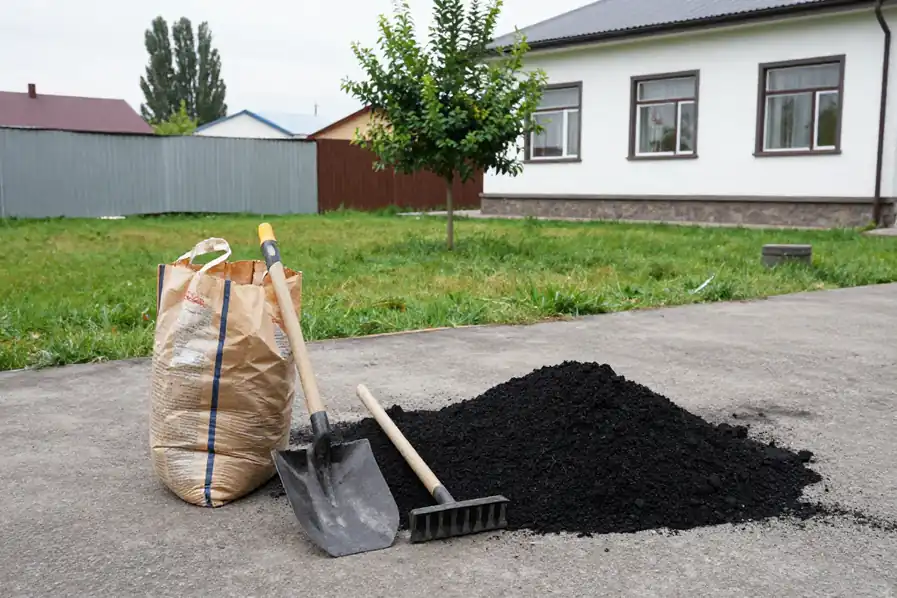
Can asphalt be laid on the ground without crushed stone
You cannot lay asphalt directly on the ground without a crushed stone base — the coating will sag and crack because there is nothing to distribute the wheel load over the area. Even dense-looking loam or clay on Almaty plots lose their bearing capacity when wet: in spring the soil becomes saturated with moisture and heaves, and in summer it settles. A crushed stone base of 15–20 cm, laid on compacted soil in layers with watering and rolling with a vibratory roller, redistributes the point pressure of the wheel over tens of square centimeters. Without this layer, the car presses the asphalt into the soil at points, and cracks spread precisely from these points — first as a web at the entrance, then across the entire site.
Why the surface sags and cracks
Settlement and cracks are almost always the result of an uncompacted base or a too-thin layer, not 'bad asphalt'. In my practice of inspecting yards in the suburbs of Almaty, nine out of ten complaints about 'defective mix' ended with opening up: under the crack there was loose sand without rolling or crushed stone laid in a single layer without wedging. The second source is thickness: 2–3 cm of hot mix on a solid base supports only pedestrian load, while an entrance for a crossover requires 6–7 cm. A crack is a symptom: if you do not open up and restore the base under it, pouring on top will fall off after the first winter with temperature changes, when water in the open crack freezes and expands it.
Slope and drainage: how water leaves the yard
A slope of 1–2% from the house and drainage channels divert water so that it does not stand at the foundation and does not wash away the edge of the coating. The direction of the slope is set based on the site's terrain: if the yard has a natural fall toward the street, water flows by gravity into the channel at the gate, and if the site is in a lowland, a linear channel with a grate is added on the low side, along with curbs that keep the asphalt edge from crumbling. Through PROFI-DOM, elevation marks and the direction of flow are fixed during the survey before work begins. The slope cannot be redone after laying — only by opening the coating, so the drainage decision is made at the stage of preparing the base, not after.
How the work is performed in stages
We will examine two scenarios in parallel: what the owner does himself with cold asphalt on a small pothole, and how the same steps look for a crew on an area.
Pit preparation and calculation of mixture volume
The pit is cleaned of loose soil and dirt, dried, and if deeper than five centimeters, filled with crushed stone of 5–20 mm fraction and compacted, while the material volume is calculated by area and layer thickness. Consumption per m² with a layer of 4 cm is about 90–100 kg of mix, with 5 cm — 110–120 kg; a pit of 1,5 × 2 m takes approximately 3–4 bags of 25 kg. The edges of the pothole are cut vertically with a grinder or shovel, the bottom is blown free of dust, otherwise the bitumen film will not bond to the base. Half of unsuccessful patches are laying on a “saucer” with gentle edges: the compound is squeezed outward by the wheel, and the patch loses its shape in one season.
Laying and compaction: what to use for tamping without a vibratory plate
Cold asphalt is laid in layers of 4–5 cm and compacted with a plate compactor, or without one — with a manual tamper weighing 8–12 kg and a homemade roller from a barrel of water, achieving a dense surface that does not yield underfoot. The mix is laid with a margin of 1,5–2 cm above the coating level: it settles during compaction. Tamping goes first along the edges, then the center, each layer — 15–20 blows per square until no mark remains. A plate compactor weighing 60–90 kg handles it in 2–3 passes, while manual tamping requires 4–5 rounds. Compaction should go from the edges to the center, not the other way: this way the mix does not bulge beyond the patch boundaries and the edge stays even.
Laying over an area: crew stages
How to lay asphalt on an area is a sequence: preparing and compacting the base with a vibratory roller, priming with bitumen emulsion, laying the hot mix with an asphalt paver and rolling with a roller for 4–6 passes. First the soil is removed, a 10 cm sand cushion and a 15–20 cm crushed stone base are backfilled, sprayed with emulsion and left to settle for 20–30 minutes until it stops sticking. The hot mix is delivered from the plant on the day of laying and is laid at a temperature not below 120 °C; work is not carried out in rain or frost. Each stage is checked before moving to the next: if the crushed stone is not compacted, the top layer will lie flat but will settle under load already in the first season. Priming with bitumen emulsion before laying at sites in Almaty is performed by PROFI-DOM — this stage appears as a separate line in the estimate and should be checked when accepting hidden works.
How to evaluate the result and what to look at during acceptance
Acceptance is not only about whether it looks level, but also checking thickness, slopes and that no extra lines appeared in the estimate. We'll break down what to look at in the documents and on the coating itself.
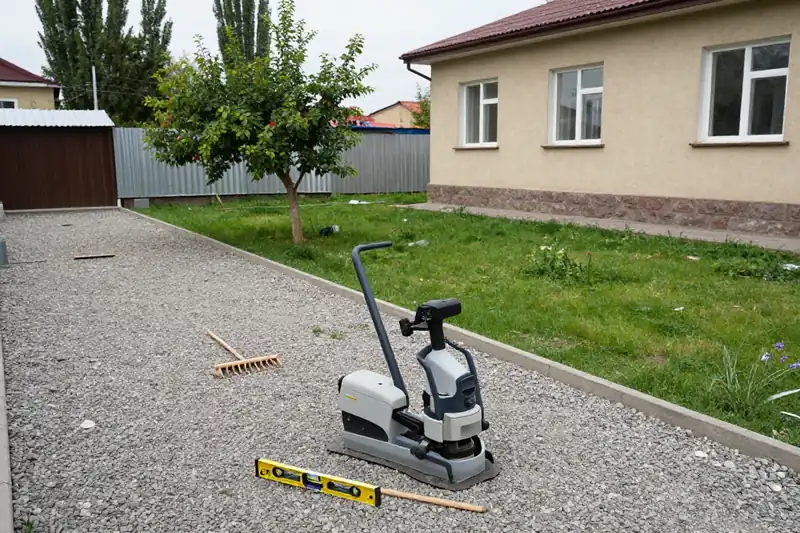
What is included in the estimate and how to avoid extra charges
The asphalt paving estimate must show removal of the old surface, crushed stone, curbs and soil removal — otherwise these lines will surface as additional charges during the work. Most often it is removal that is "forgotten": removed asphalt and excess soil are several truckloads, and their cost is comparable to laying the path. Check whether volumes are specified in cubic meters and tons, not just "preparation work" — the volumes show whether the crushed stone base matches the stated 15–20 cm. A separate line is the curb stone with installation on concrete, not just "curb". An estimate fixed in the contract and not changing is the main filter against "cheap in words": contractors should be compared by scope of work, not by a single figure per m². Through PROFI-DOM, the estimate is provided before work begins and fixed in the contract — this point makes it convenient to verify other offers on the market as well.
How to check layer thickness and evenness
Layer thickness is checked at the edge by the curb or by a control cut, and evenness — with a three-meter rule and visually by puddles after rain. At the edge you can see how the asphalt is laid: if at the curb the thickness is 3 cm instead of the stated 5, the layer further across the area will also be thinner. The rule is applied across the path in several places — a gap of more than 5 mm over a three-meter section already indicates unevenness. The slope is checked with a level: 1–2% from the house, that is, 1–2 cm per meter — less, and water will stagnate. If after rain puddles stand in the same place in the yard, this is a sign of a slope error, not “it hasn’t settled yet,” and it must be fixed before it dries completely.
Contract, payment and warranty under the contract
PROFI-DOM fixes the estimate and deadline in the contract, works on payment 30/40/30 and provides a contractual warranty — no intermediaries, with its own crews. This payment scheme — advance, payment upon foundation completion and settlement after laying — ties payments to work actually performed. Check three things in the contract: the scope of work with volumes, a deadline fixed in writing, and a section on warranty obligations — what exactly the contractor remedies and within what time he responds to a call. Staged payment protects the customer from a situation where money is paid in advance but the scope is not yet closed: if the foundation is accepted with remarks, it is logical to withhold the second payment until they are rectified.
Common mistakes and how to avoid them
We analyze three mistakes that force a yard or driveway to be redone: saving on the base, paving in unsuitable weather, and trying to cover a large volume on your own.
Thin layer and saving on the base
The most common cause of early cracks is a thin layer on uncompacted base, when they save on crushed stone and rolling. On a private plot it looks like this: the crushed stone base was made 8–10 cm instead of 15–20, the vibratory roller was replaced with a hand tamper, and the hot mix was laid 4–5 cm instead of 2–3. Visually the surface is even, but under a wheel or foot it sags pointwise, and cracks start exactly from these spots — first as a spider web, then opening up to 5–10 mm. Moreover, the sagging does not appear immediately but after the first autumn moisture, when the soil under the cushion gets wet. In my opinion, one should check not the top but the hidden works: before laying, ask to show the crushed stone thickness with a tape measure and the trace of the roller pass. Saving on the base costs more than the entire top layer.
Weather: why they don't lay in rain and frost
Hot asphalt is not laid in rain or frost: moisture and cold interfere with adhesion and compaction, and the surface deteriorates quickly. Bitumen film on crushed stone does not bond with a wet base, and at temperatures below +5 °C the mix cools faster than it can be rolled — an under-compacted layer will later flake. Through PROFI-DOM, the hot mix is delivered from the asphalt plant on the day of laying, and work does not start in rain: postponing to a dry window is cheaper than redoing it. Bagged material allows laying over a wider temperature range, but it also requires a dry pit — water under the patch will push it out from inside after the first frost. Look not at the weekly forecast but at a dry window of at least 6–8 hours after laying.
When it is better to entrust the work to a crew
It is worth entrusting the work to a crew when the area is large, transport enters, or hot asphalt is needed — there you cannot do without equipment and a prepared base. The boundary runs by load and volume: a 1×1,5 m pit or a garden path can realistically be covered with cold asphalt yourself in a couple of hours, while a 60–80 m² yard for a passenger car and parking for two cars — that is already a vibratory roller, geotextile on weak soil and a crew of 3–4 people. PROFI-DOM serves private houses and small territories in Almaty and suburbs — from the entrance to the paths, with a slope of 1–2% from the house and drainage trays. Acceptance of hidden works here is more important than speed: without it the crew will leave, and you will see the subsidence next spring.
Conclusion
We put together five conclusions that most often decide the fate of a yard or driveway: they bring the base, layer thickness, drainage and estimate composition into a single picture.
Key takeaways
- Cold laying with your own hands: justified on pits up to 1-2 m² and garden paths, where manual tamping is sufficient for pedestrian load.
- Hot laying over the area: parking and vehicle entrance require a prepared crushed stone base and compaction with a vibrating plate — such volumes cannot be done by hand.
- Settlement and cracks: they appear from a layer of 3-4 cm instead of 5-7 cm and uncompacted soil, not from a "bad mix" — check these two parameters during acceptance.
- Slope of 1-2% away from the house: drainage into a channel or drainage ditch is planned before laying — once the mix cools, the geometry can no longer be corrected.
- Estimate by scope of work: dismantling the old coating, gravel, curbs and soil removal must be separate lines — their absence at the beginning means an additional payment at the end.