
The roof is leaking in an apartment building: what a resident should do and how to protect their rights

If the roof is leaking in an apartment building, first of all record the leak on photo and video, then apply in writing to the KSK or OSI. If they fail to act — file a complaint with the housing inspectorate or the akimat. The roof is common property, and its repair is the responsibility of the management organisation.
Why the roof leaks in an apartment building: main causes
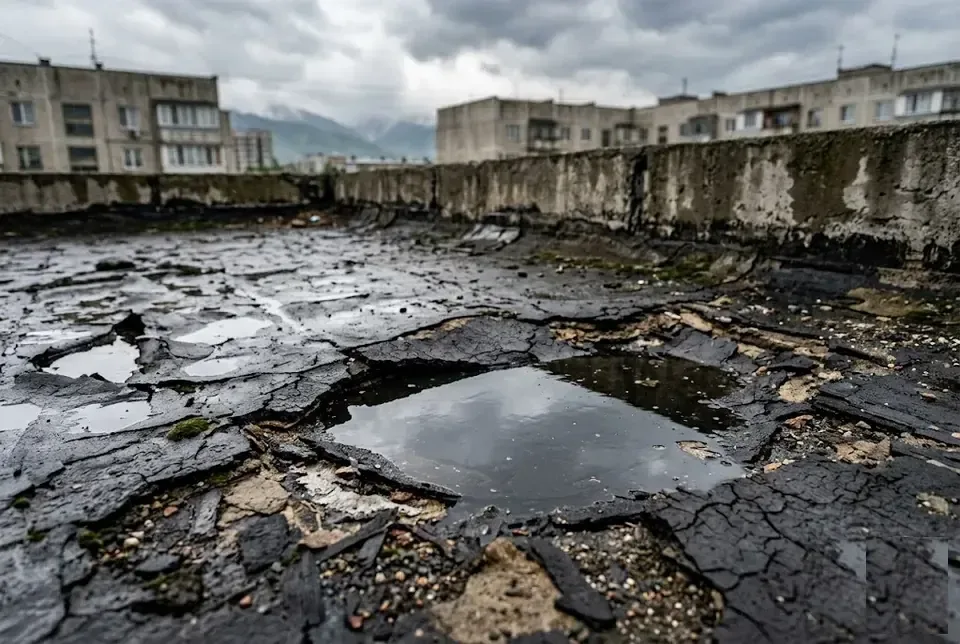
Where to turn if the roof is leaking is a common question, so we will look at it in detail. We will examine why roof leaks occur — from natural wear and tear to installation errors and blocked drains.
Waterproofing wear — the main cause of leaks in a flat roof
The main reason water gets into the apartment is the natural wear of the waterproofing layer, which in standard buildings lasts 10–15 years. In Almaty apartment buildings of Soviet-era construction (series 1-464, 1-447), the rolled bitumen-based soft roofing — roofing felt or glass-bitumen felt — completely loses its elasticity by this time: in the cold the material cracks, and when heated during the day to +30°C on the dark surface the bitumen softens and slides off the base. The junctions to parapets 45–60 cm high and to ventilation shafts are especially vulnerable — there delamination occurs first because of temperature changes and vibration from ventilation operation. After 10–15 years rolled materials require replacement: cracks and delamination at the junctions are a direct path for water into the top-floor apartment.
Clogged drains and standing water on the roof
Blockage of internal drainage funnels with leaves and construction debris leads to water stagnation on a flat roof, and through the slightest defects in the waterproofing moisture penetrates into the apartment. In the buildings of the Altyn-Orda and Ulan residential complexes, the drainage funnels become clogged with poplar fluff and sand from the courtyard areas — during a downpour of 20–30 mm/h intensity, within 40 minutes a layer of water 5–10 cm deep forms on the roof, whose pressure is enough to find a microcrack at the opposite end of the roof. Regular cleaning of the drainage funnels twice a year — in spring and autumn — reduces the risk of leaks by 60–70% without a major overhaul, so residents of the upper floors should remind the KSK chairman about the seasonal check of the drains.
Installation errors and faulty junctions
Poor-quality roof repairs — incorrect torch application of rolled materials or poor sealing of seams — create areas where water seeps through within 1–2 season. A typical mistake in local buildings is overlapping the sheets by less than 10 cm instead of the standard 15–20 cm and the absence of priming with bitumen primer before torch application, as a result of which moisture seeps under the applied layer and peels off up to 30% of the covering over the winter. Most often leaks occur where the roof meets parapets, ventilation ducts and antennas — these junctions require reinforced waterproofing (an additional layer of material carried up the vertical wall by 25–30 cm) and inspection after every heavy rain.
Comparison of roof types and their vulnerability to leaks
| Roof type | Main causes of leaks | Typical damage locations | Service life of the waterproofing |
|---|---|---|---|
| Flat (rolled) | Waterproofing wear, standing water, clogged drains | Junctions to parapets, ventilation shafts and outlets | 10–15 years |
| Pitched (metal roof tiles) | Metal corrosion, loose fastenings, damaged valleys | Sheet fastening points, valleys, ridges | 20–30 years |
| Pitched (corrugated sheeting) | Mechanical damage, installation errors | Sheet joints, pipe abutments | 25–35 years |
Who is responsible for repairing the roof of an apartment building

When the roof leaks into an apartment, residents do not always know who is obliged to fix the problem — the KSK, the OSI or the akimat. Let us look at how responsibility is divided by law.
Cooperative of Property Owners and Associations of Property Owners — the main parties responsible for roof maintenance
The maintenance and repair of the roof of an apartment building is the responsibility of the KSK or OSI — the organisation managing the building, since the roof is the common property of the owners. In Almaty, more than 70% buildings are serviced by KSAs, while the rest have switched to the OSI form with a direct management contract; both are obliged to respond to leak reports within 24 hours, and the deadline for eliminating emergency defects is up to three working days. If the management company ignores the request, residents have the right to send a complaint to the housing inspectorate — which issues an order with specific deadlines for compliance. Even if the roof has sprung a leak on the top floor, the resident is not obliged to repair the roof themselves — this is the direct responsibility of the management organisation, funded by routine contributions.
When the akimat or the housing inspectorate is responsible for repairs
The akimat and the housing inspection do not repair roofs directly, but they oversee the activities of the KSK and the OSI, and if these are inactive they can compel repairs through an order. The district akimats across the city (Bostandyk, Medeu, Almaly) approve an annual housing stock modernisation programme each year, which includes buildings with critically worn roofs — usually structures from the 1960–1980-s. Major roof repairs can be funded from the akimat's budget under this programme, but it is the KSK or the residents themselves who must initiate the inclusion of a building in the plan through a collective appeal to the district akimat — individual complaints are less likely to make it into the modernisation plan.
Routine and major repairs: what is the difference and who pays
| Parameter | Routine repair | Major repairs |
|---|---|---|
| What it includes | Sealing cracks, repairing junctions, replacing a section of waterproofing | Complete replacement of the roof covering, repair of the screed, replacement of the gutters |
| Source of funding | Monthly residents' contributions for building maintenance | A special levy from residents, the akimat budget, a loan |
| Completion time | Up to 30 days from the request | From 3 months to a year (inclusion in the programme) |
| Who initiates | Cooperative/Association of Property Owners upon a resident's request | General meeting of residents, KSK decision |
If the KSK refuses to carry out routine repairs, citing the need for a major overhaul, this is unlawful: routine repairs do not require a special budget and must be carried out under the building maintenance contract.
Where to turn if the roof leaks, and how to document the leak

If you do not know where to turn when a leak occurs, follow a clear algorithm — from the emergency service to drawing up a report.
First steps when a leak occurs: emergency service and temporary repair
In the event of an active leak, first call the emergency service of your KSK or the city — they are obliged to arrive within 1–3 hours to temporarily stop the leak (shutting off the water, laying film over the roof). The KSK dispatch centre takes requests around the clock, and the unified emergency service of Almaty (109) duplicates the call if your KSK does not answer. The technician on site shuts off the riser if a pipe has burst on the technical floor or covers the damaged roof section with tarpaulin until major repairs are carried out. While making the call, take photos and videos linked to the premises — capture the streaks on the walls, the bubbling wallpaper and the puddles on the floor for later reporting. Before the emergency crew arrives, place basins and move furniture away from the walls, but never attempt to climb onto a wet roof — it is dangerous and risks injury.
How to correctly draw up a roof leak report
The leak report is drawn up by a commission with the participation of a KSK or OSI representative and two witnesses — it records the date, location, nature of the damage and a preliminary assessment of the loss.
- Date and time: the exact time the leak was discovered and the KSK was contacted — the difference in hours affects the assessment of how promptly the service responded
- Place: building address, apartment number, specific room (bedroom, kitchen) — to link the damage to a specific area
- Nature of the damage: a description of the water marks, bubbling wallpaper and damp ceiling — each item of damage is listed separately
- Cause (presumed): failure of waterproofing, blocked drainage, an accident on the technical floor — recorded from the technician's words
- Signatures: KSK/OSI representative, resident, two witnesses (neighbours) — without the resident's signature the report is considered one-sided
If a KSK representative refuses to sign the report, draw it up yourself with two neighbours and send it by registered letter with acknowledgement of receipt — such a report has legal force in court.
What documents are needed to record a leak and go to court
To sue over a roof leak you will need: a leak report, photo and video materials, an application to the KSK with a mark of acceptance, a report by an independent damage assessor and correspondence with the KSK. Call the assessor before any cosmetic repair — otherwise it is difficult to prove the extent of the damage. Take your photos and videos with a date reference: preferably with a newspaper in the background or a weather screenshot from your phone, to confirm that the footage was taken on the day of the leak. Submit the application to the KSK in two copies — keep one with an incoming number and a stamp for yourself, as this is proof of a pre-trial approach. If the KSK refuses to stamp it, send the application by registered letter with acknowledgement of receipt and an inventory of the contents — the date of sending counts as the date of the application, and the three-year limitation period for water damage starts from that day.
Step-by-step procedure: where to turn when a leak occurs
If the roof is leaking into an apartment, the sequence of actions is: 1) the KSK emergency service, 2) a written application to the KSK/OSI, 3) if there is inaction — the housing inspectorate, 4) the district akimat, 5) court.
- Step 1 — emergency service: call the KSK dispatch centre or the city's unified emergency service to temporarily stop the leak — write down the request number and the dispatcher's name
- Step 2 — documentation: take photos and videos of the leak and draw up a report with a KSK representative and witnesses — the more detailed the footage, the higher your chance of compensation
- Step 3 — application: submit a written application to the KSK/OSI demanding repairs (in duplicate, keep one copy with a receipt mark)
- Step 4 — follow-up: if there is no response within 3 days — contact the housing inspectorate or the akimat; the inspectorate issues an order for repairs within 15 working days
- Step 5 — court: if repairs or compensation are refused, file a claim with the court at the location of the building — alongside your application to the KSK, submit an application to the housing inspectorate, which is obliged to carry out an inspection and issue an order for repairs
How to get KSK or OSI to carry out repairs when they fail to act

The roof is leaking on the top floor — a common question, so let us examine it in detail. If the KSK does not respond to your request, roof repairs in an apartment building can be secured through the housing inspectorate, the akimat or the courts — the course of action depends on how long they have been inactive.
Roof repair deadlines by law: what the KSK must do
By law, the KSK or OSI must respond to a leak report within 1–3 days, and carry out routine roof repairs within 30 days from the date the application is submitted. The countdown starts not from the date the leak was discovered, but from the date the written application is registered in the KSK's incoming correspondence log — so demand a receipt stamp. If the leak creates an emergency situation (flooding electrical panels, threatening load-bearing structures), repairs must begin within 24 hours — this is a direct ground for a complaint to the housing inspectorate.
What to do if the KSK does not repair the roof: a complaint to the housing inspection
If the KSK ignores the request or refuses to carry out the repair, file a complaint with the housing inspectorate — it will conduct an inspection and issue a binding order. The inspectorate reviews the application within 15 working days and may impose an administrative fine on the KSK chairman under Article 333 of the Code of Administrative Offences of the Republic of Kazakhstan (from 20 to 50 MCI). The complaint can be filed online through the e-government portal or in person at the district housing inspectorate — attach a copy of the application to the KSK with a mark of acceptance, otherwise the inspectorate may refuse to consider it for failure to follow the pre-trial procedure.
Appeal to the akimat and prosecutor's office in case of prolonged inaction
If more than a month has passed and roof repairs in the apartment building have not begun, contact the district akimat — it can initiate an inspection of the KSK and apply administrative measures. The akimat has the right to convene an extraordinary meeting of residents to replace the KSK chairman if the inaction is systemic. In an extreme case, if the KSK's inaction threatens the safety of residents (for example, the leak has damaged the electrical wiring), you can file an application with the prosecutor's office — this speeds up the response of all authorities, since the prosecutor has the right to issue a representation on eliminating the violations within 10 days.
How to write an application to the KSK about a roof leak: a sample
- To whom and from whom: to the chairman of the KSK/OSI [name], from [full name], apartment No. [number] — state the address and contact phone number.
- Substance of the request: “I request that the roof above my apartment be repaired in connection with the leak discovered on [date]. I attach the leak report dated [date] and photographic evidence of the damage” — a specific description without general phrases.
- Legal basis: refer to the article of the Law of the Republic of Kazakhstan “On Housing Relations” that governs the obligations of the KSK to maintain common property — this removes any opportunity for the chairman to brush you off.
- Signature and date: sign and date it, and keep the second copy with the acceptance stamp (incoming number, secretary's signature, seal) — without it the court will not accept a claim for inaction.
How flat roofs of apartment buildings are repaired
If a leak appears on the top floor, it is important to understand which repair technologies are used for a flat roof and how routine repairs differ from a major overhaul.
Flat roof repair technologies: torch-on, mastic, membrane
| Technology | Service life | Cost (relative) | What repairs it is suitable for |
|---|---|---|---|
| Torch-applied rolled materials | 10–15 years | Low | Routine and major |
| Liquid mastic (spray application) | 8–12 years | Medium | Routine (local areas) |
| PVC membrane | 25–30 years | High | Major (full replacement) |
Stages of major roof repair: from dismantling to waterproofing
- Dismantling: removal of the old roofing membrane and cleaning of the base of debris — this takes 1–2 days depending on the area.
- Screed repair: restoration of the concrete base and creation of a 2–3% slope for water to drain towards the drainage funnels.
- Vapour barrier: laying a film that protects the insulation from moisture rising from inside the building through the floors.
- Thermal insulation: installation of mineral wool or expanded polystyrene boards at least 100 mm thick to reduce heat loss.
- Waterproofing: torch-on application of roll materials in two layers or installation of a PVC membrane with hot-air welding of the seams.
- Junctions: sealing of the connections to parapets, ventilation shafts and drainage funnels — the most vulnerable point, where leaks most often occur.
How to temporarily stop a leak before major repairs
Before a major repair, the water can be temporarily stopped with a patch of roll material on bitumen mastic or by sealing the crack with polyurethane sealant — this will hold back moisture for 1–3 months. In winter conditions, Almaty crews often use cold mastic, which is applied without heating and sets within 2–3 hours at temperatures down to −5 °C. Such emergency repairs do not require covering the whole roof and can be done in a single visit, but if the cause is not eliminated — stagnant water or damaged abutments — the leak will return the following season, often in a different part of the roof.
Residents' rights and compensation for damage from a leak
When the roof leaks and floods the apartment, the resident has the right to demand from the KSK not only roof repairs but also full compensation for damaged property — let us look at how to correctly assess the damage, which laws to cite and what to do if the KSK evades payment.
How to assess the damage from a roof leak and recover it from the KSK
Damage from a leak is assessed by an independent appraiser — their report listing the damaged property and the cost of restorative repairs serves as the basis for a claim against the KSK. In Almaty the service costs 25 000–40 000 KZT, and the report is certified by the signature and seal of a company licensed to carry out valuation activity in the Republic of Kazakhstan. The report is accompanied by the leak report drawn up with the participation of the KSK or neighbours — without it the court may dismiss the claim as unproven. A typical case: on the 12-th floor of a building on Abai Avenue, a downpour flooded a renovated interior and parquet — the appraiser calculated 1,2 million KZT in damage, and the court ordered the KSK to pay that amount. Carry out the assessment before starting repairs in the apartment, otherwise the KSK may claim that part of the damage is unrelated to the leak — keep everything as it is until the specialist arrives.
What rights do residents of upper floors have when the roof leaks
Residents of the upper floors have the right to demand from the KSK not only roof repairs but also restoration of the apartment's interior finishing, as well as compensation for damaged furniture and appliances — this follows directly from Article 21 of the Law of the Republic of Kazakhstan “On Housing Relations”, where the roof is classified as common property of the apartment building. If the leak has recurred three times in one season, file a complaint with the akimat's housing inspectorate — it issues an order with a specific deadline for eliminating the cause. In practice, there have been cases where the KSK tried to shift responsibility onto a resident because of the installation of a satellite antenna, but the expert examination showed that the cracks in the waterproofing had formed through years of wear, and the court sided with the owner. When a leak poses a threat to life (ceiling collapse or short circuit in the wiring), the resident has the right to demand temporary relocation at the KSK's expense until the repair is completed — this is a real mechanism, not a formal right.
Can you refuse to pay for building maintenance if the roof leaks
You cannot refuse to pay for building maintenance because of a roof leak — these are separate obligations, and non-payment will lead to penalties of 0,5% of the debt amount for each day of delay and lawsuits from the KSK. The Law of the Republic of Kazakhstan “On Housing Relations” separates the obligation to maintain common property (a monthly contribution) from the KSK's responsibility for its condition — a leak does not exempt you from payments. Instead of refusing to pay, demand a recalculation or a reduction in the tariff for services rendered poorly: having recorded the leak in a report, submit an application to the KSK demanding a reduction of the monthly contribution by 20–30% until the defect is rectified — such precedents exist in the practice of the Almaty housing inspectorate, and this is a lawful way to exert pressure without risk to yourself.
Limitation periods and court practice on roof leaks
The limitation period in cases of roof leaks is three years from the moment the damage is discovered, and within this period a claim for compensation can be filed even if the roof has already been repaired. The count starts from the date when the resident learned of the leak and recorded it in a report: if the report was drawn up a month later, the period shifts to exactly that date. Court practice in the city shows that where there is a correctly drawn-up report and an assessor's report, the courts most often side with the resident and oblige the KSK to compensate the damage in full — for example, the Medeu District Court upheld the claim of a resident of a building on Zheltoksan Street, awarding 890 000 KZT for ruined laminate flooring and furniture, where the key evidence was a report signed by the KSK chairman. If the KSK does not comply with the judgment, contact a private bailiff — they will freeze the accounts and recover the amount forcibly, which is more effective than repeated lawsuits.
Conclusion
When the roof leaks in an apartment building, the main thing is not to panic and to act according to a clear algorithm: from recording the leak to recovering compensation.
Key takeaways
- First of all, record the leak: draw up a report with neighbours and a KSK representative, take photos and videos — this is the main document for any further claims; without it the court will not accept the claim.
- Identify the responsible party: the flat roof of an apartment building is the responsibility of the KSK or management company — they are obliged to organise repairs at the expense of the building maintenance funds, not at your expense.
- Demand it in writing: submit an application to the KSK requiring them to eliminate the cause of the leak; if there is no response within three days — complain to the housing inspectorate of the akimat or the prosecutor's office.
- Assess the damage: if furniture or finishes have been affected, invite an independent assessor and prepare a compensation claim — the limitation period for such cases is three years from the moment of the leak.
- Do not refuse to pay for KSK services: this is illegal and will lead to penalties and legal costs; instead, demand a recalculation for poor-quality service through the same akimat.