Types of welding work: a complete overview of metal welding methods, types of welds and joints
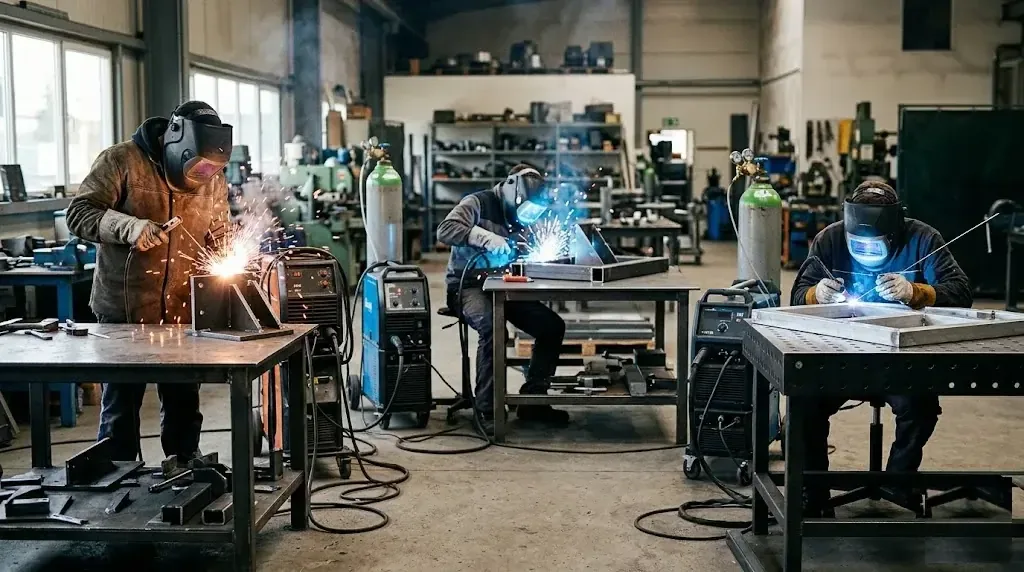
Types of welding work fall into three classes by physical principle: thermal (arc, gas, laser), thermomechanical (resistance, diffusion) and mechanical (friction, explosion, ultrasonic). In everyday life and industry, manual arc (MMA), semiautomatic (MIG/MAG) and argon-arc (TIG) welding are used most often — each suits its own metals and thicknesses.
Classification of welding types by physical principle
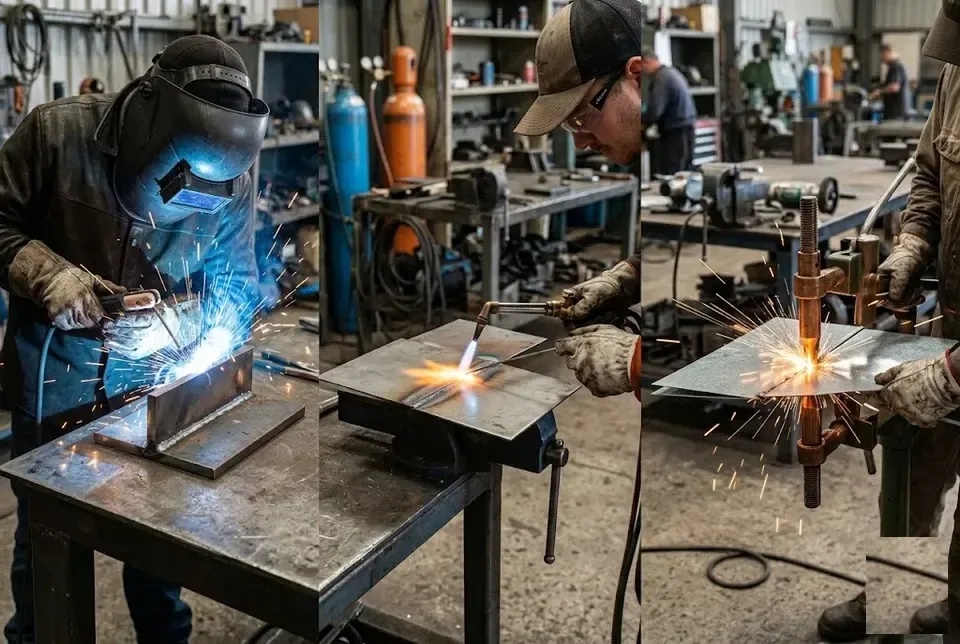
Types of welding work fall into three classes by energy source: thermal, thermomechanical and mechanical. Let us look at each class with examples of methods.
Thermal welding: arc, gas, laser, plasma, electroslag
Thermal welding is the most widespread class, where the metal is heated to melting without external pressure; it includes arc, gas, laser, plasma and electroslag welding. Within arc welding there are three main methods: manual metal arc (MMA), semi-automatic welding in shielding gas (MIG/MAG) and tungsten inert gas welding (TIG) — all operate within an arc temperature range from 3000 to 5000 °C. Gas welding uses a flame from the combustion of acetylene or propane with oxygen, with a temperature reaching 3200 °C, which makes it effective on thin-walled structures (up to 3–4 mm) and non-ferrous metals. Laser and plasma welding produce a narrow weld with a minimal heat-affected zone, which is critical on precision parts and stainless steel. Arc welding produces an arc temperature of up to 5000 °C and gas welding up to 3200 °C, so on thick metal (from 20 mm) arc methods are more effective than gas ones.
Thermomechanical welding: resistance and diffusion
Thermomechanical welding combines heating the metal to a plastic state with the application of pressure — the main methods are resistance welding (spot, butt, seam) and diffusion welding. Resistance spot welding, the most widespread method in industry, joins sheets through electrical resistance between copper electrodes: in 0,1–0,5 seconds a current of up to 100 kA heats the contact point to 900–1200 °C, forming a cast nugget 5–12 mm in diameter. Resistance butt welding is used on rods, pipes and rails — at Almaty enterprises this method is used to join rebar in the construction of monolithic buildings. Diffusion welding, by contrast, works in a vacuum with heating to 0,7–0,9 of the melting point and pressure up to 50 MPa, joining metal through the mutual diffusion of atoms. Resistance spot welding is the main method in the automotive industry: the body of a modern car contains 3000–5000 spot welds.
Mechanical welding: friction, explosion, ultrasonic
Mechanical welding joins metals by pressure without heating to melting — this class includes friction welding, explosion welding and ultrasonic welding. Friction welding, the most advanced of the mechanical methods, rotates one part relative to another at 1000–6000 rpm under axial force: within 2–10 seconds heat is released at the joint, plasticising the metal, after which the rotation stops and the pressure fixes the joint. Ultrasonic welding, popular in electronics and instrument making, joins thin sheets (0,1–3 mm) and polymers through high-frequency vibrations (20–60 kHz) — in Almaty workshops this method is used to pack battery assemblies and repair plastic housings. Explosion welding, a niche method for cladding (applying a corrosion-resistant layer to a cheap metal), accelerates the flyer sheet to 200–600 m/s, creating a wavy profile at the interface. Friction welding is used to join dissimilar metals (for example, steel with aluminium) that cannot be welded by arc methods due to different melting points.
Comparative table of welding classes by physical principle
| Class | Energy source | Process temperature | Main methods | Typical application |
|---|---|---|---|---|
| Thermal | Heating to melting point | 1500–5000 °C | Arc (MMA, MIG/MAG, TIG), gas, laser, plasma, electroslag | Construction, pipelines, repair of steel structures |
| Thermomechanical | Heating + pressure | 800–1200 °C | Resistance (spot, butt, seam), diffusion | Automotive industry, aviation, rebar joining |
| Mechanical | Pressure without melting | Up to 200 °C (locally) | Friction, explosion, ultrasonic | Dissimilar metals, electronics, cladding |
Arc welding: MMA, MIG/MAG, TIG and other methods
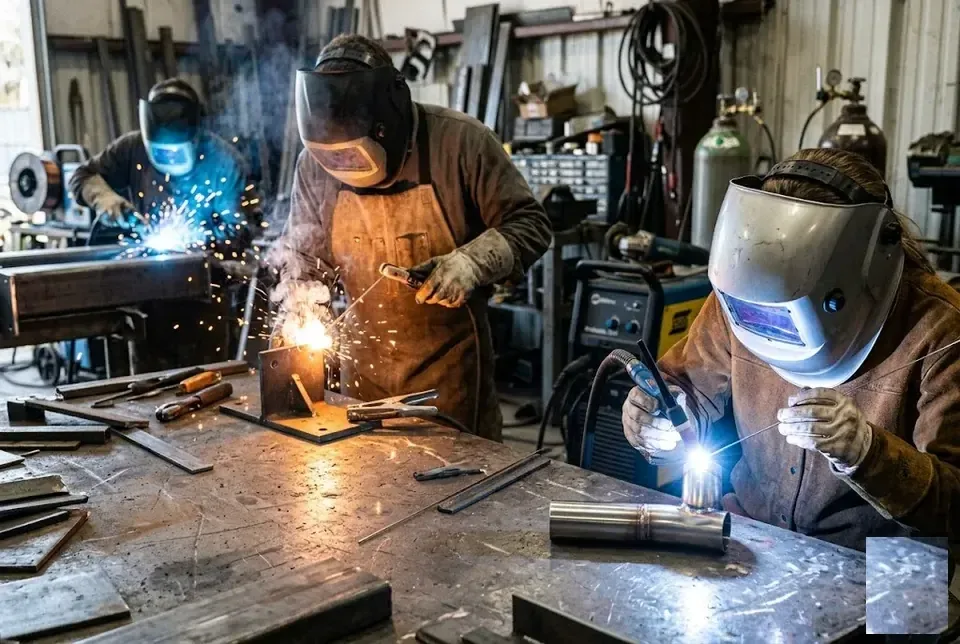
Arc methods are the foundation of welding production: from household repairs to factory structures. The main arc welding methods are MMA, MIG/MAG, TIG, submerged arc and flux-cored wire. Let us look at the five main methods — from simple manual arc to specialised submerged arc welding — with equipment, nuances and real-world tasks.
Manual metal arc welding (MMA): equipment, electrodes, applications
Manual metal arc welding (MMA — Manual Metal Arc) uses a coated electrode that melts and forms the weld; the equipment is a welding inverter, an electrode holder and a ground clamp. As the arc burns, the electrode coating releases a gas cloud that protects the weld pool from oxygen and nitrogen, while the slag solidifies on top of the weld as a crust. The electrode diameter is selected according to the metal thickness: for 2 mm sheet, a 2,5 mm electrode and 70–90 A current are used; for 5 mm — 3,25 mm and 110–140 A. Resanta SAI-160 or FoxWeld 1800 Master inverter machines weigh 4–6 kg and run on a household 220 V supply — this is the standard in the garage and on site. For a beginner, electrodes of 3 mm diameter and 90–120 A current are optimal — with them it is easier to control the arc and there is less risk of burning through the metal.
Semi-automatic MIG/MAG welding: how MIG differs from MAG
MIG (Metal Inert Gas) uses an inert gas, argon, while MAG (Metal Active Gas) uses an active gas, CO₂ or a mixture; MIG is used on aluminium and stainless steel, MAG on carbon steel. In both cases the welding wire (solid, 0,6–1,2 mm in diameter) is fed automatically through the torch, and the gas comes from a cylinder through a regulator at a flow rate of 8–15 l/min. The most popular wire is ER70S-6 (1 mm) for steel — it produces a stable arc and little spatter at currents of 150–220 A. The Aurora Speedway 200 or Kemppi MinarcMig 200 — semiautomatic machines are typical units in car repair shops and body repair: they weld body metal 0,8 mm without burn-through and join frames 4–5 mm in a single pass. A mixture of argon 82% + CO₂ 18% (the so-called “triple mix”) is considered universal for semiautomatic welding: it produces less spatter than pure CO₂ and deeper penetration than pure argon.
TIG argon-arc welding: features and applications
TIG (Tungsten Inert Gas) is argon-arc welding with a non-consumable tungsten electrode and a filler rod, providing the neatest and most precise weld without spatter. The arc burns between the tungsten rod (usually 2% lanthanated — WL20) and the workpiece, while the filler — a rod of the same composition as the base metal: ER4043 for aluminium, ER308L for stainless steel — is fed with the left hand. Fubag TIG 200 DC or BlueWeld Tig 220 AC/DC machines run on direct current for steel and alternating current for aluminium, allowing pulse frequency to be adjusted on thin sheets. TIG is the only arc method that can weld aluminium from 0,5 mm thick without the risk of burn-through, but the welding speed is 2–3 times lower than that of a semiautomatic machine.
Submerged arc and flux-cored wire welding (FCAW)
Submerged arc welding shields the arc with a layer of granular flux, which delivers high weld quality on thick metal (from 10 mm); FCAW (Flux-Cored Arc Welding) uses a flux-cored wire that provides its own shielding without external gas. Submerged arc work is done on automatic rigs — for example, ADF-1000 tractors on factory beams and pipelines: the flux (AN-348A or OSTs-45) is fed from a hopper ahead of the arc, and the slag is easily knocked off after cooling. FCAW is popular on open sites and during structural installation — the E71T-1 wire (1,2 mm diameter) welds in the wind without a gas cylinder, although it produces more spatter than MIG. Submerged arc welding leads in productivity among arc methods: in a single pass it can weld metal up to 30 mm thick, but only in the flat position.
Comparison of arc welding methods: table
| Method | Electrode/wire | Protection | Metal thickness | Speed | Weld quality | Equipment cost |
|---|---|---|---|---|---|---|
| MMA | Coated electrode | Electrode coating | 1–20 mm | Low | Medium | Low |
| MIG/MAG | Solid wire | Gas (Ar, CO₂, mixture) | 0,8–25 mm | High | High | Medium |
| TIG | Tungsten + filler | Argon | 0,3–10 mm | Low | Very high | High |
| Submerged arc | Solid wire | Flux layer | 3–30 mm | Very high | High | High |
| FCAW | Flux-cored wire | Self-shielding | 1–15 mm | High | Medium | Medium |
For a home workshop, an MMA inverter is optimal (from 15 000 KZT), for a car service — a MIG/MAG semi-automatic (from 80 000 KZT), for fine work — TIG (from 120 000 KZT).
Gas and contact welding: where they are used
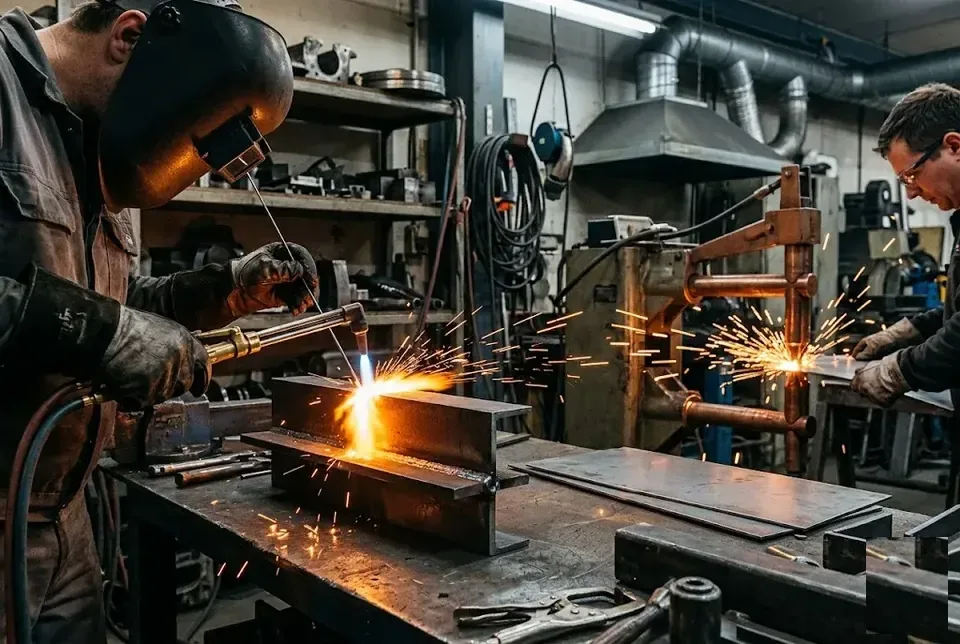
Gas and resistance welding are classic methods that remain relevant. Gas welding is universal in repair, resistance welding is indispensable in mass production.
Gas welding: acetylene-oxygen, equipment, features
Gas welding uses an acetylene-oxygen flame (temperature up to 3200 °C) and a filler rod; the equipment includes cylinders, regulators, hoses and a torch. Unlike arc methods, the flame requires no electricity and is easily adjusted in power — from fine soldering of a radiator to cutting 30 mm sheet. Acetylene produces a reducing zone in the flame that protects the molten pool from oxidation, which is important on non-ferrous metals and thin-walled pipes. When welding brass and bronze, a neutral flame is used; for aluminium, one with excess oxygen. In PROFI-DOM practice, a gas station is most often assembled on the basis of 40 l cylinders: acetylene (pressure 1,5 atm) and oxygen (150 atm), with BAMO regulators and a G2 torch. Gas welding is the only method that can weld cast iron without preheating to 600 °C, which is critical when repairing cast iron housings and engine blocks.
Resistance welding: spot, butt, seam
Resistance welding joins metals by pressure and electric current without filler materials; it is divided into spot (bodywork repair), butt (rods, rebar) and seam (leak-tight seams). Spot machines deliver a current of 8–30 kA at a clamping force of 200–800 kg: for 1 mm steel 10 kA is enough, while on galvanised steel — 20% more due to the contact resistance of the coating. Flash butt welding is used in factories when joining rebar of 12–40 mm diameter — the seam is not inferior in strength to the base metal. Seam (roller) welding produces a leak-tight seam on fuel tanks and radiators: the rollers travel along the joint, forming overlapping spots with a pitch of 2–5 mm. Spot welding is the main method in bodywork repair: one spot withstands a shear load of up to 500 kg, and an entire car body contains 3000–5000 spots.
Beam and plasma methods: laser and plasma welding
Laser welding uses a focused beam for precision joining of thin parts (from 0,1 mm), while plasma welding uses a constricted arc with a temperature of up to 30 000 °C for high-speed welding. Fibre lasers with a power of 1–4 kW weld stainless steel and titanium up to 3 mm thick at a speed of up to 5 m/min — in Almaty workshops making medical products this is the main method. Plasma welding (microplasma from 0,5 A) allows joining 0,05 mm foil without burn-through, which is beyond any arc method. Plasma torches run on argon or an argon-hydrogen mixture, and the constricted arc produces a narrow 2–5 mm seam with minimal melting of the edges. Laser welding produces a minimal heat-affected zone (0,1–0,5 mm), so it is used in electronics and medicine, where neighbouring elements must not be overheated.
Types of welded joints and types of weld seams
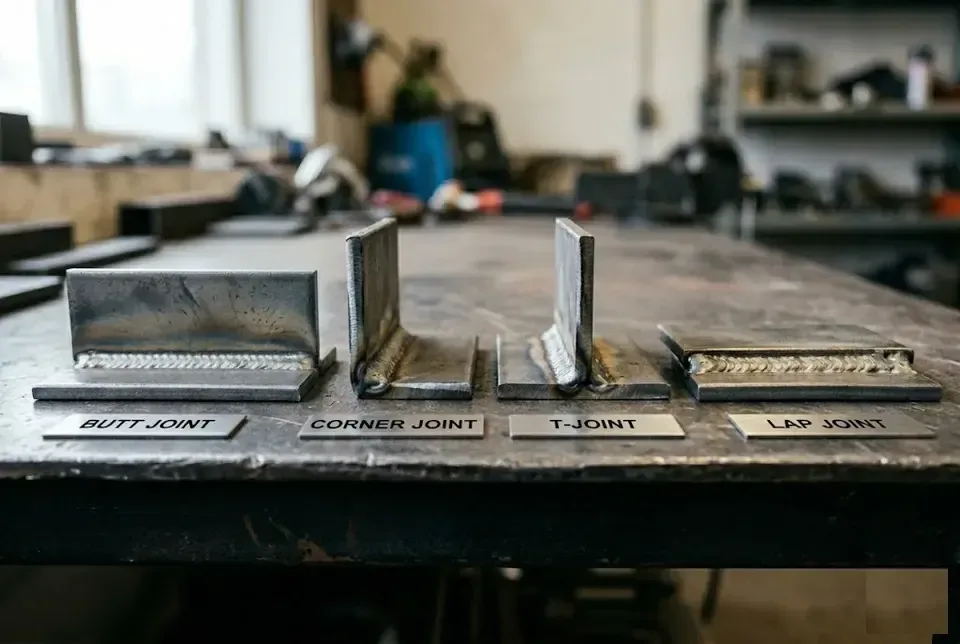
This basic classification is what every welder should know. The strength of the entire structure depends on choosing the right joint.
Five types of welded joints: butt, corner, T-joint, lap, edge
The butt joint is the strongest (parts in the same plane), the corner joint is at an angle, the T-joint is T-shaped, the lap joint has one part on top of the other, and the edge joint joins side surfaces. In household repairs, butt and corner joints are most common: gates, wicket doors and greenhouse frames are welded with them. T-joints go on factory beams and columns where the load runs perpendicular to the weld. The lap joint is popular in body repair — on thin sheets up to 2 mm it is easier to make without burn-through, but it creates thickening in the weld zone. Edge joints are used less often — mainly on thin-walled radiator or exhaust pipes where there is no room for a lap. A butt joint withstands a tensile load up to 95% of the base metal's strength, while a lap joint only 60–70%, which is why butt joints are chosen for load-bearing structures.
Classification of welds by position: flat, horizontal, vertical, overhead
By position, welds are divided into flat (in a horizontal plane — the simplest), horizontal (on a vertical plane), vertical (bottom-up or top-down) and overhead (above the head — the most difficult). A flat weld gives maximum productivity: the welder does not expend effort holding the pool — the metal spreads evenly on its own, and the speed reaches 15–20 m/h with MMA. A horizontal weld requires guiding the electrode at an angle of 45–60° so that the deposited metal does not run down. Vertical welds are more often made bottom-up — this gives deeper penetration, but the speed is 30–40% lower compared with flat. An overhead weld requires reducing the current by 15–20% compared with flat and a short arc — otherwise the molten metal drips onto the welder and the seam ends up with lack of penetration.
Table: joint types and recommended methods
| Joint type | Position of the parts | Recommended welding methods | Typical application |
|---|---|---|---|
| Butt | In one plane | MMA, MIG/MAG, TIG, submerged arc | Pipelines, sheets, beams |
| Corner | At an angle (90°, 45°) | MMA, MIG/MAG, TIG | Frames, skeletons, angle bars |
| Tee | T-shaped | MMA, MIG/MAG, submerged arc | Beams, columns, supports |
| Lap joint | One on top of the other | MIG/MAG, TIG, spot | Body repair, thin metal |
| Butt | With side surfaces | Gas, TIG | Thin-walled pipes, radiators |
On thin metal (up to 2 mm) in a lap joint, MIG/MAG or TIG is best — MMA carries a high risk of burn-through, while gas welding is too slow and heats a large area.
How to prepare edges for welding: joint preparation and bevel
On metal thicker than 5 mm, edge preparation is required — a bevel at an angle of 30–45° to ensure penetration of the weld root; on thin metal (up to 3 mm) preparation is not needed. According to GOST 5264-80, on butt joints on 6–20 mm sheets a V-shaped preparation with a 1–2 mm root face is used so that the electrode does not burn through the gap. X-shaped preparation (on both sides) is used on metal from 20 mm — it halves the volume of deposited metal compared with V-shaped preparation and reduces shrinkage deformation. On main gas pipeline pipes a U-shaped preparation is often made — it gives a smooth transition and fewer stress raisers. V-shaped edge preparation is the most common: it gives the welder access to the weld root and reduces electrode consumption by 20–30% compared with X-shaped preparation.
How to choose a welding type for metal and thickness
The types of metal welding differ by material, thickness and the required weld quality. Let us look at which method suits steel, stainless steel, aluminium, cast iron and copper.
Carbon steel welding: from thin sheet to thick rolled stock
Carbon steel is the most versatile material: for thickness up to 3 mm, MIG/MAG or TIG is suitable; from 3 to 20 mm, MMA or MIG/MAG; above 20 mm, submerged arc or gas welding. Manual metal arc welding (MMA) uses a coated electrode that melts and protects the weld from oxidation — on 5–12 mm steel this is the main method in households and on construction sites. MIG/MAG with 0,8–1,2 mm wire and an argon-CO₂ mix delivers high productivity on 3–10 mm sheets and requires almost no slag cleaning. On steel 1–2 mm thick (body repair), MIG/MAG with 0,6–0,8 mm wire and a current of 40–80 A is optimal — MMA at such thicknesses causes burn-through due to the high current density.
Stainless steel welding: MIG/MAG, TIG, MMA
Stainless steel is welded with MIG/MAG using stainless wire and an argon 98% + CO₂ 2% mixture, TIG with a filler rod, or MMA with special electrodes (for example, TsL-11). MIG/MAG on sheets from 3 mm is the fastest method for welding food containers or handrails, but it requires precise wire feed settings: too high a speed causes porosity in the seam. MMA with TsL-11 electrodes is indispensable in field conditions where there is no gas cylinder, but after welding the scale must always be cleaned off with a brush. TIG is the best choice for stainless steel up to 3 mm thick: it produces no scale and preserves the corrosion resistance of the seam, whereas MMA can cause intergranular corrosion if the settings are wrong.
Aluminium welding: TIG, MIG, gas
Aluminium is welded with TIG on alternating current (thickness 0,5–6 mm), MIG with argon and aluminium wire (from 3 mm) or gas welding with flux; a conventional MMA inverter is not suitable for aluminium. TIG on aluminium 1–3 mm thick produces a clean, tight weld without spatter — this is the standard in repairing radiators, tanks and profiles. MIG with a pulse mode and 1,2 mm wire on sheets from 4 mm allows aluminium frames to be welded in a single pass without undercuts. Gas welding with an acetylene-oxygen torch and AF-4A flux is used on aluminium up to 2 mm thick, but the weld is less strong than with TIG. Before welding aluminium, the oxide film must be removed mechanically (with a stainless steel brush) and the surface degreased — otherwise the weld is porous and weak.
Cast iron and copper welding: special methods
Cast iron is welded with gas welding (with preheating to 400–600 °C) or MMA with special electrodes (for example, OZCh-2); copper is welded with TIG using argon or with gas welding with flux due to its high thermal conductivity. Gas welding with an acetylene-oxygen torch on cast iron 5–20 mm thick is the classic method for repairing engine blocks and gearbox housings, as slow heating reduces the risk of cracks. MMA with OZCh-2 electrodes is more convenient for small repairs of cast iron pipes or pump housings on site, but the weld requires slow cooling in asbestos. TIG on copper 1–3 mm thick produces a dense weld without pores, and gas welding with PV-200 — flux on sheets from 3 mm. Copper conducts heat 5 times faster than steel, so a quality weld requires preheating to 300–500 °C and a current 30–50% higher than for steel of the same thickness.
Table for selecting a welding method by material and thickness
| Material | Thickness up to 1 mm | Thickness 1–3 mm | Thickness 3–10 mm | Thickness over 10 mm |
|---|---|---|---|---|
| Carbon steel | TIG | MIG/MAG, TIG | MMA, MIG/MAG | MMA, submerged arc, gas |
| Stainless steel | TIG | TIG, MIG/MAG | MIG/MAG, MMA | MMA, submerged arc |
| Aluminium | TIG (AC) | TIG (AC), MIG | MIG, gas | MIG |
| Cast iron | — | Gas, MMA (special electrodes) | Gas, MMA | Gas |
| Copper | TIG | TIG, gas | TIG, gas | Gas |
Pros and cons of the main welding methods
Every welding method has strengths and weaknesses. Let us look at the advantages and disadvantages of the four main techniques — so you can choose the right one for your task.
Manual metal arc welding (MMA): pros and cons
MMA is the most affordable and easiest method to start with: equipment costs from 15 000 KZT, requires no gas, is suitable for steel, cast iron and stainless steel, but produces a lot of slag and requires cleaning of the weld. A welding inverter with a coated electrode is easy to find in any shop — from Tekhnodom to Sulpak — and consumables are sold at any building market for 200–500 KZT per pack. The method works in wind and outdoors, is not afraid of rust or dirt on the metal, so it is often used in repairing fences, gates, greenhouse frames and frames. The main drawback of MMA for a beginner is the difficulty of controlling the arc: if the arc length is wrong, the electrode sticks to the workpiece, and the weld ends up with undercuts or lack of fusion.
Semi-automatic MIG/MAG welding: pros and cons
MIG/MAG is the most productive and convenient method for medium thicknesses: high welding speed (up to 10 m/h), minimal slag, no need for frequent cleaning, suitable for steel, stainless steel and aluminium. The welding wire is fed automatically, and the shielding gas (CO₂ or Ar) protects the molten pool from the air — this produces a smooth, dense weld without scale. In PROFI-DOM practice, MIG/MAG is used in body repair and in making canopies, staircases and railings, as the method is 2–3 times faster than MMA on the same metal thickness. The main drawback of MIG/MAG is its dependence on gas: in wind on an open site the shielding cloud is blown away and the weld becomes porous, so outdoors it is better to use MMA or flux-cored wire.
TIG argon-arc welding: pros and cons
TIG is the highest-quality and neatest welding method: the weld is even, with no spatter or slag, suitable for stainless steel, aluminium, copper and thin sheets from 0,5 mm. The tungsten electrode does not melt, and the filler wire is fed by hand — this gives full control over the pool and minimal distortion of the workpiece. Around the city, TIG is often chosen for repairing exhaust systems and making stainless steel handrails and food equipment, where weld aesthetics and tightness matter. TIG requires a highly skilled welder and two hands (torch + filler wire), so the welding speed is 2–3 times lower than MIG/MAG, and equipment costs from 200 000 KZT.
Gas welding: pros and cons
Gas welding is a universal method for thin sheets (up to 3 mm), non-ferrous metals and cast iron: it requires no electricity, is suitable for repair in the field, but produces a wide heat-affected zone. Acetylene and oxygen are mixed in the torch, creating a flame up to 3150 °C that melts the edges of the workpiece — this allows aluminium, copper and brass to be welded without expensive TIG equipment. On local construction sites and in garage workshops, gas welding is used for soldering radiators, repairing pipes and joining thin-walled profiles, where the arc method burns through the metal. Because of the slow heating, gas welding distorts thin parts more than arc welding, so for precise work on stainless steel or aluminium it is better to choose TIG.
Conclusion
Once you have understood the main welding operations and types of welds, it is easier for a beginner to choose equipment and not make a mistake with the method for their task — let us summarise the key points in a checklist.
Key takeaways
- Types of welding work fall into three groups: thermal (arc, gas, beam), thermomechanical (resistance) and mechanical (friction, ultrasonic).
- Arc methods are the foundation of industrial welding: MMA — for steel and cast iron, MIG/MAG — for productive work, TIG — for stainless steel and aluminium.
- The type of joint and the weld position affect strength: butt joints are the most reliable, corner and T-joints are used for frames, and overhead welds are the most difficult.
- Choosing the method for the metal and thickness is the key to quality: for thin sheets (up to 3 mm) — TIG and gas, for medium (3–10 mm) — MIG/MAG, for thick (over 10 mm) — MMA and submerged arc.
- Pros and cons of each method: MMA — cheap, but lots of slag; MIG/MAG — fast, but requires gas; TIG — high quality, but slow and expensive; gas — versatile, but deforms the parts.